





 Portuguese
  English
  Spanish
  3 min of reading
  1 comment


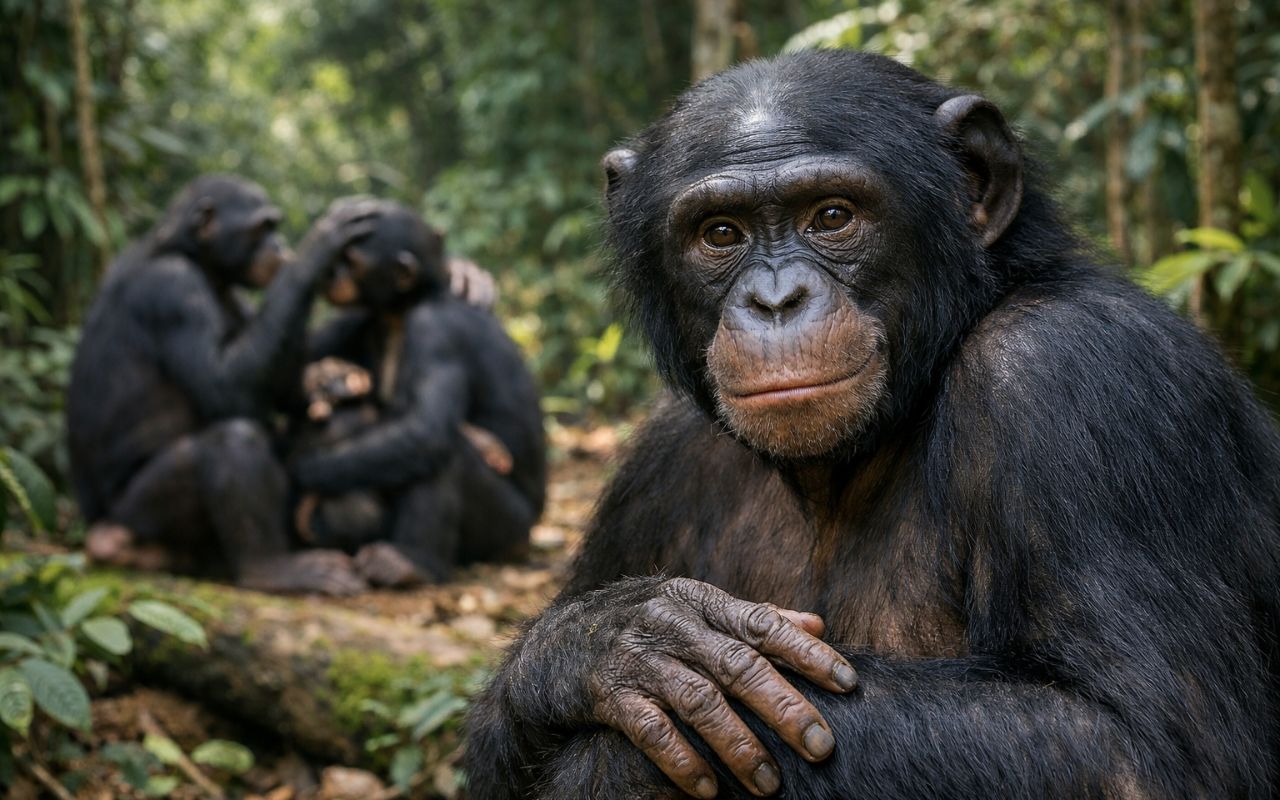


International Research Shows Bonobos Respond to Possible Invasions by Strengthening Social Relationships Without Aggression.
In a scenario where the struggle for territory often ends in lethal confrontations, one primate species is heading in the opposite direction. Bonobos, who live in the forests of the Democratic Republic of Congo, demonstrate that cooperation can prevail even in alert situations.
A recent study reveals that when they perceive signs of the presence of unknown groups, these animals intensify social behaviors without resorting to violence.
The work was conducted by an international team led by researchers from Kyoto University and its results were published in the scientific journal PLOS ONE.
-
Thousands of people in poor countries are paid cents to film household tasks, label images, and operate systems remotely all day long, and this invisible work fuels a $17 billion market that trains the artificial intelligences of Google, Tesla, and Meta.

-
Technology created in the United States uses deep drilling to store high-level nuclear waste.

-
Dozens of Chinese research ships are discreetly mapping the ocean floor in three oceans – and naval analysts see a military pattern.

-
The winter of 2026 in Brazil will not be what you expect: meteorologists warn that the season will be warm and rainy at the same time due to the advance of El Niño, which is already warming the Pacific and changing the climate of the entire country.


The investigation analyzed how bonobos react to stimuli that in other species often provoke immediate aggression.
Close Kinship to Humans but with Different Choices
From an evolutionary standpoint, bonobos occupy a unique position. They share about 98.7% of their DNA with humans, a figure similar to that observed in chimpanzees.
Still, the behavioral paths of these species have diverged over time.
While humans and chimpanzees often respond to external threats with organized hostility, bonobos have developed societies based on tolerance, cooperation, and peaceful conflict resolution, a rare trait among large primates.
The foundation of this behavior lies in how bonobo groups are organized.
Unlike other related species, their communities are predominantly led by females, who exert decisive influence on social dynamics.
These female alliances help reduce internal disputes and favor collective living strategies. Instead of physical confrontations, bonobos use social interactions—such as grooming and affiliative behaviors—to alleviate tension and strengthen relationships.
Physical Similarities, Profound Differences in Behavior
At first glance, bonobos may be confused with chimpanzees.
However, there are striking differences. They tend to be taller, have dark faces, rosy lips, and quite evident facial expressions.
On the social aspect, the distinction is even clearer. The groups are highly connected and rely on constant communication to maintain stability, which drastically reduces the occurrence of serious aggression.
How Did Scientists Test Reactions to Threats?
To observe how bonobos deal with possible rivals, researchers monitored eight groups kept in captivity, spread across five institutions located in four countries.
During the experiment, recordings of unknown bonobo vocalizations were played, creating the impression that another group was approaching.
The strategy aimed to provoke the so-called “common enemy effect”, a phenomenon where groups increase internal cohesion in the face of external threat.
Upon hearing the sounds, bonobos showed increased alertness.
They became more attentive, rested less, and adopted more alert body postures.
However, contrary to what was expected in species like chimpanzees, there was no increase in aggressive behaviors.
Instead, researchers observed a moderate increase in affiliative interactions, such as mutual grooming, without significant changes in the physical distance between individuals.
An Ancient Trait of Primate Evolution
According to the study’s authors, this response indicates that the tendency to reinforce bonds in the face of external threats may be an ancestral trait of the shared lineage of humans, chimpanzees, and bonobos, predating the separation of these species.
The main difference lies in how this impulse is expressed. In chimpanzees, it often comes with aggression.
In bonobos, the same mechanism manifests more mildly, prioritizing social cohesion.
With information from Xataka.







There was this film a year ago that showed five female bonobos ganging up and killing a single male bit his hands and feet, stomped repeatedly on him and chewed his genitals. They also performed lesbian acts over his body.