Portuguese
  Spanish


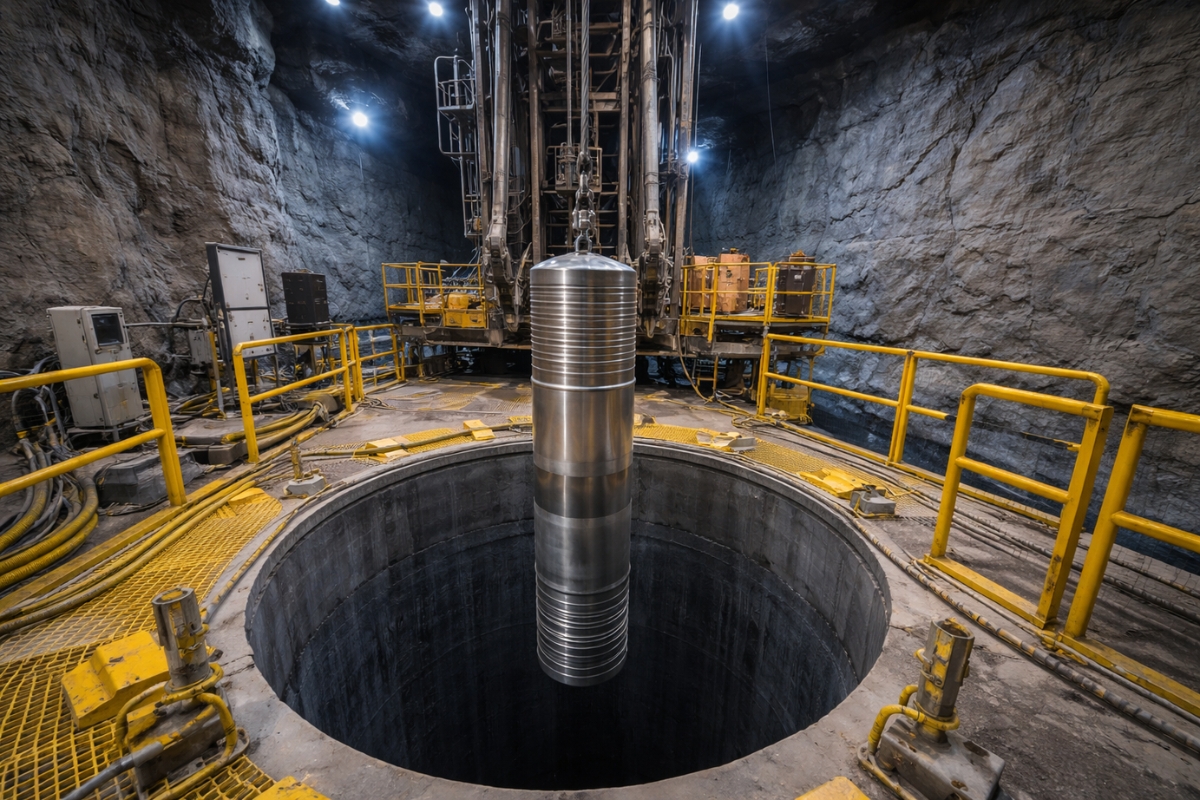

High-level nuclear waste reaches exposure levels well below the limit after testing with deep wells in shale and granite, and the result puts geological disposal back at the center of the energy strategy.
A company from the United States confirmed the viability of a drilling technology aimed at the safe disposal of high-level radioactive waste. The proposal targets materials generated from the recycling of advanced reactor fuel.
In practice, the system transports this material to deep wells in rock formations such as shale and granite. The goal is to maintain isolation for long periods and reduce radiological exposure to very low levels.
High-level waste achieves long-term safety
The validation showed that the analyzed material can be directed to deep structures with performance exceeding the targets used in the technical model itself. The central point is the ability to keep the content away from the environment for an extended period.
-
China Develops Custom 140-Ton Electric Mining Truck with 770 kWh Swappable Battery, Deploys 290 Units in Xinjiang’s Largest Zinc Mine

-
Meta to Launch Arena, a New Prediction App Targeting 3.56 Billion Users, Competing with Polymarket and Kalshi

-
Scientist Challenges Famous Human Evolution Theory, Argues Homo Sapiens Evolved Gradually Over Thousands of Years
-
15-Year-Old American Builds Ocean Generator with PVC Pipe and 3D-Printed Propeller for $12, Wins National Prize, Presents at White House, and Makes Forbes 30 Under 30 List




This result strengthens the idea that geological disposal can move from the theoretical field to gain traction as a practical solution. For the nuclear sector, this represents a significant advancement in the management of more sensitive waste.

Partnership brings together Oklo and US national laboratories
The work also brought together Oklo Inc. and the national laboratories of Argonne and Idaho. The cooperation aimed to improve technologies related to the recycling of used nuclear fuel through electrorefining.
This process separates materials and helps to give a new destination to what remains after the use of fuel. This increases the possibility of better closing the cycle of this type of energy.
Model in shale and granite indicates exposure well below the limit
According to Deep Isolation Nuclear, a company focused on solutions for nuclear waste, the physics-based modeling indicated that disposal in generic shale and granite rocks was several levels below a strict radiological dose standard.
This data is one of the most important from the study because it reinforces the promise of long-term safety. It also helps support the case for deep repositories for high-level waste.
Law change could open space for a new route
The results also put pressure on the regulatory debate in the United States. Currently, the widespread adoption of this type of repository depends on legal changes that authorize the disposal of high-level waste in deep wells.
If this path advances, the sector could gain a concrete alternative for dealing with materials from the recycling of advanced reactor fuel. This alters the discussion about cost, storage, and future planning.
Technology uses known drilling and universal container
The company claims that its technology was designed to leverage drilling practices already used in the market. The system can operate with vertical, inclined, or horizontal deposits, which increases project flexibility.
Another important point is the development of a universal container system. This package was created over three years with support from the Advanced Research Projects Agency of the US Department of Energy.
Demonstration held on January 16, 2019 marked the sector
On January 16, 2019, the technology underwent a demonstration considered pioneering at a commercial drilling test facility. At the time, it was possible to position and retrieve a prototype container in a deep horizontal well.
More than 40 observers from various countries witnessed the operation, including representatives from the US government, industry professionals, investors, environmentalists, and local residents. The test helped demonstrate that the solution can move from paper to scale.
The advancement reinforces the search for a more stable response to one of the most delicate issues in nuclear energy. When disposal enters a new technical level, the entire chain begins to view the future with a different weight.
If the deep well alternative gains regulatory and commercial space, the impact could go beyond engineering. The management of nuclear waste changes levels, and this alters the strategic reading.