





 Portuguese
  English
  Spanish
  5 min of reading
  0 comments


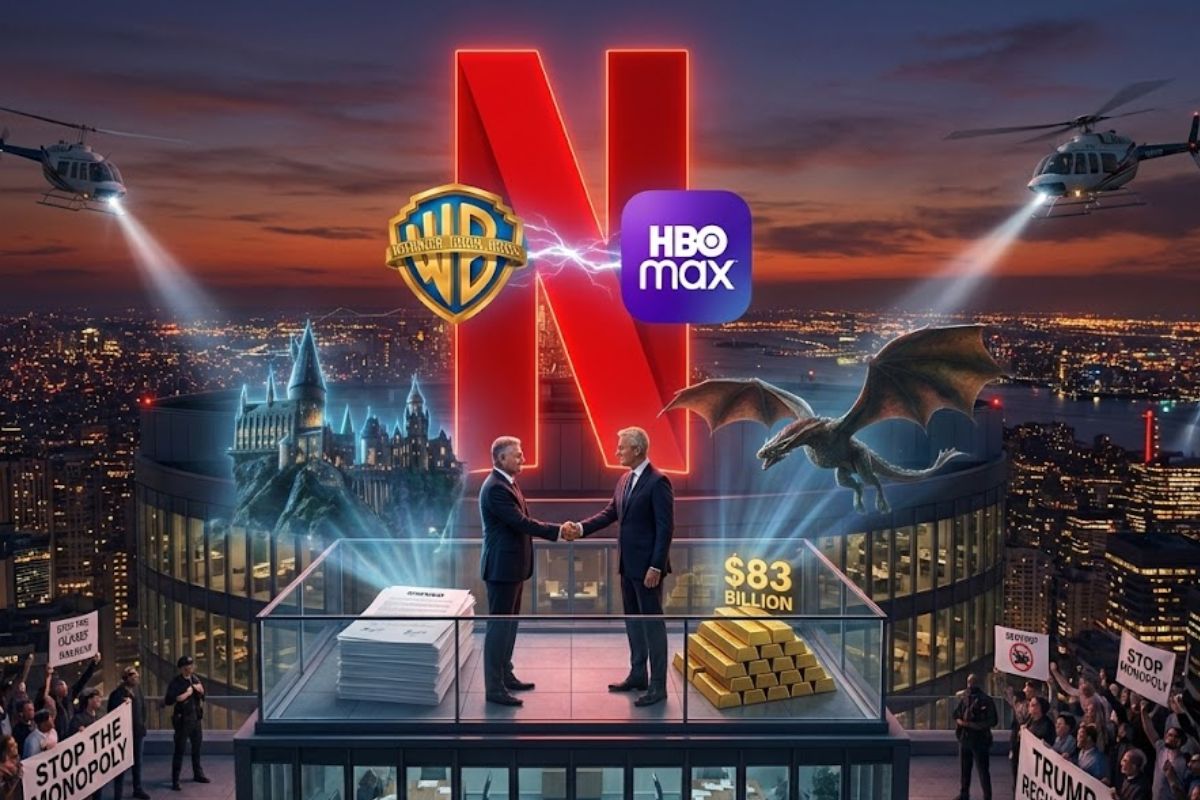
With Over 300 Million Subscribers, Netflix Combines Movie, TV Studios, and HBO Max from Warner Bros. Discovery in an $83 Billion Deal that Challenges Trump Government Regulators, Frightens Hollywood, Pressures Competitors like Comcast and Paramount, and Reignites Global Monopoly Fears in Streaming.
Netflix announced on Friday, December 5, 2025, a deal worth $82.7 billion, including debt, to acquire the movie and TV studios and streaming business of Warner Bros. Discovery, with completion expected after the spinoff of the cable TV arm by the third quarter of 2026.
The announcement, the result of a fierce battle with Comcast and Paramount earlier this week, triggered an immediate reaction in Hollywood and Washington, where Trump government regulators and film producers have already been discussing, since Thursday, 4, the antitrust impact and the risk of unprecedented concentration in the global entertainment market.
How the Deal Between Netflix and Warner Bros. Discovery Was Stitched Together
According to people familiar with the negotiations, Warner Bros. Discovery put its movie and television studios and the HBO Max streaming service up for sale and entered into exclusive talks with Netflix. The final bids from Netflix, Comcast, and Paramount were submitted this week, following an intense behind-the-scenes battle.
-
The institute that trained the greatest aerospace engineers in Brazil has just opened its first campus outside São Paulo after 75 years: ITA Ceará will have R$ 445 million, new courses in energy and systems, and classes are expected to start in 2027.

-
Luciano Hang, owner of Havan, goes to Juiz de Fora after the tragedy in February, brings R$ 1 million, hands out R$ 2,000 cards, and donates up to R$ 15,000 to victims in the region.

-
The Brazilian passport allows legal residence in dozens of countries without the need for a prior visa, and most Brazilians are unaware that they can apply for residency directly upon arriving in nations in South America, Africa, and even Europe.

-
Petrobras sends a message to Brazilian truck drivers after fuel collapse and reveals plan to have 100% domestic diesel.


Netflix won by offering primarily cash payments and committing to keep Warner Bros. Discovery’s films releasing in theaters, something significant for a company that has always favored domestic streaming.
The value of $82.7 billion, which amounts to about $83 billion in official communications, includes debt and makes this the largest transaction ever attempted by Netflix.
The company, which has always described itself as a “builder and not a buyer,” is changing levels by taking over the first major traditional studio to be absorbed by a Silicon Valley competitor.
Warner Bros. thus becomes the definitive symbol of big tech’s aggressive entry into the heart of Hollywood.
Impact of the Megamerger on Hollywood, Movie Theaters, and Unions
With over 300 million paid subscribers worldwide, Netflix was already the largest streaming service. By incorporating Warner Bros. Discovery’s studios and HBO Max, a colossus is born with enhanced power over movie theater owners, labor unions, and content providers. Industry executives believe that smaller companies may be pushed into new mergers just to remain competitive against the new giant.
This move also completes a years-long process in which tech companies grew in Hollywood mainly through original production, without buying large studios.
Now, this model is reversing. By absorbing a century-old studio, Netflix makes it clear that it is willing to buy catalog and negotiation power, not just build it film by film.
Trump Regulators Under Pressure and Politics at Play
Any closure of the deal will depend on the approval of federal regulatory authorities. How the Trump government will define the key players in the rapidly transforming media sector, with the entry of Apple and Amazon, will be crucial for antitrust analysis.
The Netflix and Warner Bros. Discovery case will be the first major test of how Washington intends to handle megamergers in streaming.
Politics is already entering the calculus. David Ellison, CEO of Paramount, has cultivated a close relationship with President Donald Trump, who has publicly praised the executive’s family.
Brian Roberts of Comcast has experienced clashes with Trump, who called him a disgrace to broadcasting. This memory weighs heavily when discussing behind the scenes which combination of companies would have the best chance of receiving the green light. Nevertheless, Netflix’s proposal has advanced and become the main plan under discussion.
Anonymous Letter from Producers to Congress Warns of Netflix Monopoly
On Thursday, 4, a group of film producers sent an anonymous letter to the U.S. Congress expressing “serious concerns” about Netflix’s acquisition of Warner Bros. Discovery. In the document, they state that “any time spent in theaters is, for Netflix, time not spent on the platform” and that, therefore, the company would have no real incentive to strengthen screenings in theaters.
The producers also warned of the risk of “monopolistic control” in the streaming market if the transaction is approved. They decided not to sign the letter for fear of professional reprisals.
Netflix’s formal promise to continue releasing Warner Bros. Discovery films in theaters, included in the negotiated package, seeks to address these criticisms, but does not eliminate uncertainty about how the company will act in practice in the medium term.
The Historical Weight of Warner Bros. Discovery in Old and New Hollywood
Few brands symbolize the romance of old Hollywood as much as Warner Bros. Its studios have hosted stars like Bette Davis and James Cagney, and its century-old catalog includes classics like Casablanca, The Maltese Falcon, Bonnie and Clyde, Dirty Harry, The Shining, and Chariots of Fire. Through agreements made in the 1990s, Warner Bros. also controls MGM icons, such as The Wizard of Oz and Gone with the Wind.
The recent phase is also strong. In the spring and summer, Warner Bros. scored eight consecutive box office hits, including Ryan Coogler’s Sinners and Paul Thomas Anderson’s One Battle After Another, both tipped for the Oscars.
HBO, in turn, has established itself as the leading premium TV network, with current hits like Euphoria, The Gilded Age, and The White Lotus. Adding all of this to Netflix’s portfolio means, for many analysts, redefining who controls the schedule of prestigious film and TV releases.
What Changes for Netflix’s Catalog and Global Strategy
By absorbing Warner Bros. Discovery, Netflix also gains control over characters like Bugs Bunny and TV giants like Friends and Game of Thrones. This adds to the platform’s own phenomena, like Stranger Things and KPop Demon Hunters.
The difference is that, with Harry Potter, Game of Thrones, and MGM classics, the company gains multigenerational franchises capable of retaining subscribers for decades.
Even with original hits, analysts like Robert Fishman of MoffettNathanson pointed out in a report on November 12 that Netflix lacked “enduring franchises” to ensure recurring engagement from new and old users.
The megamerger offers exactly this type of asset, at the cost of regulatory shock and unprecedented concentration in Hollywood.
In light of this scenario, do you believe that the Netflix-Warner Bros. Discovery megamerger benefits subscribers more or represents an exaggerated risk of monopoly in global entertainment?










-

-

3 pessoas reagiram a isso.