





 Portuguese
  English
  Spanish
  6 min of reading
  0 comments


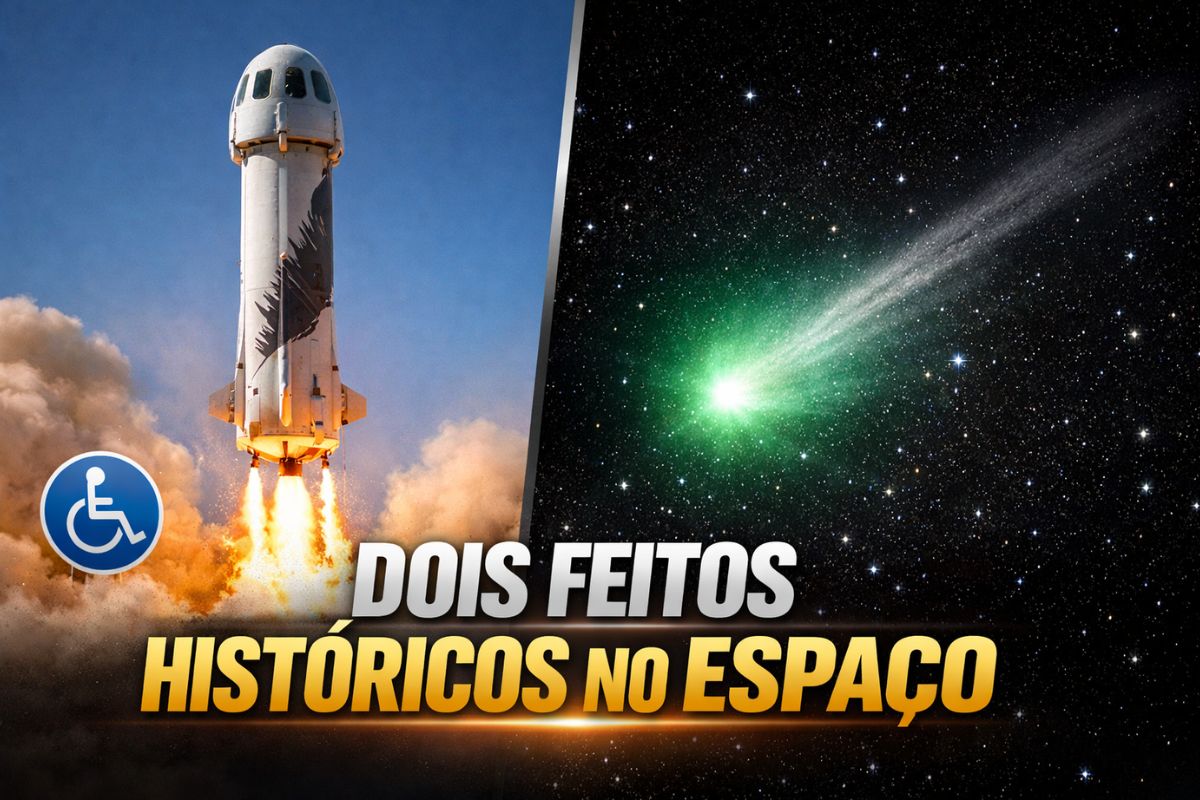
In the same weekend, Blue Origin’s New Shepard rocket takes a German engineer in a wheelchair to space and the interstellar comet 3I/Atlas crosses the Solar System, raising hypotheses of ice volcanoes and rare X-ray emissions that may change what we know about space and interstellar comets.
While the suborbital tourist flight expands who can experience space, 3I/Atlas, the third identified interstellar visitor, passes through Earth’s neighborhood at high speed, on a hyperbolic trajectory, showing signs of strange activity and a story that intertwines solid science, rumors of alien technology, and new clues about unknown regions of the Milky Way.
New Shepard: Historic Flight for Inclusion in Space

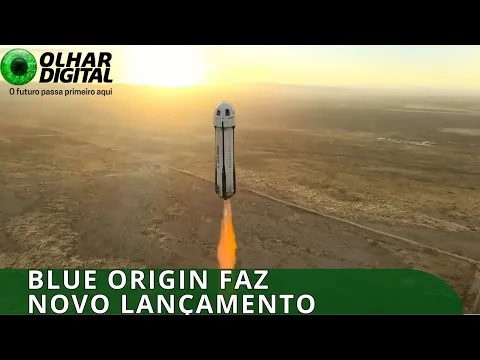
The latest launch of New Shepard, Blue Origin’s suborbital rocket, was scheduled for a Thursday, but a problem detected during pre-launch checks forced the team to delay the takeoff. The mission finally took off on Saturday at 11:17 AM Brasília time, marking the company’s 16th suborbital tourist flight.
-
The U.S. Army has introduced its first new lethal grenade since the Vietnam War: the M111 kills using pressure shock waves that bounce off walls and can explode the enemy’s lungs without producing a single shard.

-
Engineers are replacing pressure valves with hydraulic microturbines within drinking water networks and are generating up to 1,100 MWh per year with in-pipe hydropower technology that harnesses energy previously wasted in urban pipelines.

-
Elon Musk focused on Brazil and lowered the price of Starlink, his internet service, but the question remains: is it worth it? An expert provides a detailed analysis of the internet that promises to connect any part of Brazil.

-
Workers were performing maintenance on the sewage system when they found a 3.2-meter beam that may be part of a 1,300-year-old Viking ship buried under the pipes since the medieval period in Europe.


Aboard were six space tourists, but one passenger turned the flight into a historic milestone. Micaela Benthouse, a German aerospace and mechatronics engineer at the European Space Agency, became the first person who uses a wheelchair to go to space, practically demonstrating how the frontier between space and interstellar comets is becoming more accessible to profiles of travelers previously entirely excluded from such experiences.
Simple Adaptations That Change Who Can Go to Space

For Micaela to board, it wasn’t necessary to reinvent the rocket, but rather to adapt critical details of the experience. Blue Origin included a transfer board to facilitate movement between the hatch and the seat inside the capsule. After landing, a special mat ensured immediate return to the wheelchair, which had remained on the ground during takeoff.
Another important point is that the launch platform already had an elevator capable of taking passengers to the top, about seven stories above the ground. With these relatively simple solutions, the flight that once seemed reserved for a very specific type of tourist is now able to include more people, reinforcing the idea that access to space can be expanded without requiring radical changes to the rocket’s structure.
How the New Shepard Suborbital Flight Works
The New Shepard consists of two stages: a reusable booster and a passenger capsule installed on top. Unlike orbital spacecraft, it does not reach enough speed to enter Earth’s orbit. The flight is a round trip to the edge of space, lasting approximately 10 minutes.
During this short interval, passengers experience a few minutes of weightlessness and get a privileged view of the planet from above, with the curvature of the Earth and the contrast between the black of space and the blue of the atmosphere. According to engineer Jake Mills from Blue Origin, the most recent mission reinforces the goal of expanding access to space tourism, which has already accommodated other people with disabilities, such as passengers with hearing impairments. The message is clear: the concept of who can go to space is changing, while science closely observes each new interstellar comet that passes through our orbit.
3I/Atlas, the Interstellar Comet That Stole the Show in 2025

If the New Shepard flight marked space tourism, the comet 3I/Atlas was identified as the largest astronomical phenomenon of 2025. The third interstellar visitor already identified in our Solar System caught attention since its discovery in July due to its high-speed hyperbolic orbit, indicating that it is not bound by the Sun’s gravity and is merely passing through our neighborhood before continuing its journey.
Initial studies suggest that 3I/Atlas could be around 7 billion years old, possibly older than the Solar System itself. Just this fact would be enough to make it a special object in the history of space and interstellar comets, but the comet’s behavior added layers of mystery and debate among scientists.
Rumors of Alien Technology and Response from the Scientific Community
As new measurements were released, rumors began circulating that 3I/Atlas could have alien technological origins. The speculation was anchored in real data, such as the detection of atomic nickel, but the interpretation strayed from scientific consensus.
The majority of experts rejected this hypothesis, and NASA officially dismissed the idea that the object was a spacecraft or artificial structure. Instead, the comet has been treated as yet another complex chapter in the study of bodies coming from outside the Solar System, helping to understand how distant regions of our galaxy form and evolve and how space and interstellar comets can provide clues about those remote areas.
Ice Volcanoes, Antitail, and a Giant Green Coma
As observations progressed, a NASA mission detected carbon dioxide in the comet’s coma, the cloud of gas surrounding the nucleus that extends about 350,000 kilometers. This coma exhibited a characteristic greenish glow, visible in telescope recordings, reinforcing interest in its composition.
Ground-based telescopes also recorded an antitail pointing toward the Sun, a type of tail that appears to go against what is expected. Instead of extending away from the star, part of the material aligns with the direction opposite to the main tail, an effect linked to the interaction between dust, gas, and sunlight. These unusual behaviors helped establish 3I/Atlas as a rare case study in the entire history of space and interstellar comets.
The Ice Volcanoes Hypothesis and the Controversy Over What 3I/Atlas Is
One of the most recent studies on 3I/Atlas proposed that its surface may be covered by active ice volcanoes, the so-called cryovolcanoes. The expulsion of frozen material, gases, and dust could explain the observed non-gravitational acceleration, where the comet seemed to gain extra momentum that could not be explained merely by the gravity of Solar System bodies.
This hypothesis, however, did not pass without contestation. Some researchers raised the possibility that 3I/Atlas might not be a classic comet but an asteroid or another type of body with unusual characteristics. Despite the doubts, the majority of scientists continue to view ice volcanoes as the most consistent explanation, keeping 3I/Atlas at the center of the debate regarding how bodies from other stars behave.
Radio Signals, X-Rays, and the Farewell of the Interstellar Visitor
The most recent observations detected radio signals emitted by 3I/Atlas and, for the first time, X-ray emissions associated with the object. This type of emission is not what is expected from a common comet and reinforces the importance of monitoring the phenomenon as closely as possible.
After its closest approach to Earth, the comet is now heading out of the Solar System, on a trajectory that may still be slightly altered as it passes near Jupiter, something expected to happen in March. Monitoring continues, and each new reading helps to build a more comprehensive picture of interstellar visitors, expanding our understanding of the space and interstellar comets that cross our orbit and reveal secrets of the Milky Way.
In your opinion, what marks this historic moment for space and interstellar comet 3I/Atlas more: the first person in a wheelchair traveling beyond the atmosphere or an ancient comet leaving mysterious clues while crossing our Solar System?





-

-

2 pessoas reagiram a isso.