





 Portuguese
  English
  Spanish
  4 min of reading
  0 comments


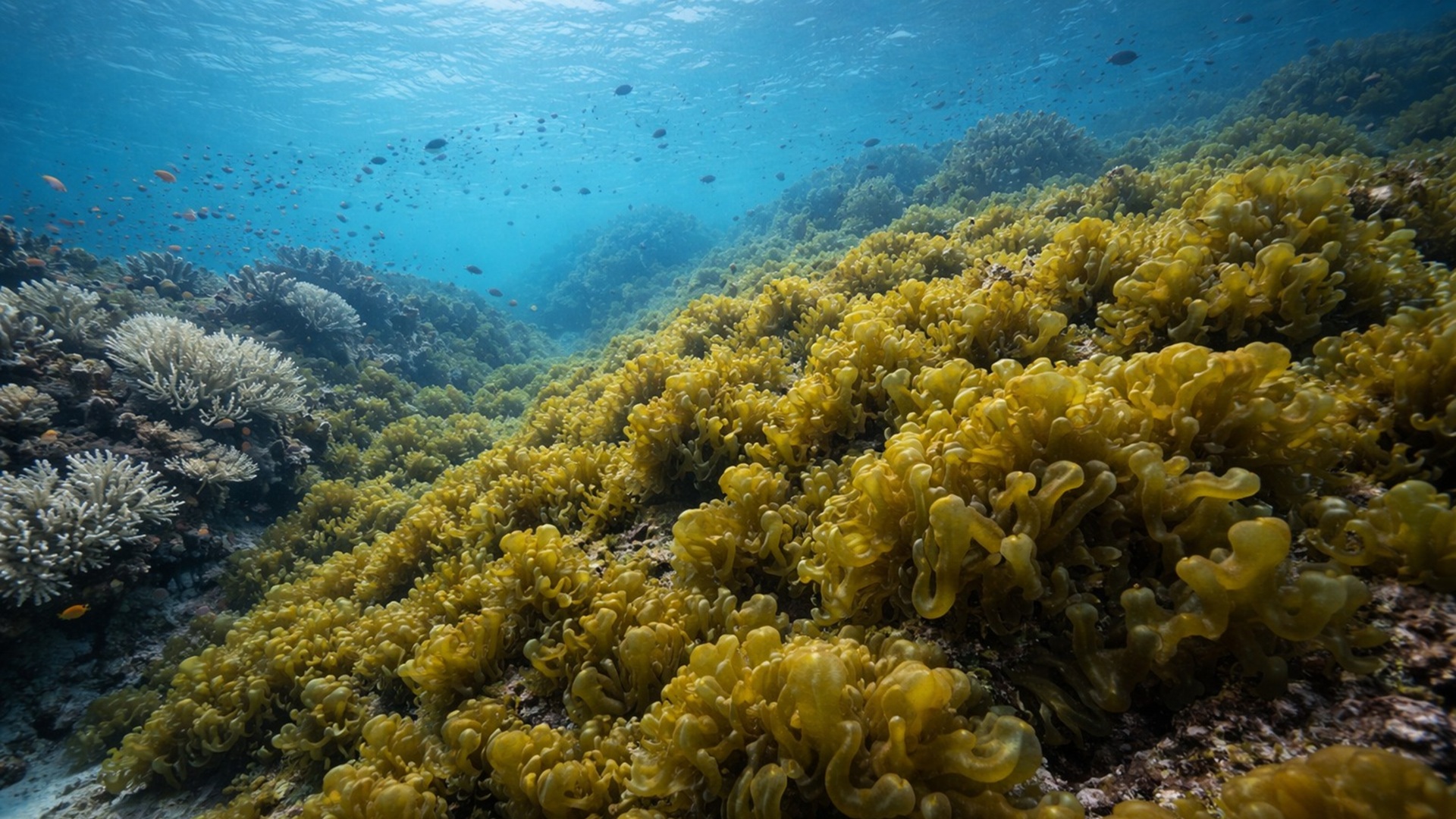
International Study Based on Natural Reefs of Papua New Guinea Shows That the Continuous Increase in Carbon Dioxide Is Expected to Reduce Coral Recovery, Simplify Reef Ecological Structure, and Favor the Dominance of Fleshy Algae in the Oceans by the Year 2100
An international study published in November 2025 analyzed coral reefs in Papua New Guinea and concluded that the increase in carbon dioxide may, by 2100, reduce reef recovery, decrease their ecological complexity, and favor the dominance of fleshy algae in tropical marine ecosystems.
Ocean Acidification and Projected Changes by 2100
By the year 2100, the increase in carbon dioxide levels is expected to profoundly alter the chemistry of the oceans. According to the study, this change may compromise the natural recovery of coral reefs and favor ecosystems dominated by fleshy algae.
As the ocean absorbs CO2 from the atmosphere, seawater becomes more acidic. This process can gradually erode the limestone that forms coral skeletons, reducing their capacity for growth and survival over time.
-
The gigantic steel shell built to contain Chernobyl for a century has been pierced by a drone, exposing a critical system and creating a hole that could cost over 500 million euros to repair.

-
Brazilian Navy reaches a new level by taking over an airport with a 1,600-meter runway used by 1,800 military personnel and autonomous attack drone testing.

-
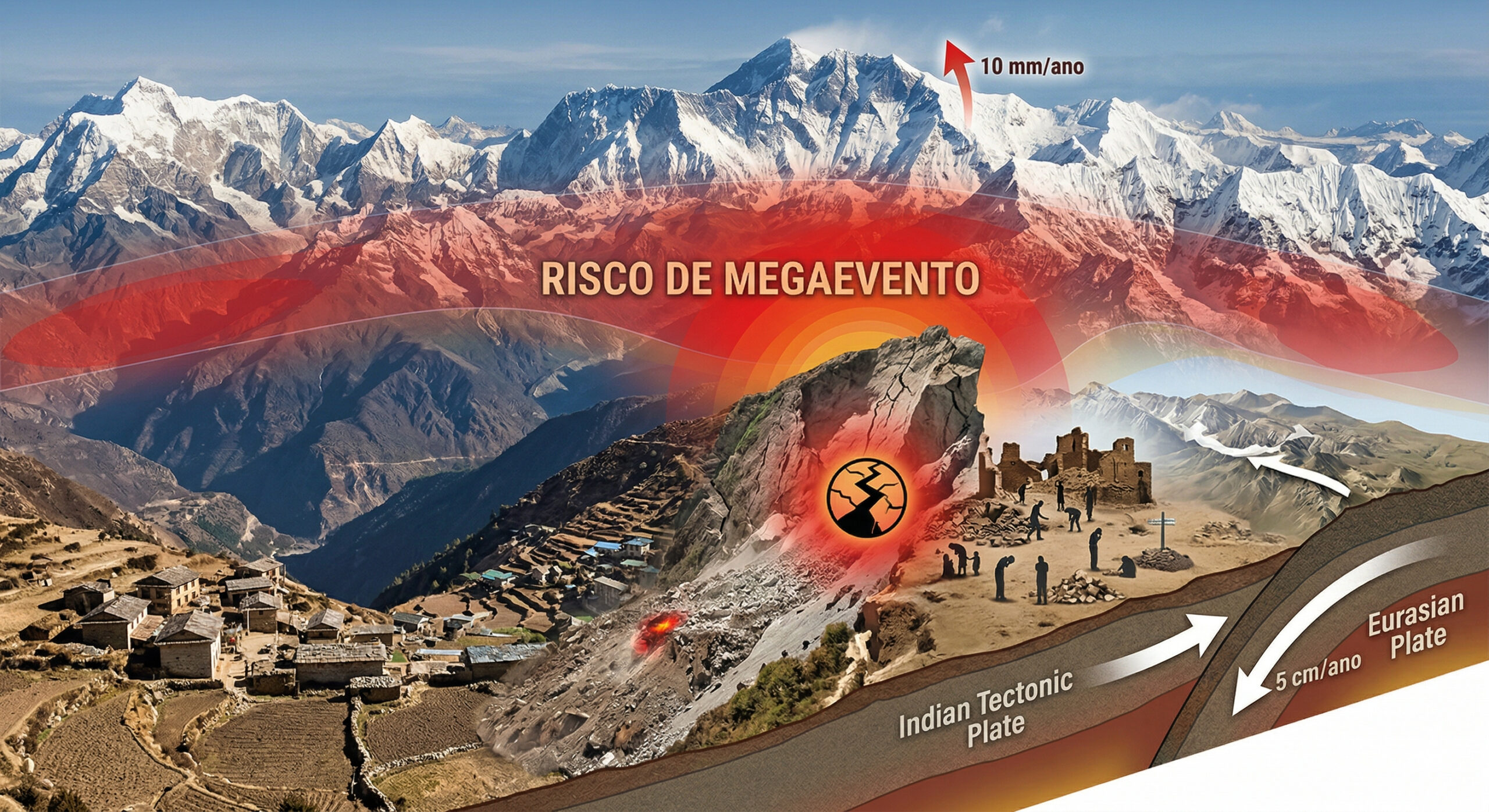
The Himalayas continue to grow to this day, with tectonic plates advancing 5 cm per year, mountains rising up to 10 mm annually, and the 2015 earthquake that killed 9,000 people may have increased the risk of an even larger seismic mega-event.
-
At an altitude of 400 km by astronauts from the International Space Station, Paris transforms at night into a golden mesh so precise that it reveals the outline of the Seine River, avenues, and entire neighborhoods like a luminous map drawn over the Earth.


Oceans are slightly alkaline, with an average pH of 8.0, but acidity has already increased by about 30%. With the continuous rise in CO2 emissions, an additional decrease to a pH of 7.8 is projected by the year 2100.
A Natural Laboratory in Papua New Guinea
To understand how entire reefs respond to acidification over time, researchers analyzed rare environments located near shallow underwater volcanoes in Papua New Guinea. In these areas, CO2 naturally escapes from the seabed.
These sites exhibit elevated carbon dioxide levels similar to those expected for future oceans. Therefore, they function as natural laboratories to observe long-term ecological responses under real conditions, something difficult to replicate in tanks or computer simulations.
The research was led by a team from the Australian Institute of Marine Science, which investigated complete reef communities exposed to different levels of CO2 along a continuous environmental gradient.
Discovery of the Research Site and Start of the Study
In 2000, during research in Milne Bay, about 500 km east of Port Moresby, researcher Katharina Fabricius observed gas bubbles emerging between the coral reefs. At that time, the phenomenon was not associated with acidification.
In 2009, with the advancement of discussions on ocean acidification, Fabricius analyzed gas samples and found that they contained almost pure CO2. This discovery paved the way for a decade-long research program.
The scenario allowed for the study of how tropical marine ecosystems adapt and how organisms acclimatize after generations of prolonged exposure to elevated carbon dioxide levels.
Resistant Corals and Ecological Tolerance Limits
The study identified that only the most resistant coral species can survive in areas with severe acidification, where pH is below 7.7. These conditions are expected when atmospheric CO2 concentrations reach around 1000 ppm.
Even in these environments, reefs cease to exist as complex systems. Structural diversity decreases, and fleshy algae begin to dominate the space previously occupied by corals and calcifying algae.
According to the senior author of the study, these environments function like a “time machine,” allowing us to observe today the tolerance limits of reefs in the face of future CO2 emission scenarios.
Results Along the CO2 Gradient
Researchers studied organisms in 37 sites distributed along a CO2 exposure gradient of approximately 500 meters. This enabled the observation of gradual changes in reef communities.
The data shows that there is no sudden collapse or abrupt tipping point. Instead, as CO2 increases, fleshy algae progressively become dominant, replacing and suffocating corals.
This gradual ecological transition results in lower diversity, reduced habitat complexity, and diminished recovery capacity of reefs after environmental disturbances.
Reduction in Reproduction and Chain Impacts
Another relevant finding was the significantly lower presence of young corals in the most acidified areas. This indicates that reefs cannot grow or recover quickly under high levels of CO2.
This limitation has direct implications for other species. Many fish use coral reefs as shelter and food sources in their early life stages, affecting entire ecological chains.
According to the researchers, human coastal communities may also be impacted, as they depend on these fish for subsistence and economic activities, further amplifying the reach of the observed changes.
Logistical Challenges and Scientific Relevance
Access to the studied reefs is complex, requiring international flights, internal travel to Milne Bay province, and about six hours by boat. Despite this, the team conducted detailed field observations over several years.
The reefs in the region are described as ecologically rich, and collaboration with the local population was essential for the development of the research. The study gathered unique field data considered globally significant.
The investigation is noted as the first of its kind to assess, under real conditions, how entire coral reef communities change in response to ocean acidification, providing direct evidence rather than just modeled projections.
Projections for the Future of Reefs
The results indicate that changes already observed in CO2 gradients in the Great Barrier Reef may intensify. The reefs of Papua New Guinea serve as an indicator of what may occur in other regions.
The higher the CO2 emissions in the atmosphere, the greater the transformations in coral reefs and the coastal communities that depend on them, adding to the impacts of global warming and rising sea levels.
The study, published in the journal Communications Biology on November 24, 2025, reinforces that ocean acidification is a global problem still poorly studied, but with profound and progressive ecological impacts.








-

-

-

-

8 pessoas reagiram a isso.