





 Portuguese
  English
  Spanish
  5 min of reading
  0 comments


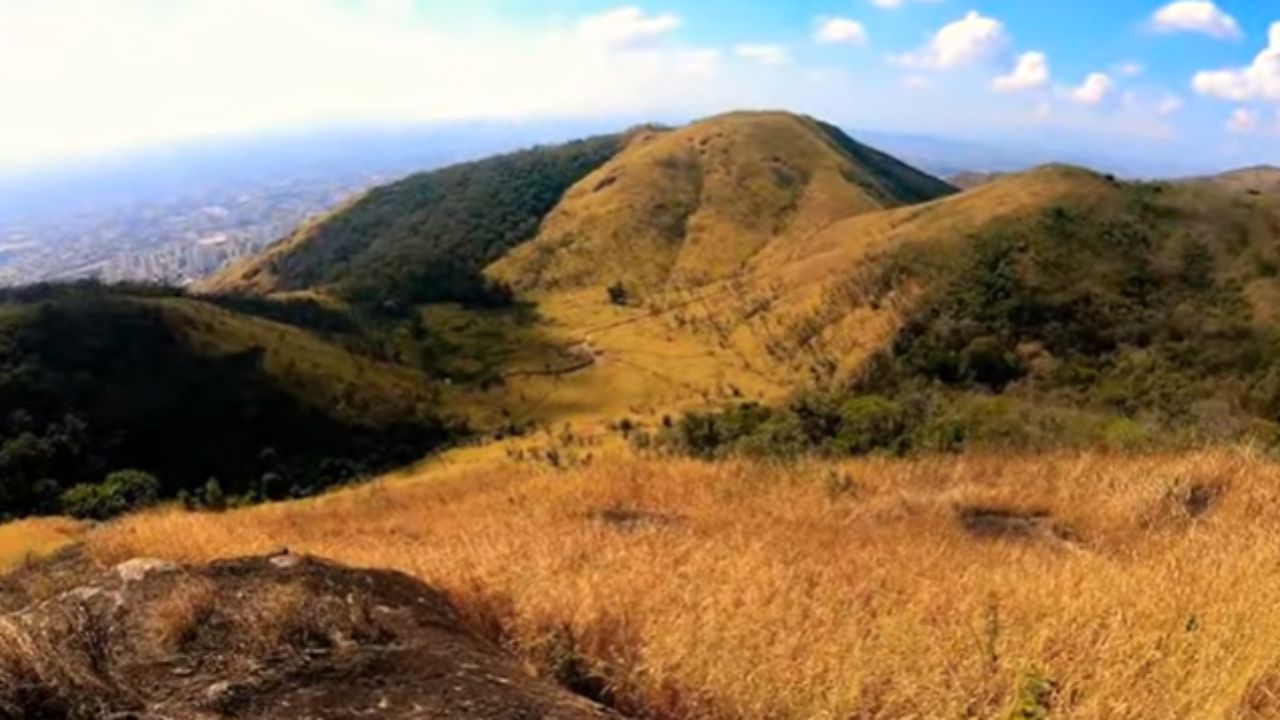
Geologists Reassess the Mendanha Massif and Refute the Crater: Understand Why the Famous ‘Volcano of Nova Iguaçu’ Is Actually a Subvolcanic Intrusion of 64 Million Years Exposed by Erosion.
The Mendanha Massif, popularly known as the Volcano of Nova Iguaçu, has been a point of debate in Brazilian geology for decades. Although the idea of an extinct volcano dominates popular imagination, what we see today in the Baixada Fluminense is far from the preserved cone and crater that was believed to exist. A series of crucial studies, led by geologists such as Akihisa Motoki (UERJ), have dismantled this hypothesis and reclassified the structure. The site is not a superficial volcanic edifice, but rather its “roots”, the system of magmatic “plumbing” exposed by the action of millions of years of erosion, a revelation that further enhances its scientific value.
The complex geological history of the Mendanha Massif, dated at about 64 million years, according to studies such as the thesis of Carlos Eduardo Miranda Mota (Redalyc), positions it in the Poços de Caldas-Cabo Frio Magmatic Alignment. This article explains the context of the formation of these rare alkaline rocks and presents the definitive scientific conclusion: the supposed “volcanic bombs” are weathering formations, and what we visit is an open-air laboratory that reveals the heart of an ancient volcanic system.
The Context of 64 Million Years: The Origin of Magma in the Southeast
The Mendanha Massif is the imposing structure, standing nearly 900 meters tall, that has become synonymous with the Volcano of Nova Iguaçu and dominates the landscape of the Baixada Fluminense. It is not an isolated geological phenomenon, but one of the alkaline bodies that make up the “Alkaline Province of Southeastern Brazil”, a large-scale event that occurred between the Late Cretaceous and the Eocene. The predominant explanation for this alignment is the hot spot model: a stationary plume of magma in the mantle over which the South American Plate moved, leaving a “trail” of alkaline rocks.
-
These living root bridges and ladders are over 700 years old and help indigenous people survive in one of the rainiest regions in the world.

-
From sertanejo star to international investor: Ana Castela invests millions in a mansion in the USA, creates a themed accommodation in Orlando, and shows that the “boiadeira” also wants to grow away from the stage.

-
The 10 most stunning motorhomes in the world: a $3 million trailer with a rooftop nightclub and garage for a Ferrari, “palaces on wheels” with Italian marble, private cinema, and five-star hotel luxury for billionaires.

-
Trump wanted to spend $400 million on the White House, but the courts prohibited the million-dollar construction.


Detailed research, such as the doctoral thesis of Carlos Eduardo Miranda Mota (Redalyc), introduces significant complexities. New geochronological datings complicate the simple model of a linear hot spot trail. Petrogenesis, or the origin of the magma, is more complex, suggesting that the magmas that formed Mendanha were generated from enriched mantle magmas, but whose chemical signature is associated with the ancient crustal weakness zone (the Ribeira Orogen).
The Mendanha Massif is, therefore, the result of a hybrid and complex geodynamic process. Its formation, dated at about 64 million years, involved the tectonic reactivation of ancient crustal zones by a mantle plume. The magma did not rise to the surface in a pure form; it underwent fractional crystallization and assimilated surrounding rocks (AFC), where the hot magma “digested” parts of the crust it traversed. The result is the diversity of rare alkaline rocks we see today.
The Scientific Refutation: Why Is There No Preserved Crater?


The central debate in Nova Iguaçu is not whether volcanism occurred, but what exactly we see today. For decades, the hypothesis that the Mendanha Massif was an extinct volcano with its original form preserved (cone and crater) was treated as a fact, based on the presence of abundant pyroclastic rocks. These rocks, formed from material ejected during explosive eruptions, seemed to confirm the existence of a superficial volcano.
Since 2006, a series of scientific articles, notably those by geologist Akihisa Motoki and his collaborators (UERJ), reexamined the field evidence and refuted the hypothesis of the preserved volcano. Studies showed that the valley interpreted as a volcanic crater is not composed of pyroclastic conglomerate, but instead consists of massive trachyte. The conclusion is that the circular morphology is not a crater, but a feature developed by differential erosion over millions of years, which sculpted the current shape.
The “nod” of the debate resided in the structures that appeared to be unmistakable “volcanic bombs”. The petrographic analysis by Motoki and Sichel provided the definitive answer, proving that these structures are, in fact, pseudo-bombs created by weathering processes (the action of rain and time). The supposed “vesicles” (holes) are dissolution cavities, formed by the leaching of alkali feldspar phenocrysts. Furthermore, the dark and hard “crust” was identified as a weathering phenomenon called case hardening, and not a rapid cooling edge of lava, proving that “these clasts are not bombs, spatter, or scoria”.
The New Geology: Exposed Subvolcanic Intrusion and Geopatrimony
The scientific conclusion about the Volcano of Nova Iguaçu is unequivocal: it is not a preserved volcanic edifice. It is an eroded subvolcanic intrusion (Motoki/UERJ). This means that while volcanic eruptions indeed occurred over 60 million years ago, the cone, the crater, and all superficial deposits have been completely eliminated by erosion.
What visitors and scientists observe today are the “roots” of the volcano, its “plumbing”. The rocks in the park expose the conduits and fractures that existed about 3 kilometers deep below the original volcano. Far from diminishing the importance of the site, this revelation makes it even greater. The Mendanha Massif is a geologically rare example in the world, a “natural dissection” that exposes the internal structures that fed the eruptions, allowing direct study of the heart of an ancient volcanic system.
The Mendanha Massif is an “alkaline complex” (Mota/Redalyc) due to its notable diversity of rocks. The main lithologies are Sienites (plutonic rocks that form most of the plumbing) and Trachytes (the volcanic equivalent of sienite). This complex geological history, with resistant alkaline rocks, has created a landscape of sharp relief that now serves as a vital refuge. The Massif, protected by the Municipal Natural Park of Nova Iguaçu (PNMNI), is a refuge of primary Atlantic Forest and an important hub for ecotourism, with the “Serra do Vulcão Free Flight Ramp” considered one of the best in Brazil for the sport.
The Importance of a “Non-Volcano”

The true narrative of the Volcano of Nova Iguaçu is an integrated story of geology, erosion, and life. The hypothesis of the preserved cone has been scientifically refuted by studies from UERJ (Motoki), which reinterpreted the supposed “volcanic bombs” as products of weathering. The site is, in reality, an eroded subvolcanic intrusion, exposing the internal structures formed deep within the Earth over 60 million years ago, a fact confirmed by petrographic and geochronological analysis (Mota/Redalyc).
The name “Volcano”, although geologically inaccurate for the current shape, has become the cultural brand that drives tourism and supports the conservation of the heritage. The Mendanha Massif is a fascinating example of geopatrimony, where popular myth and scientific reality coexist. Geology dictated geomorphology, which in turn protected local biodiversity and accelerated ecotourism, proving that the exposed heart of a volcano is, by far, more valuable than its ancient cone.
What did you think of the reclassification of the Mendanha Massif? Does the change in status from “volcano” to “volcanic roots” diminish or increase the importance of the site as heritage? Leave your opinion in the comments; we want to know how this new scientific perspective impacts your view of the famous Volcano of Nova Iguaçu.







-

Uma pessoa reagiu a isso.