





 Portuguese
  English
  Spanish
  6 min of reading
  0 comments


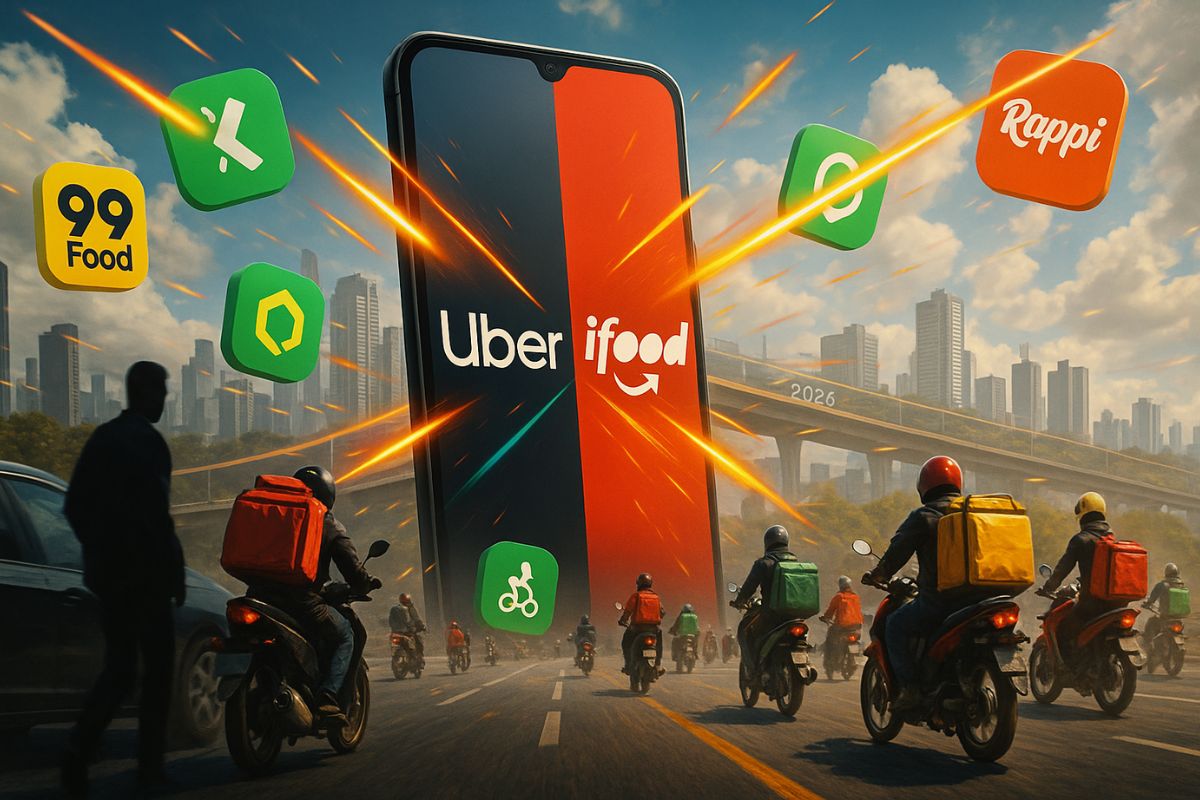
Partnership Between Giants Changes the Delivery Landscape in Brazil by Integrating Rides and Deliveries into One Ecosystem, While 99Food, Keeta, and Rappi Resume Competitive Front with Billions in Investments and Aggressive Expansion Plans.
The competition for the Brazilian delivery market enters a new phase with the start of integration between Uber and iFood apps. Starting in November 2025, the two companies will share space within each other’s apps, connecting mobility and deliveries in the same digital environment and adding another layer of complexity to the so-called delivery war.
In practice, iFood users will be able to request Uber rides without leaving the app, while the Uber app will display meal, grocery, and other item deliveries made by iFood. The initiative debuted in Belo Horizonte and has a timeline set to reach other capitals and eventually all cities served by the platforms by January 2026. Meanwhile, rivals such as 99Food, Keeta, and Rappi are resuming positions on the front, emphasizing that the delivery market is far from being settled.
Integration of Uber and iFood Amid the Delivery War
The integration between Uber and iFood is announced in a context of fierce competition in the delivery market, marked by new entrants and the return of players who had previously retreated. The partnership has two central movements.
-
The former CEO of Petrobras got straight to the point: Brazil has a lot of oil but depends on imports for gasoline and diesel because Brazilian refineries were designed to process a type of oil that the country hardly produces anymore.

-
The Mar Sem Lixo program has already removed 133 tons of waste from the São Paulo coastline and pays more than R$ 1 million to fishermen.

-
With over 1 million bottles per year and 1.2 million vines, winter wines are advancing and gaining a strategic laboratory worth R$ 3.4 million in the Midwest.
-
Elderly individuals aged 65 or older who have never contributed to the INSS can receive R$ 1,621 per month in 2026 without having paid any contributions in their lifetime: learn how the benefit works that already supports nearly 7 million Brazilians.


In the first phase, iFood users will have a specific Uber tab within the app, allowing them to request rides directly through the interface they already use to order food or shop for groceries.
Then, in December, the Uber app will gain a tab dedicated to iFood, displaying meal, grocery, and other item deliveries in the same environment where the customer already requests rides.
This feature debuts this Monday in Belo Horizonte, with planned expansion to major capitals like São Paulo, Rio de Janeiro, Brasília, Curitiba, Fortaleza, Campinas, Goiânia, Recife, Porto Alegre, and Salvador still in December.
The forecast is that by January 2026, the integration will be available in all cities where Uber and iFood already operate in mobility and delivery.
Return of Uber to Meal Delivery, Now via Partnership
The partnership also indirectly marks Uber’s return to delivery of meals in Brazil after the closure of Uber Eats in March 2022. Previously, the company operated directly in the food delivery segment, in direct competition with iFood.
With the current agreement, Uber re-enters the delivery market not with its own restaurant brand, but as a gateway for iFood deliveries within its main app.
The company maintains its focus on mobility and ancillary services, while benefiting from the flow generated by a dominant partner in the meal segment. Meanwhile, iFood broadens its exposure to Uber’s user base, reinforcing its brand presence during trips and not just during food orders.
Rivals React and Strengthen the Delivery War
As Uber and iFood deepen their partnership, the competitive landscape of delivery gains new ingredients with the return of 99Food, the arrival of Keeta, and Rappi’s reinforcement.
99Food, which operated for four years in Brazil before retreating, returns as a delivery option within the 99 app.
Controlled by Chinese company Didi Chuxing since 2018, 99 announced an investment plan of R$ 2 billion by June 2026 in the country, seeking to recover space and align transport and delivery offerings in the same ecosystem.
Keeta, linked to the Chinese group Meituan, began operations in Brazil at the end of October, with a pilot app in Santos and São Vicente, on the coast of São Paulo.
The announced promise is to invest US$ 1 billion over five years, which, converted, is about R$ 5.4 billion. The strategy is to enter the delivery market with robust capital and a focus on gradual expansion.
Rappi has announced R$ 1.4 billion in new investments, with two main objectives: to expand the base of partner restaurants and to increase its operation from around 50 cities to 300 cities.
This move puts more pressure on iFood and reinforces that the delivery market is still regarded as strategic by multiple groups, including international ones.
Partnership is a Reaction to Competition or Ecosystem Strategy
Amid the interpretation that the market is experiencing a genuine delivery war, the integration could be seen as a direct response to the return of 99Food, the entry of Keeta, and the reinforcement of Rappi. However, iFood and Uber maintain a different narrative.
According to the CEO of iFood, Diego Barreto, conversations began in September of the previous year, when there was no discussion yet about new entrants like Keeta in Brazil.
The narrative is one of ecosystem strategy: to bring more services together in one place to increase convenience and engagement, rather than solely reacting to heightened competition.
In the same vein, Silvia Penna, general director of Uber in Brazil, points out that the union makes consumers’ lives easier, as they can resolve mobility and delivery in the same digital environment.
The logic is that, in a scenario with multiple offers, the integrated experience, the diversity of services, and brand strength gain weight in the decision of which app the customer opens first.
Joint Subscription and Impact on Users’ Wallets
A key point of the new phase of the delivery war is the joint subscription announced by iFood and Uber. The companies will launch a unified loyalty plan for R$ 21.90 per month, combining benefits from both sides.
Currently, the iFood Club costs R$ 12.90, and Uber One costs R$ 19.90. Those who choose to subscribe to both separately pay more than the amount of the new joint subscription.
According to the CEO of iFood, the proposal is to generate economic benefits both in the monthly fee and in the combination of discounts and free delivery, reinforcing the recurring use of mobility and delivery in a single basket of services.
In practice, this single subscription is a response to user behavior that switches apps in search of prices, delivery fees, and promotions.
By unifying benefits, Uber and iFood aim to keep the customer within the same axis of apps, reducing the temptation to migrate to competitors for delivery orders or for everyday rides.
What Changes in the Delivery Experience for the User
From the user’s perspective, the central change is the presence of cross-tabs between mobility and delivery. In the iFood app, a dedicated Uber tab appears for ride requests.
In the Uber app, a dedicated iFood tab appears for meal, grocery, and other item orders.
This integration is applied automatically, with no extra action required from the user. The trend is that the customer will perceive less of a boundary between a ride app and a food app, dealing with a more continuous flow of services: leaving home, requesting transportation, choosing a restaurant, receiving the order, and returning, all with the same credentials and, in some cases, with the same loyalty subscription.
At the same time, with Keeta, 99Food, and Rappi strengthening investments and expanding geographical coverage, the delivery user tends to find more alternatives for prices, delivery times, and promotions, especially in large cities.
The app that manages to better balance convenience, total cost per order, and platform stability gains relevance.
Upcoming Chapters of the Delivery War Until 2026
The announced timeline foresees a phased expansion of the delivery and mobility integration between Uber and iFood. In November, Belo Horizonte serves as a laboratory.
In December, the union reaches major capitals, both in the Uber tab within iFood and in the iFood tab within the Uber app.
By January 2026, the integration is expected to cover all cities where both companies already operate. At the same time, the investment plan of 99Food continues until June 2026, the execution of Keeta’s five-year strategy, and Rappi’s plan to multiply by six the number of served cities.
This set of moves reinforces that the Brazilian delivery market is entering a consolidation phase with multiple giants, strong foreign capital, and ecosystem partnerships, rather than a simple “one against all” contest.
For consumers, the challenge will be to navigate subscriptions, coupons, fees, and deadlines to truly understand where the best cost-benefit lies in each situation.
With so many changes coming at once, one question remains for you who use apps every day: in your daily practice, do you tend to concentrate everything in a single delivery and mobility app, or do you prefer to switch between various options depending on the price and current promotion?







-

Uma pessoa reagiu a isso.