





 Portuguese
  English
  Spanish
  4 min of reading
  0 comments


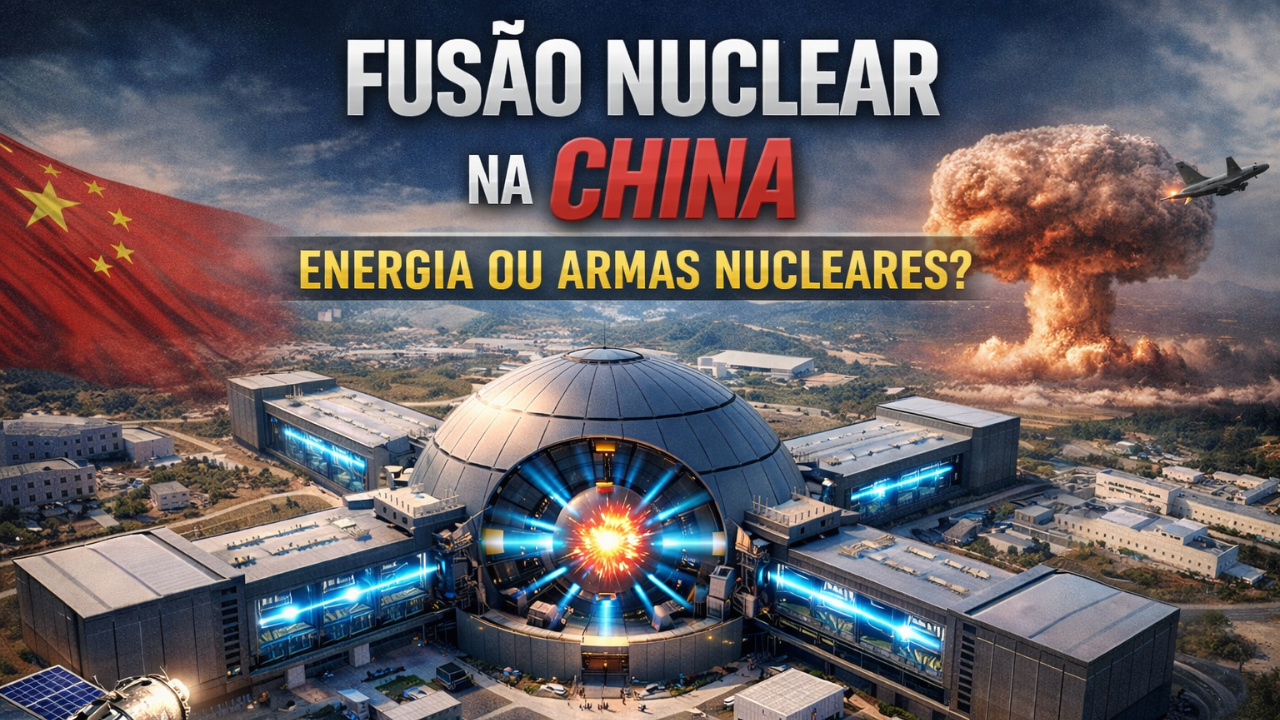
Nuclear Fusion Complex in Mianyang Puts China at the Center of the Nuclear Race and Reignites Debate on Civil and Military Use of Technology.
The construction of a gigantic nuclear fusion complex in China has put the United States on high alert after satellite images revealed the unprecedented scale of the facility.
The project, recently identified by American analysts, is being built in Mianyang, in southwestern China, and employs laser fusion technology.
What worries Washington is the potential dual use of the facility: generating clean energy or strategic advancements in nuclear weapons, amid a new phase of the nuclear race.
-
USA and China compete for Brazil over resources that could be worth trillions — rare earths put the country at the center of a global dispute

-
Global summit with over 40 countries pressures Iran for a blockade in the Strait of Hormuz and warns of direct impact on oil, food, and the global economy.

-
Russia has broken the U.S. maritime blockade to send oil to Cuba and is now loading a second ship while Trump says that “Cuba is next” in a possible military action against the island.

-
Spain challenges the USA and closes its airspace for operations against Iran, raising global tension and provoking the threat of a trade rupture.


The images were analyzed by experts from CNA Corp, an independent research organization in the U.S., in partnership with the James Martin Center for Nonproliferation Studies (CNS).
According to researchers, the complex, called “Laser Fusion Primary Device Laboratory,” has proportions greater than those of the main American facility in the sector.
The discovery comes at a time of increasing geopolitical tension, where scientific advancements can have direct impacts on global strategic balance.
Nuclear Fusion and Laser Fusion: What Is Being Built in China?
The Chinese complex has been designed with four large external arms, which are expected to house ultra-high-power laser systems.
These beams converge into a central chamber, where the nuclear fusion experiment takes place.
In practice, laser fusion consists of concentrating intense energy on hydrogen isotopes, causing a reaction similar to that happening in the Sun’s interior.
The declared goal of this type of research is to generate clean, abundant, and virtually unlimited energy.
However, the technology also has strategic applications.
This is because the study of reactions allows for a better understanding of the mechanisms involved in nuclear detonations.
Comparison with the U.S. Expands Debate on Nuclear Race
The most immediate comparison is with the National Ignition Facility (NIF), located in California.
The American structure gained prominence in 2022 when it reached the so-called “scientific equilibrium threshold,” when it produced more energy in the fusion reaction than the energy applied by the lasers.
The investment in the American project was US$ 3.5 billion (about R$ 18.8 billion).
Nonetheless, according to estimates from Decker Eveleth, a researcher at CNA Corp, the Chinese experimental chamber is approximately 50% larger than the NIF.
This data suggests an even broader ambition on the part of China, both in the scientific and strategic fields.
Consequently, analysts believe that this move could indirectly impact the current nuclear race.
Clean Energy or Advancement in Nuclear Weapons?
Thus, nuclear fusion is seen as a revolutionary energy promise.
Unlike nuclear fission, used in power plants and atomic bombs, fusion generates less radioactive waste and uses abundant fuel.
On the other hand, research in inertial confinement fusion — the basis of laser fusion — has strategic relevance.
The Comprehensive Nuclear-Test-Ban Treaty (CTBT), signed by the United States and China, prohibits nuclear explosions in any environment.
In this context, laboratory experiments allow for the simulation of extreme conditions without conducting actual tests.
This can strengthen the reliability and development of nuclear weapons, even without physical detonations.
William Alberque, a nuclear policy analyst at the Henry L. Stimson Center, states that any country with a facility similar to the NIF can boost confidence in its projects and improve future models without physical testing.
Thus, the statement reinforces the so-called “gray zone” between science and military application.
Experts Urge Caution on New Nuclear Race
Despite the concerns, not all experts see the advancement as an immediate threat.
Siegfried Hecker, former director of the Los Alamos National Laboratory, notes that countries with a broad history of nuclear testing use laser fusion primarily to maintain the security of their existing arsenals.
Omar Hurricane, chief scientist of the inertial confinement fusion program at Lawrence Livermore National Laboratory, also puts the scenario into perspective.
He then recalls that France, the United Kingdom, and Russia operate similar facilities and emphasizes that scientific advancement is unlikely to be contained.
China Heavily Invests in Nuclear Fusion
Even without official comments from Chinese authorities, the scale of the project demonstrates a robust investment.
Thus, the structure in Mianyang is considered the largest of its kind in the world.
Therefore, more than signaling an immediate escalation in the nuclear race, the venture may represent a strategy for technological leadership.
At the same time, it reinforces the central role of nuclear fusion in the contest for innovation, clean energy, and geopolitical influence.
In summary, the new Chinese facility highlights how science, energy, and international security are intertwined.
Now, the global challenge will be to ensure that the advancement of laser fusion contributes more to energy solutions than to the strengthening of nuclear weapons in a context of growing international tension.
See more at: Upon Flying Over China, the United States Discovered a Facility That Deeply Concerned Them








Seja o primeiro a reagir!