





 Portuguese
  English
  Spanish
  5 min of reading
  1 comment


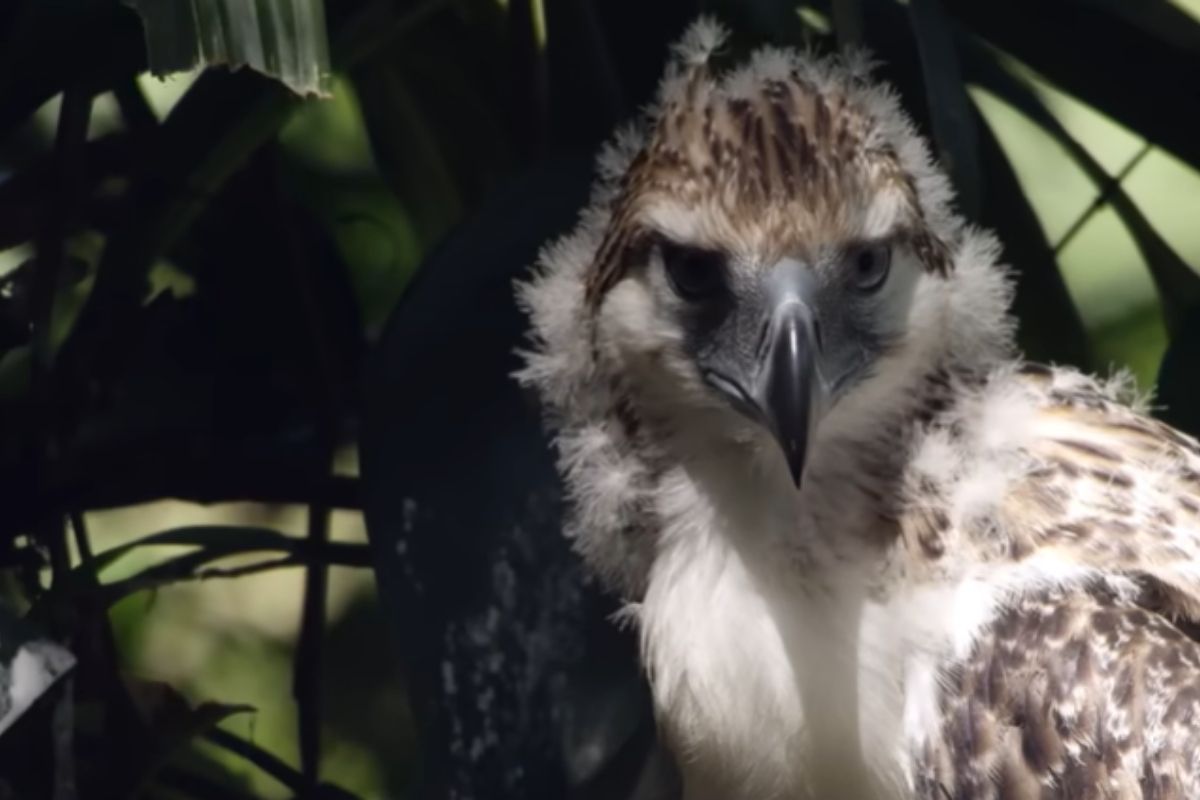


The Philippine Eagle, one of the rarest and most imposing raptors in the world, tries to survive on a few islands in the country while losing habitat, suffering from hunting, and depending on extremely slow reproduction to avoid disappearing forever
The Philippine Eagle is now a symbol of an unequal struggle for survival. With fewer than 900 adults left and a presence restricted to only four islands in the Philippines, the species is classified as critically endangered and faces a real risk of extinction. It is a top predator in the rainforest, capable of patrolling hunting areas that span dozens of square kilometers, but this power is not enough to compensate for centuries of destruction of its environment.
At the same time, a rare chick observed in a hidden nest in the treetops shows the other side of this story: that of resilience.
It took weeks of searching, filming platforms scattered through the forest, and months of monitoring to closely document the routine of this young Philippine Eagle chick under the intense care of its parents.
-
With a cost per shot close to zero, the DragonFire laser could change naval warfare in 2027 and provide British ships with nearly unlimited defense against drones.

-
A British startup creates tires that generate electricity in electric vehicles when passing over potholes, speed bumps, and cracks.

-
Scientists have created robots made with living cells that have their own nervous system, swim on their own, explore the environment, and self-organize without any genetic engineering, and now they want to do the same with human cells.

-
Students create a solar-powered ambulance that operates without a plug, without fuel, and still keeps medical equipment running in remote areas.


Each captured scene helps to better understand the species’ behavior and reinforces why each new chick matters so much.
One of the Rarest Raptors on the Planet

The Philippine Eagle is considered one of the largest and rarest birds of prey in the world. Its size, hunting power, and role in the food chain make it a true icon of the Philippine forests.
As a top predator, the Philippine Eagle helps maintain ecological balance by controlling populations of other animals and indicating the health of the forest where it lives.
This bird occupies the upper canopy of the forest, using its keen eyesight to locate prey across a vast territory.
Its hunting range can cover tens of square kilometers, which requires large contiguous areas of native forest. When the forest disappears, the very logic of life for the Philippine Eagle is broken.
Forests Destroyed Since the 17th Century
The greatest threat to the Philippine Eagle comes from habitat loss. Much of the Philippines’ forests have disappeared since the 17th century, mainly due to deforestation, logging, and the encroachment of human activities into natural areas.
Today, less than a quarter of the historical forest cover remains, meaning the species is trying to survive in increasingly smaller fragments of forest.
With fewer tall trees and less continuous areas, suitable locations for building safe nests at great heights are becoming rarer.
The Philippine Eagle depends on these trees for breeding, hunting, and protection. When this scenario is lost, it is pushed into limited areas, often closer to human communities, increasing the risk of conflict and hunting.
Slow Reproduction and Prolonged Dependence
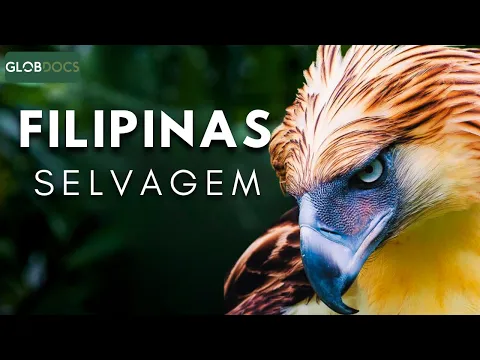

In addition to habitat loss, the species’ own biology makes recovery slower. Pairs of Philippine Eagles form stable pairs and typically mate for life.
They produce only one egg every two years, which means an extremely low reproduction rate for such an endangered bird.
When an adult Philippine Eagle dies, it is not simple to “replace” that individual, because the species takes years to form, raise, and mature a new adult.
Both parents share the work of raising the chick, taking turns hunting and feeding. They bring a variety of prey to the nest, such as birds, snakes, and small mammals, including animals living in the tree canopies.
This joint dedication is essential for the chick to have enough energy to grow, molt, and learn to move safely at heights.
The Routine of the Chick in the Secret Nest
The chick observed in this secret nest represents, in practice, this developmental trajectory. At the beginning of its life, it is covered by soft down and completely depends on its parents for food and protection.
Around six weeks, it begins to explore new movements, observing its surroundings and reacting to the care of the pair of Philippine Eagles that feed it.
After about two months, the chick begins to shed its down for definitive feathers and starts developing the famous crest characteristic of the Philippine Eagle.
At 15 weeks, this young chick already stretches and flaps its wings vigorously, practicing flights that, at first, are just awkward jumps and short falls within the nest area.
By around five months, it finally takes its first complete flight but is still not ready to live independently.
Dependence That Can Last More Than a Year
Even after leaving the nest, the young Philippine Eagle’s story is far from over. The parents continue to feed and guide the chick for about a year and a half after its first flight.
During this period, the young eagle learns to hunt efficiently, navigate the territory, and avoid dangers, including those posed by human activities.
This long dependence means that the same pair of Philippine Eagles spends many months dedicated to a single chick.
If something happens to the nest, the parents, or the surrounding forest, all that investment of time and energy can be lost in a matter of hours. That is why each active nest and every observed chick gains such importance in conservation strategies.
Deforestation, Hunting, and Risk to Nests
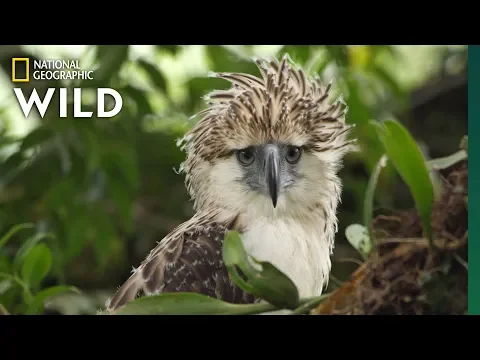
The Philippine Eagle nests are often reused each breeding season. This makes the parents’ job easier but also makes these sites even more vulnerable when the forest is cleared or when hunters approach.
The combination of deforestation and hunting risk turns every tree-nest into a critical location for the species’ future.
In addition to losing trees to build nests, the Philippine Eagle also faces lower prey availability. Less forest means fewer animals at the base of the food chain, which directly affects the parents’ ability to keep the chick well-fed.
When the environment becomes scarce, the Philippine Eagle needs to fly more, expend more energy, and take more risks to find food.
Conservation and Hope for the Philippine Eagle
Despite all the challenges, there are signs of hope. Conservation groups study the behavior of the Philippine Eagle, monitor nests, and work with local communities to protect forest areas and reduce hunting.
The protection of active nests and the enforcement of laws against illegal capture and killing give the species a real chance to recover.
Every chick that leaves the nest and manages to survive represents a small victory. In such a reduced population, each new Philippine Eagle that learns to fly, hunt, and reproduce in the future is one step closer to warding off the risk of extinction.
Therefore, rare images of a chick in a secret nest are not just beautiful: they are a concrete reminder of everything at stake.
And you, after learning the story of the Philippine Eagle and the chick in its secret nest, what do you think should be a priority to ensure the survival of this species in the coming years?






Dedicated people doing their best to save the Haribon should be given more than enough budget from the government. Strict rules on hunting and logging must be implemented. More power to our conservationists!!!