





 Portuguese
  English
  Spanish
  3 min of reading
  2 comments


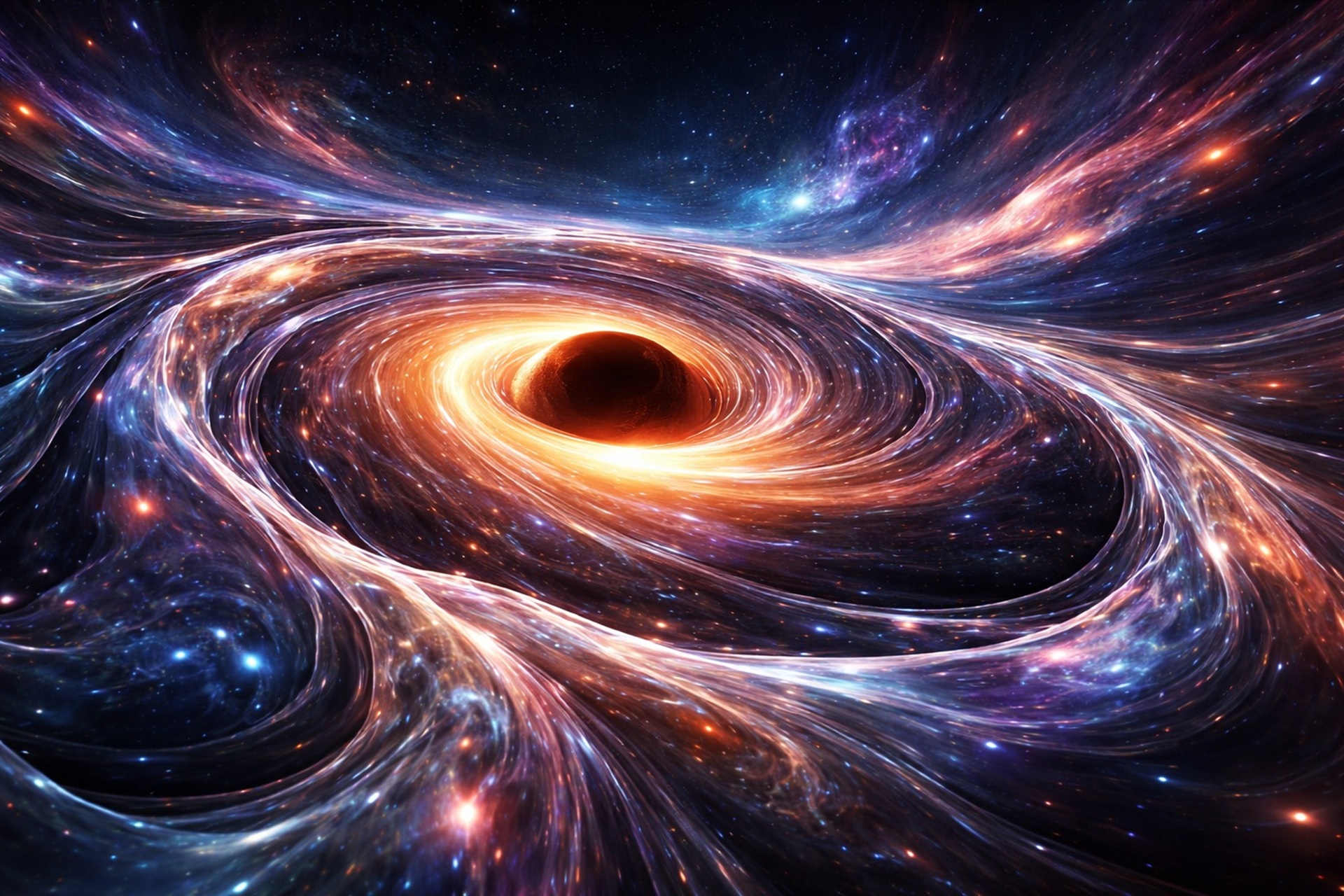


Published Research In Preprint Suggests That Recent Discrepancies In The Expansion Rate Of The Universe, Observed By Astronomical Instruments, May Be Explained If Space Has Volume Viscosity, Challenging The Standard Cosmological Model Based On Dark Energy Constant
The dominant cosmological model may be incomplete, according to a study proposing to treat space as a viscous fluid, capable of altering the expansion rate of the universe and reconciling recent discrepancies observed in large-scale astronomical data.
A new study suggests that the current understanding of the universe has fundamental flaws in describing cosmic expansion.
The study proposes that space has volume viscosity, affecting the dynamics of the cosmos and offering a possible explanation for recent observational divergences.
-
With a cost per shot close to zero, the DragonFire laser could change naval warfare in 2027 and provide British ships with nearly unlimited defense against drones.

-
A British startup creates tires that generate electricity in electric vehicles when passing over potholes, speed bumps, and cracks.

-
Scientists have created robots made with living cells that have their own nervous system, swim on their own, explore the environment, and self-organize without any genetic engineering, and now they want to do the same with human cells.

-
Students create a solar-powered ambulance that operates without a plug, without fuel, and still keeps medical equipment running in remote areas.

Questioning The Lambda-CDM Model
Traditionally, scientists describe the universe through the Lambda-CDM model, which considers dark energy as a fixed and immutable cosmological constant, responsible for the accelerated expansion of space over time.
This widely accepted model faces a persistent problem. Recent observations indicate that the actual rate of galaxies moving away does not exactly match theoretical predictions, suggesting limitations in the current formulation of dark energy.
The data that intensified this debate were obtained by the Dark Energy Spectroscopic Instrument, known as DESI, installed at the Mayall Telescope at the Kitt Peak National Observatory.
The Proposal Of Vacuum Viscosity
The study was published on the arXiv preprint server and has not yet undergone peer review. The author is Muhammad Ghulam Khuwajah Khan, a researcher at the Indian Institute of Technology.
Khan proposes that space has volume viscosity, a property that measures a fluid’s resistance to expansion or compression. In this case, it refers to the resistance of the vacuum itself to the expansion of the universe.
The central idea is that as space expands, an almost imperceptible drag effect arises, comparable to the difference between the flow of water and honey, but applied to the structure of the cosmos.
Spatial Phonons And Cosmological Drag
To explain this behavior, the researcher introduces the concept of spatial phonons. In solid-state physics, phonons represent collective vibrations in crystals, associated with the coordinated movement of atoms.
In the new model, these vibrations are applied to the very structure of space. Longitudinal oscillations would function as sound waves in the vacuum, creating a viscous effect that slightly slows cosmic expansion.
This drag arises when spatial phonons move during expansion, generating a pressure counter to the momentum of galaxies moving away, adjusting the model to the observations of DESI.
Fitting To Data And Limits Of The Hypothesis
According to the study, this simple model, based on observational data, shows high accuracy when fitting to DESI measurements, potentially resolving some of the discrepancies associated with the traditional cosmological constant.
Despite this, the authors themselves emphasize caution. Viscous dark energy would represent a fundamental shift in the understanding of spatial vacuum, and there is still no confirmation as to whether this viscosity is a real property of nature.
There is also the possibility that the observed effect is merely an artifact resulting from the limitations of current measurements, making it necessary to deepen the analysis of available data.
Next Observational Tests
The validation of this hypothesis will depend on future observations. The next decade of data from missions like the Euclid Space Telescope and continuous monitoring by DESI will be crucial for testing the model.
Only with new datasets will it be possible to determine whether these vibrations of space truly govern the expansion of the universe or if the vacuum remains homogeneous, as has been believed until now.








Creo que deberán pasar SIGLOS para quizás tener algún indicio de saber parte de que ” cosa” somos.
Es tan complicado además de ser extraordinario el universo si para los científicos es difícil para las personas normales que no sabemos de ecuaciones ni otros conceptos pero me gusta y siempre entiendes algo aunque sea poquito por lo menos las religiones no te engañan ya es algo