





 Portuguese
  English
  Spanish
  4 min of reading
  0 comments


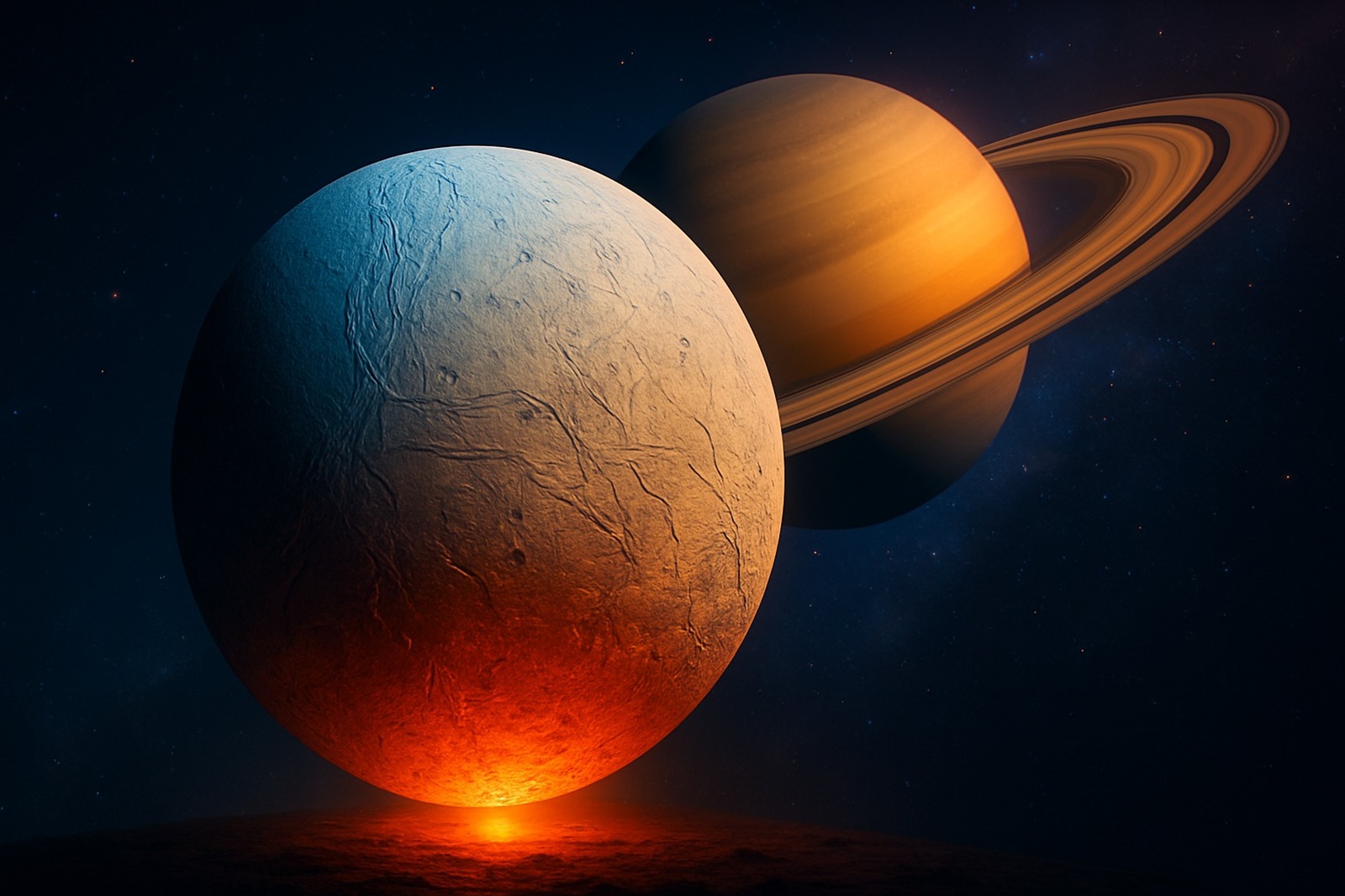
Discovery Made With Data From The Cassini Probe Reveals That The North Pole Of Enceladus Also Releases Heat, Indicating Energy Balance And Sustaining A Salty Subsurface Ocean Capable Of Supporting Life
Scientists have discovered that Enceladus, one of Saturn’s moons, possesses the long-term stability necessary for the development of life. A new study revealed the first evidence of significant heat flow at the moon’s north pole, overturning previous assumptions that heat loss was concentrated only at the south pole, known for its intense geological activity.
The discovery indicates that Enceladus is emitting much more heat than expected from a passive icy body, strengthening the hypothesis that it may harbor some kind of life.
An Active And Promising Subsurface World
Enceladus is a highly active body, with a global salty subsurface ocean, which appears to be the main source of the detected heat. The presence of liquid water, combined with chemical elements like phosphorus and complex hydrocarbons, makes its subsurface ocean one of the most promising environments in the solar system for the emergence and maintenance of life.
-
How the terraforming of Mars can transform the planet: artificial aerosols can increase the temperature by up to 35°C in 15 years, creating conditions for liquid water.

-
Scientists drilled nearly 8,000 meters into the ocean floor above the fault that caused the 2011 tsunami in Japan and discovered that a layer of clay 130 million years old was responsible for making the wave much worse than any model had predicted.
-
Thousands of years after causing the largest eruption of the Holocene, one of the world’s largest supervolcanoes is rebuilding itself beneath the sea south of Japan, receiving new magma and alarming scientists with its transformation.
-
China has activated a magnet 700,000 times more powerful than the Earth’s magnetic field that operates for over 200 consecutive hours while consuming little energy, and now the world wants to know what Beijing plans to do with this technology in 2026.
The study was conducted by a team of scientists from the University of Oxford, the Southwest Research Institute, and the Planetary Science Institute in Tucson, Arizona. The researchers emphasize that life would only be possible if the moon’s subsurface environment remains stable over time, with a balance between the energy it receives and the energy it loses.
This balance is maintained by what is called tidal heating, a phenomenon caused by Saturn’s gravity. The planet exerts a force that stretches and compresses Enceladus during its orbit, generating internal heat. If the moon were to lose energy, its surface would become inactive and the ocean could freeze. Conversely, if the energy gain were excessive, the activity would increase to the point of drastically altering the oceanic environment.
Enceladus: One of The Main Targets In The Search For Life
“Enceladus is a fundamental target in the search for life beyond Earth, and understanding the long-term availability of its energy is crucial to determining if it can support life,” explained Dr. Georgina Miles from the Southwest Research Institute and a visiting scientist in the Physics Department at the University of Oxford, the lead author of the paper.
So far, direct measurements of the moon’s heat loss had only been made at the south pole, where jets of ice and water vapor are ejected from deep fissures in the surface. The north pole, on the other hand, was considered geologically inactive.
Using data collected by NASA’s Cassini probe, scientists compared thermal images and measurements of the northern region during two periods: in the winter of 2005 and in the summer of 2015. This comparison allowed them to estimate the amount of energy that the subsurface ocean, with temperatures close to 0°C, releases as it passes through a thick layer of ice, whose surface reaches about -223°C, before radiating heat into space.
Thermal Sustainability Reinforces Chances Of Life
“Understanding the amount of heat that Enceladus is losing on a global scale is crucial to knowing if it can support life,” highlighted Dr. Carly Howett, co-author of the study and researcher in the Physics Department at Oxford and the Planetary Science Institute in Tucson.
She added that the new results point to long-lasting thermal sustainability, something considered one of the main requirements for the emergence of life. “It’s really exciting that this new result supports the long-term sustainability of Enceladus, a crucial component for the development of life,” she stated.
Scientists are now planning to determine how long the subsurface ocean has existed. This information is essential for estimating whether the moon has had enough time for biological processes to develop. So far, the age of Enceladus’ ocean remains uncertain.
Ice Layer Can Reach Almost 30 Km Deep
In addition to discoveries about heat flow, the study demonstrated that thermal data can help estimate the thickness of the ice layer covering the ocean. This metric is considered fundamental for future space missions planning to explore the moon’s interior, perhaps through robotic probes or specialized submersibles.
Measurements indicate that the ice is between 20 and 23 kilometers thick at the north pole and an average of 25 to 28 kilometers globally. These numbers are slightly higher than estimates obtained by previous remote sensing and modeling techniques.
The result provides a new reference for models trying to understand how tidal heating, the internal structure, and the long-term evolution of Enceladus’ ocean are interrelated.
These findings strengthen the view that Saturn’s moon is one of the most promising places for future investigations into the existence of life beyond Earth, remaining at the center of scientific priorities for upcoming space missions.










Seja o primeiro a reagir!