





 Portuguese
  English
  Spanish
  5 min of reading
  0 comments


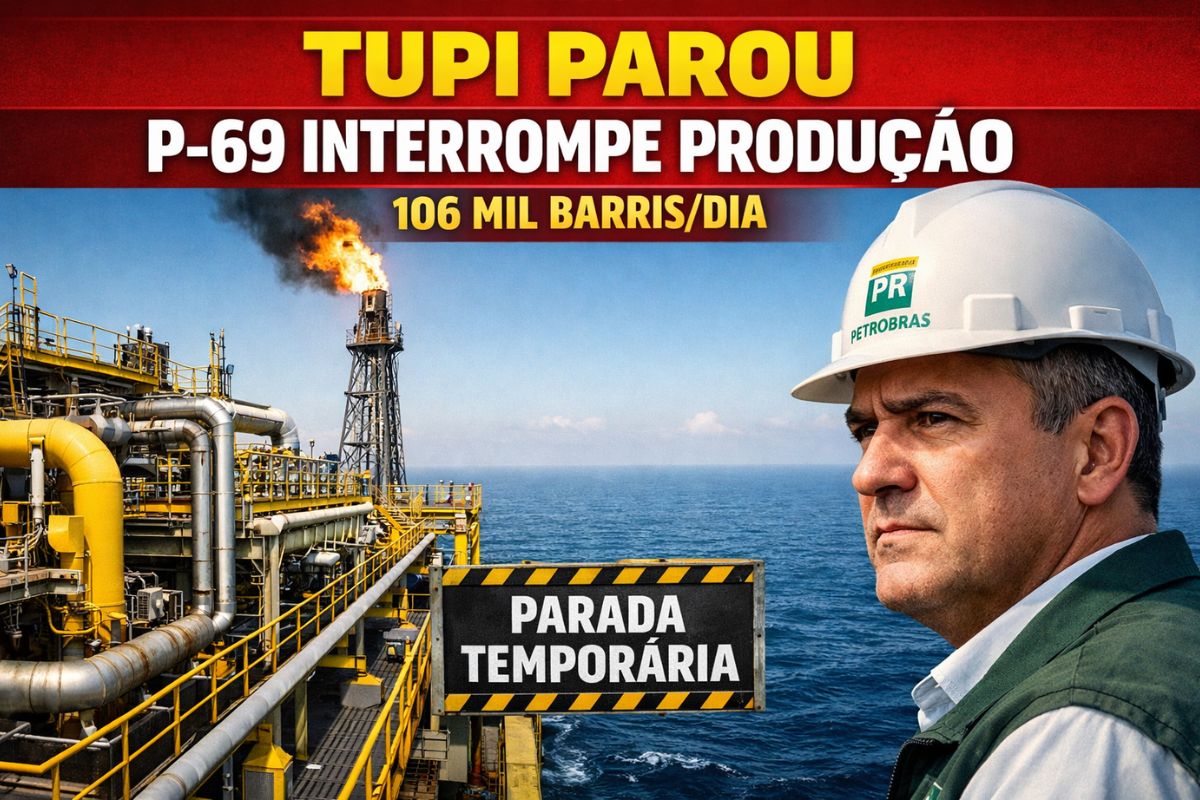
Amid the Strike of Oil Workers, Petrobras Halts Tupi P-69 Platform for Safety Procedure, Resumes Operations the Same Day, and Affirms That Production and Supply Remain Normal.
When Petrobras halts Tupi P-69, one of the most important units of the pre-salt region in the Santos Basin, any movement is closely monitored by the market. That’s what happened on Monday when the company temporarily suspended production at the unit for a safety procedure and confirmed that the stoppage lasted only a few hours until operations resumed.
The P-69 operates in the Tupi field, on the southern coast of Rio de Janeiro, and is among the largest producers in the country, averaging 106 thousand barrels per day in October, according to the latest data from ANP.
In informing that Petrobras halted Tupi platform for technical reasons related to safety, but does not detail what caused the interruption or the exact moment it occurred, the company tries to balance operational transparency with risk management in an environment already pressured by the strike of part of the workers.
-
Lula reveals a masterstroke by Petrobras to undo a deal made by Bolsonaro, which involves the return of an important refinery that currently produces less than half of what was expected and makes Brazil dependent on international diesel.
-
A study confirms that the natural gas sector will reduce greenhouse gas emissions in Brazil by 0.5% and accelerate the energy transition by 2026.

-
Petrobras implements a severe adjustment and confirms a 55% increase in the price of aviation kerosene with a proposal for installment payments for the companies.

-
The rise in oil prices could ensure an extra revenue of R$ 100 billion for the Federal Government, indicates a recent economic study.


What Is Known About the Stoppage of P-69
The company described the stoppage of P-69 as a routine safety procedure, without linking the episode to serious failures, accidents, or immediate risks to the structure.
According to the statement, “the production of P-69 was resumed in a few hours and is being normalized”, which indicates that the suspension was punctual and controlled.
At the same time, the fact that Petrobras halted Tupi platform even for a short time draws attention because P-69 is a relevant piece on the pre-salt stage.
The unit is part of the set of platforms that support a significant part of national production and, therefore, any interruption, even brief, is monitored closely by those tracking oil supply, state revenues, and operational stability in the Tupi field.
The Weight of P-69 in the Tupi Field and the Pre-Salt
The Tupi field was the first significant symbol of Brazil’s breakthrough in the pre-salt region and remains among the most relevant areas in the company’s portfolio. Within this context, P-69 stands out for its volume and production consistency.
With about 106 thousand barrels per day in October, the platform ranks among Brazil’s largest producers, helping to keep the country in a prominent position in the global oil market.
When Petrobras halts Tupi platform P-69, even if for hours, there is a natural concern about possible ripple effects, either on other units in the field or on the production schedule.
By stating that production has already resumed and is being normalized, the company signals that it sees no structural impact on the field’s curve, reinforcing the message that this was a preventive action, not an open operational crisis.
Ongoing Strike and Conflicting Versions Regarding the Cause of the Stoppage
The stoppage of P-69 happens amid a strike by Petrobras workers that began on December 15, which adds a political layer to the episode.
For the Sindipetro Litoral Paulista (Sindipetro-LP), linked to the National Federation of Oil Workers (FNP), the interruption in production at the unit would have been a direct consequence of the strike.
However, the company rejects this interpretation. In a statement, Petrobras claims that the strike did not impact production and that supply to the market remains guaranteed, with no significant changes.
According to the company, contingency teams were mobilized when necessary to maintain operations, even in strategic areas such as the pre-salt region of the Santos Basin.
This divergence of narratives means that, in practice, the discussion about why Petrobras halted Tupi platform also has a component of dispute between the union and the company at a time when part of the workforce has already ended the strike while another part continues with stoppages.
Who Continues on Strike and Who Has Already Returned to Work
Several oil workers’ unions decided to end the strike the previous week, after the Unified Federation of Oil Workers (FUP), which represents 13 unions, indicated acceptance of a proposal presented by Petrobras.
In these cases, workers began to resume their routines, with minor adjustments in schedules and team compositions in both land and offshore units.
On the other hand, four unions affiliated with the FNP, including Sindipetro-LP, decided to maintain the stoppages, arguing that the proposal still does not meet the movement’s agenda.
As a result, the strike remains active in part of the company’s operational structure, while Petrobras emphasizes that production is preserved, and supply remains regular, even in areas where contingency teams’ efforts are most intense.
Operational Safety in Focus and Silence on Technical Details
In informing that Petrobras halted Tupi platform P-69 for a safety procedure but chooses not to disclose which systems prompted the action or on what exact day the stoppage began, the company leaves some questions unanswered.
Nonetheless, the official narrative highlights that there was no impact on supply and that the measures taken follow the company’s risk management standards, which traditionally emphasizes strict protocols in pre-salt units.
This type of posture is relatively common in large offshore operations, where pointed stoppages for adjustments, inspections, or equipment testing are part of the routine, although they rarely receive such public attention.
What makes this case different is the context: an ongoing strike, union statements attributing the stoppage to the strikes, and a field that symbolizes the country’s production.
What Is at Stake When Petrobras Halts Tupi Platform
In the short term, everything indicates that the stoppage of P-69 will not have significant effects on production numbers or on market supply.
Petrobras itself emphasizes that production was resumed in a few hours and that supply to customers remains within normality.
In the medium term, however, episodes like this fuel debates about operational safety, transparency in incident communication, and the company’s ability to navigate strike periods while maintaining investors’ and consumers’ confidence.
When Petrobras halts Tupi platform for safety reasons and quickly resumes operations, the message the company tries to convey is one of control over the situation.
Unions, on the other hand, seek to emphasize that the mobilization of the workforce has enough strength to impact the routine of strategic units.
In the background, the perception remains that platforms like P-69 are critical assets, both for the company’s revenue and for public revenue and the balance of fuel supply in the country.
Any sign of instability, even if temporary, is closely monitored by the market, government, workers, and consumers.
And you, how do you evaluate this episode in which Petrobras halted Tupi platform P-69 for safety: a sign that the protocols are working as they should or an indication that the operation is under more pressure than the company admits?






Seja o primeiro a reagir!