





 Portuguese
  English
  Spanish
  5 min of reading
  0 comments


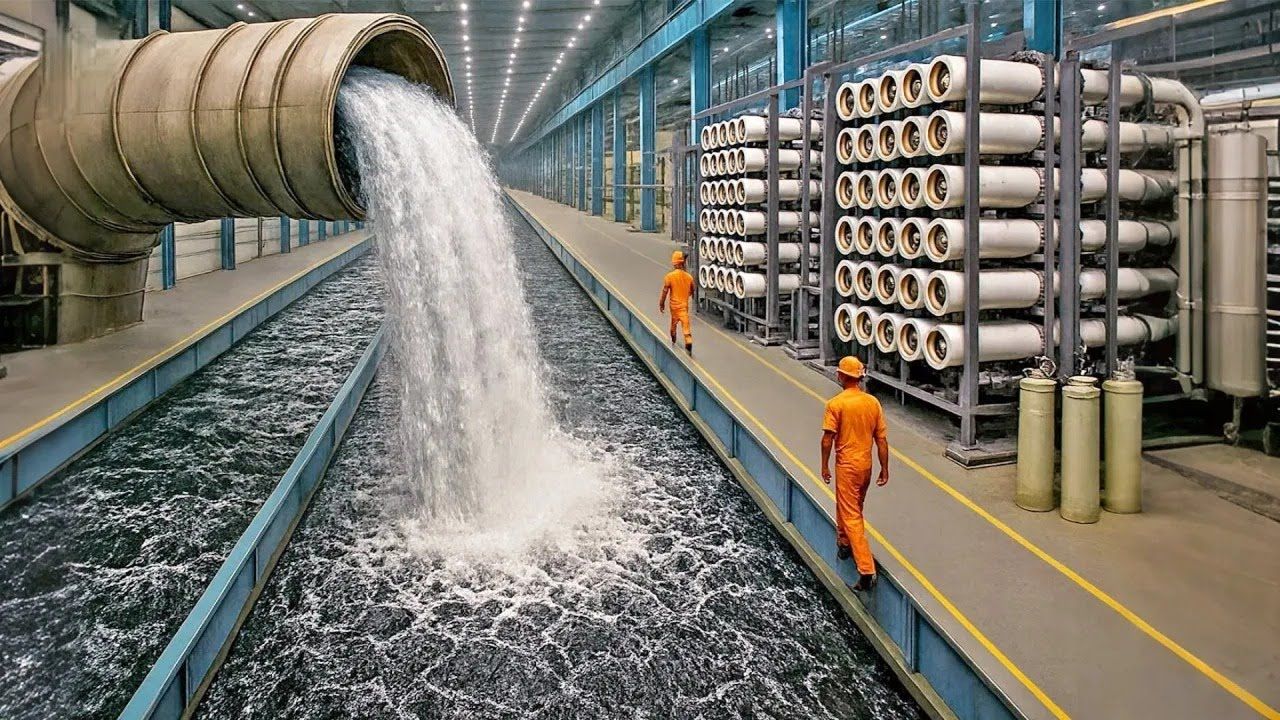
With Reverse Osmosis and Advanced Disinfection, Modern Stations Recycle Water from Bathrooms and Sewer Systems, Delivering Safe Crystal-Clear Water and Changing the Future of Cities and Industries.
Have you ever imagined that the water in your glass could have come from a bathroom? It sounds shocking, but the technology that makes this possible exists and is scaling up, with reverse osmosis at the center of the process to turn wastewater into safe drinking water.
What was once seen as “waste” enters a closed-loop regeneration process, going through successive stages of solid removal, biological treatment, filtration, and disinfection.
In the end, what comes out is crystal-clear water, ready for consumption and industrial use, with monitoring and quality control at every stage.
-
Worlds covered by water, atmospheres filled with hydrogen, and the possibility of life beyond Earth: ocean planets are rewriting the map of cosmic search and forcing scientists to rethink where to look.

-
Argentina achieves the unimaginable after more than 110 years and reintroduces the largest native herbivore of South America to the Chaco to restore a lost link in nature.

-
Returning to the Moon now costs a billion-dollar bill and reignites the competition between the USA and China for science, technology, and rare minerals on lunar soil.

-
While the world looks at oil, the war with Iran is already disrupting helium supply from Qatar, affecting car and iPhone chips, threatening AI expansion, and putting pressure on aluminum packaging at the highest value in four years.


From Sewage to Closed System: Water Is Not Discarded, It Is Regenerated
In specialized facilities, water from toilets, drains, sinks, and showers does not simply vanish. It is directed to a treatment chain where each stage has a clear function: to bring order to the chaotic flow and remove what shouldn’t go further.
The process starts with mechanical barriers that retain large debris and prevent blockages. Then, water passes through sand chambers and heavy particle separation, as well as the removal of grease and floating foam on the surface. This “rough cleaning” is what protects the rest of the system.
Primary Treatment: Settling to Remove What Sinks and What Floats

In the primary phase, water enters settling tanks, where the speed decreases and the heavier material settles at the bottom, forming sludge. At the surface, equipment removes grease and floating debris, leaving a clearer intermediate layer.
This stage does not seek “perfection.” It prepares the ground for the next step, because without this initial separation, the solids load could overload biological treatment and reduce the efficiency of what comes next. It’s the first major shift from a murky liquid to a controlled flow.
Biological Treatment: Microorganisms Do the Invisible Work
After primary settling, water enters aeration tanks. In this environment, aerobic microorganisms consume and break down a significant portion of the remaining organic compounds, working day and night in a constantly oxygenated mixture.
Next, the water goes through secondary settling, where the flakes formed by activated sludge settle and “pull” any remaining organic matter.
The water already looks cleaner, but it’s still not ready: dissolved impurities and microorganisms require advanced treatment.
Advanced Filtration and Reverse Osmosis: The Heart of Purification

When it reaches the fine filtration stage, membranes come into play that act as ultrathin barriers, blocking microscopic particles and microorganisms that would escape the naked eye. This is a decisive screening before the central step.
Then comes reverse osmosis. Under high pressure, water is forced through semipermeable membranes with extremely small pores, capable of retaining minerals, heavy metals, chemical residues, and traces of unwanted substances.
Reverse osmosis performs separation molecule by molecule, allowing only highly purified water to proceed.
Advanced Disinfection and Mineral Rebalance: Safety and Taste
Even after reverse osmosis, there are still final steps to ensure safety. The system performs final disinfection, with features such as ultraviolet light and, in some cases, small doses of disinfectant to eliminate remaining pathogens and maintain protection throughout storage and distribution.
Since reverse osmosis removes almost all minerals, the water can taste “empty.” Therefore, mineral rebalance occurs with controlled addition of elements like calcium, magnesium, and bicarbonate, adjusting pH and flavor. It’s the polishing that turns purity into pleasant drinking water.
Real-Time Monitoring: Sensors, Laboratory, and Quality Standards
This chain only works with continuous supervision. Sensors monitor parameters such as turbidity, pH, and disinfection levels, while samples are analyzed in a laboratory to validate clarity, minerals, and safety.
The logic is simple: recycled water needs to be reliable. Thus, reverse osmosis appears as part of a larger system, where each result is verified and compared to quality standards, from start to finish in the circuit.
Sludge Turns into Energy and Fertility: Waste Closing the Cycle
As the water moves on to purification, the sludge separated during settling enters another journey.
It is directed to anaerobic digesters, where microorganisms act without oxygen and generate biogas, such as methane, which can be harnessed for the plant’s own energy.
Afterward, the remaining material can turn into biosolid, rich in nutrients, with the potential for use as soil conditioner, closing a recycling cycle. Here, sustainability is not a slogan: it’s engineering applied to everyday life.
From Environmental Solution to Billion-Dollar Industry: Global Production Scale
Recycling water has ceased to be experimental technology and has become an operational solution. The base text points to a treatment and recycling market approaching tens of billions of dollars per year, with countries like the United States, Israel, Singapore, and Brazil producing hundreds of millions of gallons of purified water daily.
This growth happens out of necessity and for economic reasons. Reverse osmosis allows transforming scarcity into supply, sustaining urban and industrial demands with predictability and an increasingly invested infrastructure model.
Beyond Sewage: Reverse Osmosis Also Transforms Seawater into Potable Water
The same principle can be used in desalination. Seawater undergoes pre-filtration to remove algae, sediments, and debris, and then proceeds to reverse osmosis, where salt and other substances are separated.
After reverse osmosis, mineral rebalance and disinfection occur once again, and only then does the water go to tanks and the distribution network. It’s a complete cycle that expands possible sources of supply, beyond rivers and reservoirs.
Would you drink water produced with reverse osmosis from sewage, knowing it goes through advanced filtration and disinfection, or would you still hesitate because of its origin?






-

-

2 pessoas reagiram a isso.