





 Portuguese
  English
  Spanish
  4 min of reading
  0 comments


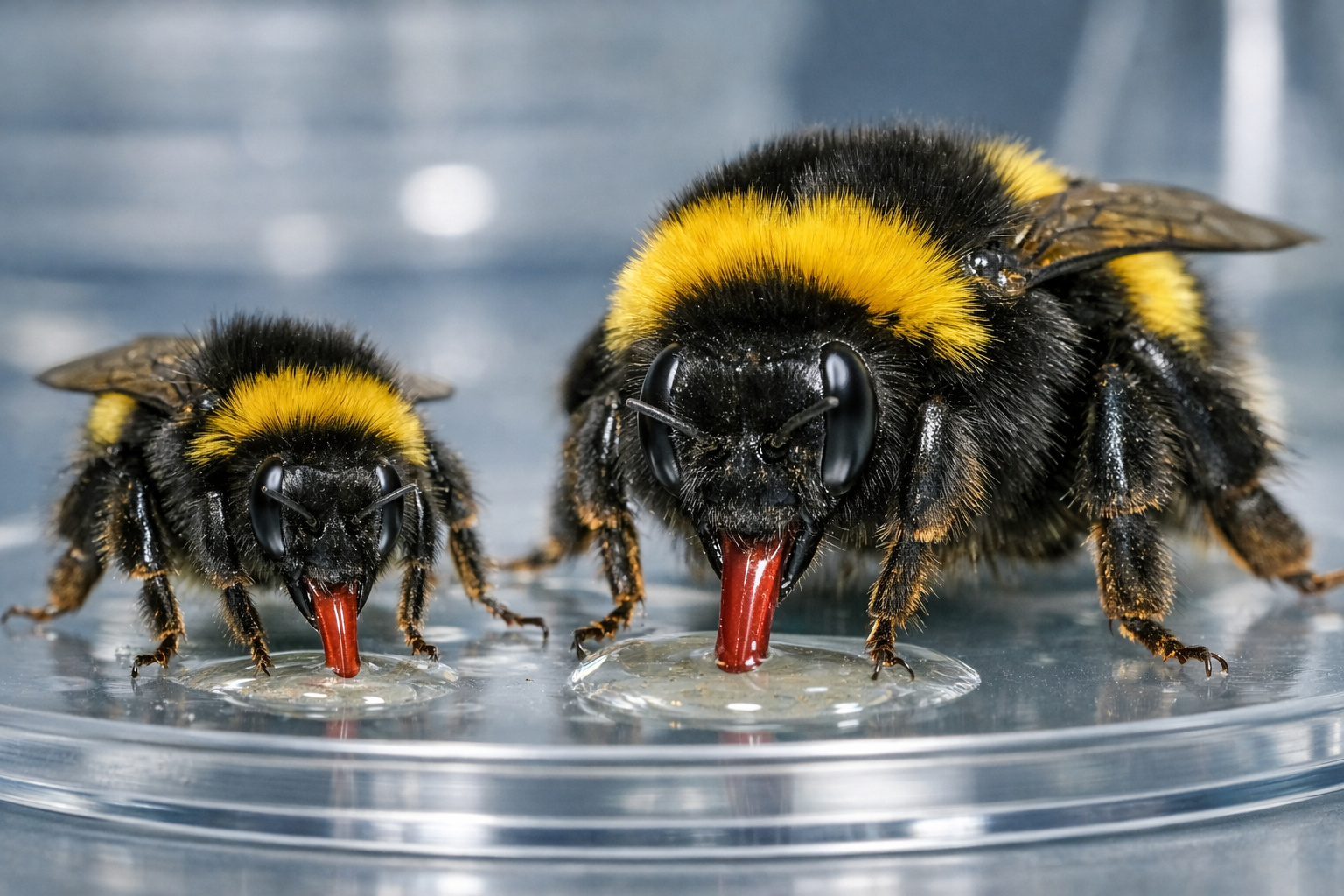
Scientific Study Reveals That Microscopic Differences in Queen Bees’ Tongues Drastically Reduce Their Efficiency When Sucking Nectar, Influence Task Division in the Colony, and May Impact Agricultural Pollination
Queen bees play a central role in the survival of any colony, but a new scientific study revealed that these leaders have an unexpected physical limitation that directly affects their ability to gather food. Although they are larger, longer-lived, and biologically essential, queen bees are not as efficient as workers when it comes to sucking nectar from flowers.
Right at the beginning of spring, these solitary females emerge from hibernation and start building a new colony on their own, searching for flowers and consuming nectar for energy. However, as soon as the first offspring are born and mature, something curious happens: the queens practically abandon external work and begin to remain almost exclusively in the nest.
The information was published in a study released on January 12, 2026 in the scientific journal Proceedings of the National Academy of Sciences (PNAS), which investigated subtle but decisive physical differences between queen bees and worker bees.
-
With a cost per shot close to zero, the DragonFire laser could change naval warfare in 2027 and provide British ships with nearly unlimited defense against drones.

-
A British startup creates tires that generate electricity in electric vehicles when passing over potholes, speed bumps, and cracks.

-
Scientists have created robots made with living cells that have their own nervous system, swim on their own, explore the environment, and self-organize without any genetic engineering, and now they want to do the same with human cells.

-
Students create a solar-powered ambulance that operates without a plug, without fuel, and still keeps medical equipment running in remote areas.


Microscopic Differences in Tongues Explain Unequal Efficiency

For decades, scientists have tried to understand why queen bees cease foraging as soon as the workers take on this role. Until now, hypotheses involved hormonal changes, metabolic differences, or an evolutionary strategy known as task specialization, where the queen concentrates all her energy on laying eggs.
However, researchers decided to observe a detail often overlooked: the anatomy of the tongue. For this, the team analyzed the mouthparts of 99 buff-tailed bumblebee specimens, including 32 queens and 67 workers, using high-powered microscopes.
The results revealed that the tongues vary between 4 and 10 millimeters in length and are covered with tiny hairs. While the tongues of queens are generally longer, they have fewer hairs than those of workers. This difference, though subtle, has a direct impact on how nectar is absorbed.
While workers have a dense layer of hairs, creating small spaces that facilitate the suction of the liquid, queens have larger gaps between these hairs, which reduces their efficiency in gathering nectar. Thus, even though they are larger, they end up being less productive in feeding.
Capillarity: The Physical Phenomenon Favoring Workers

To better understand this mechanism, scientists recorded high-speed videos of bees sucking artificial nectar in the laboratory. The footage showed that workers are able to absorb the liquid much more quickly and consistently.
This happens thanks to a physical principle known as capillary action. This phenomenon occurs when the molecules of the liquid are more attracted to solid surfaces — in this case, the hairs of the tongue — than to each other, causing the fluid to “rise” and fill the small available spaces.
According to Patrick Spicer, an engineer specialized in fluid dynamics from the University of New South Wales, previously cited in an interview with New Scientist, “the space between the hairs can pull the fluid in due to capillary action.”
As workers have denser and well-distributed hairs, they create extremely efficient microchannels for sucking nectar, while queens, with fewer hairs, lose part of that capacity. This technical detail helps explain why queens are less efficient outside the nest.
Tests with Different Nectars Confirm Queens’ Limitation
To reinforce their findings, the researchers conducted additional tests, offering bees different types of artificial nectar, varying the proportion of water and sugar. The results were consistent.
The worker bees managed to suck all types of nectar, from the most liquid to the thickest. Meanwhile, queen bees performed better only with thicker and less diluted nectars, similar to concentrated syrups.
According to the scientific paper, there is a “scale mismatch” between the length of the queens’ tongues and the spacing of the hairs, which limits their ability to capture liquids efficiently. This physical factor, combined with reproductive demands, contributes to them remaining inside the nest after the colony is formed.
As noted by Science News, in a report by Emily Conover, the discovery helps solve an ancient mystery of bee biology and sheds light on how small anatomical variations can influence the social organization of insects.
Impacts for Pollination and Agriculture
In addition to its scientific value, the discovery may have important practical implications. Beekeepers and farmers who rely on pollination may benefit from this new understanding of the insects’ foraging efficiency.
According to Saad Bhamla, a biophysicist at the Georgia Institute of Technology who was not involved in the research, understanding how the hairs on the tongue influence nectar collection could help predict which flowers are more suitable for certain species of bees and how environmental changes affect their survival.
In a scenario of global decline in pollinators, understanding even the microscopic details of bees’ bodies becomes essential. Small physical limitations, such as this discovery concerning the tongues of queens, can have cascading effects on entire ecosystems and global food production.
With information from: Smithsonian Magazine







-

-

-

-

5 pessoas reagiram a isso.