





 Portuguese
  English
  Spanish
  5 min of reading
  1 comment


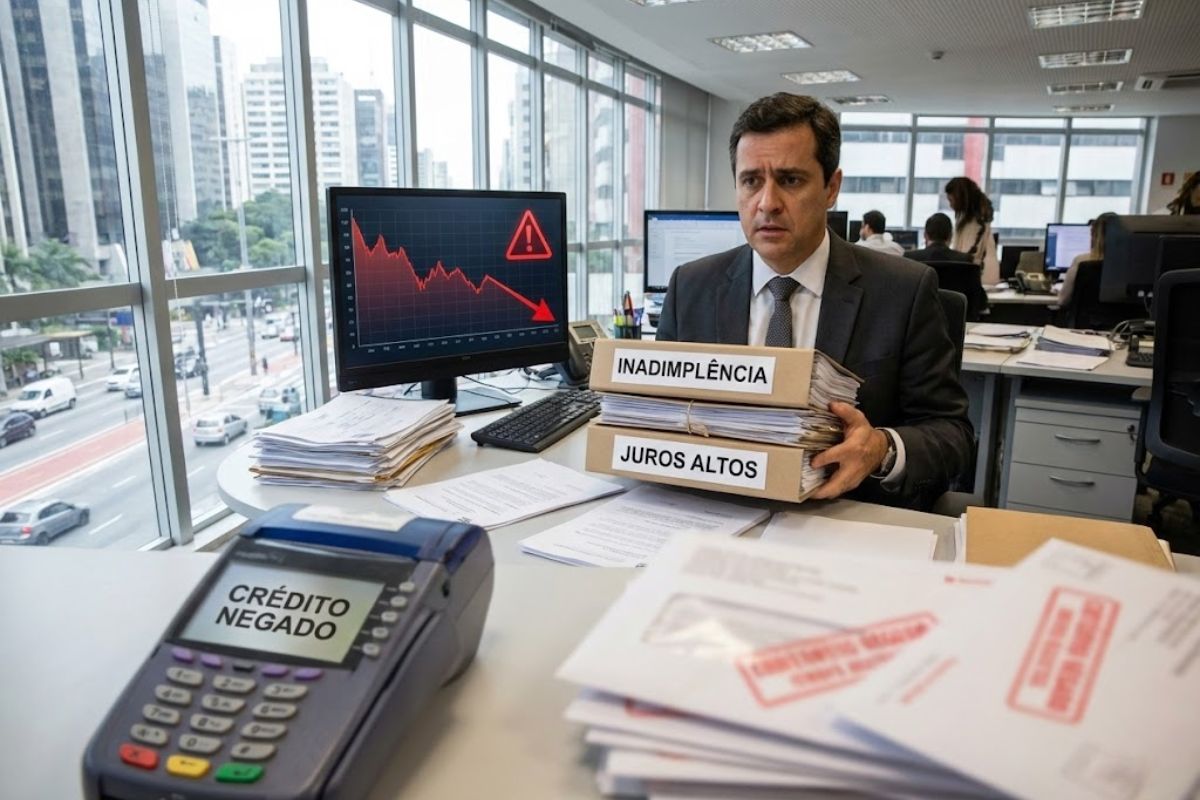


Delinquency in September 2025 Hits Historic Record, With 8.4 Million Negative CNPJs and More Than R$ 200 Billion in Debts, Suffocating Micro and Small Businesses, Increasing Credit Costs, Stalling Investments, While High Interest Rates and Heavy Collections Impact Services, Trade, and All Regions Across the Country Today.
The delinquency of Brazilian companies exploded in September 2025, when the number of negative CNPJs reached 8.4 million and the volume of debts surpassed R$ 200 billion, according to data from Serasa Experian, the highest level ever recorded in the historical series. This data raises a warning about the risk of mass bankruptcy among smaller businesses, which sustain a large part of employment in the country.
According to economist Camila Abdelmalack from Serasa Experian, the record delinquency reflects the combination of high interest rates, a slowdown in credit granting starting in the second half of 2025, and a weakening of economic activity, factors that have been eroding costs, revenue, and cash flow for companies since 2024. With more expensive and selective credit, many ventures have lost their ability to meet commitments and have been pushed into delinquency.
Micro and Small Businesses Concentrate the Largest Part of Delinquency
Out of the 8.4 million negative CNPJs in September 2025, 7.95 million belong to micro, small, and medium-sized enterprises, according to Serasa Experian.
-
The institute that trained the greatest aerospace engineers in Brazil has just opened its first campus outside São Paulo after 75 years: ITA Ceará will have R$ 445 million, new courses in energy and systems, and classes are expected to start in 2027.

-
Luciano Hang, owner of Havan, goes to Juiz de Fora after the tragedy in February, brings R$ 1 million, hands out R$ 2,000 cards, and donates up to R$ 15,000 to victims in the region.

-
The Brazilian passport allows legal residence in dozens of countries without the need for a prior visa, and most Brazilians are unaware that they can apply for residency directly upon arriving in nations in South America, Africa, and even Europe.

-
Petrobras sends a message to Brazilian truck drivers after fuel collapse and reveals plan to have 100% domestic diesel.


Within this universe, about 20 percent are MEI, a group that usually has little financial breathing room to face long periods of declining sales and intense creditor pressure.
In practice, this means that delinquency is crushing primarily those who have less margin for error.
Small neighborhood shops, local service providers, and individual microentrepreneurs are facing delays in invoices, pressing suppliers, timely rent, and rising bank fees, which quickly reduces any cash surplus.
Average Debt Grows and Tightens the Cash Flow of Small Businesses
The average debt per delinquent company reached R$ 24,074.50 in September 2025, an increase of 9.5 percent compared to the same month in 2024.
The average overdue account amount was R$ 3,331.30. For large corporations, these amounts may seem small, but for a MEI or a microenterprise, they drain cash flow and quickly push the CNPJ into the red.
With several relatively “low” accounts overdue at the same time, the entrepreneur ends up working only to pay interest and fines.
Each new delay becomes a snowball and increases delinquency, making it more difficult to obtain new credit under minimally sustainable conditions.
Services Lead Negative Accounts and Banks Concentrate a Significant Portion of Debts
The services sector accounts for 54.7 percent of negative enterprises, followed by trade at 33.2 percent.
This means that bars, restaurants, beauty salons, workshops, retailers, and service providers in general are on the front line of delinquency.
When examining the origin of the debts, the situation is also concerning. Services account for 32.1 percent of the total owed, while banks and credit card companies account for 19.5 percent.
In practice, this shows that a large part of corporate delinquency is linked to the use of expensive bank and financial credit to keep the business afloat.
Installments on credit cards, lines of credit with high-interest rates, and successive renegotiations end up becoming a trap.
The credit that should be an emergency solution ends up feeding the problem, leaving the entrepreneur trapped in cycles of debt renewal without effectively reducing the indebtedness balance.
Southeast Pulls Number of Negative CNPJs, But the Problem is National
The concentration of companies in the red is greater in the Southeast states, where 4.5 million CNPJs appear as negative.
In the South, the total reaches 1.3 million. The Northeast sums 1.2 million delinquent firms, the Midwest records 729 thousand, and the North, 499 thousand.
The numbers show that corporate delinquency is not an isolated phenomenon in a specific region, but a problem spread across the country’s map, with a direct impact on employment, local investments, and tax collection.
In many municipalities, the combination of indebted small businesses and falling consumption reduces the circulation of money in the real economy.
Tougher Credit and High Interest Rates Feed the Vicious Cycle of Delinquency
According to Camila Abdelmalack, there was a strong expansion of credit in 2024, but the scenario changed rapidly.
With the increase in delinquency, banks and other creditors became more stringent in granting new loans and renegotiating debts.
The result is a vicious cycle where delinquent companies have more difficulty accessing credit precisely when they need it most.
Micro and small businesses feel this pressure more because they do not have access to the sophisticated financial instruments used by large corporations to extend terms and reorganize liabilities. With less credit available and high-interest rates, working capital disappears, suppliers tighten, and the risk of bankruptcy increases.
On the revenue side, the weakening of economic activity and weaker household consumption also weigh in. Since a large part of sales depends on consumer credit, the reduction in the granting of credit to individuals reduces the cash flow of small businesses and feeds back into delinquency. Without new cash inflow, the only option is to cut costs and try to negotiate terms, often unsuccessfully.
Failures in Financial Management Increase the Risk for Microentrepreneurs
In addition to macroeconomic factors, the economist points out a structural problem. Many microentrepreneurs and small business owners focus practically all their energy on operations, that is, on selling the product or providing the service, while leaving financial management as a secondary concern.
Without strict control of cash flow, payment terms, and margins, delinquency appears as an almost inevitable consequence in times of crisis.
In periods of stronger economic activity, this fragility may go unnoticed because stronger revenue helps cover planning errors.
But in a scenario of high interest rates, falling consumption, and growing delinquency, any carelessness in cash control, payment terms, or credit acquisition can quickly transform into unmanageable debt.
Among the measures that can help avoid extreme delinquency are closely monitoring accounts payable and receivable, negotiating terms with suppliers, avoiding mixing personal finances with those of the company, and seeking information on financial education and management tools.
In your view, what should be the number one priority to reduce the delinquency of Brazilian companies and prevent even more CNPJs from being suffocated by debt in the coming months?










Não é só os juros altos que estão levando as empresas à insolvência, mas, some-se a isso também, a pesada carga tributária, contrabando e concorrência desleal elevada em muitos dos segmentos da economia. O imbrólhio é grande para ser contornado rapidamente e a contento.
Vai demandar muito esforço do governo e da sociedade.
Vemos muita propaganda na TV e mídias sociais como se a vida das pessoas estivessem sendo transformadas rapidamente, mas a realidade das famílias é bem diferente do que está sendo mostrado.