





 Portuguese
  English
  Spanish
  5 min of reading
  0 comments


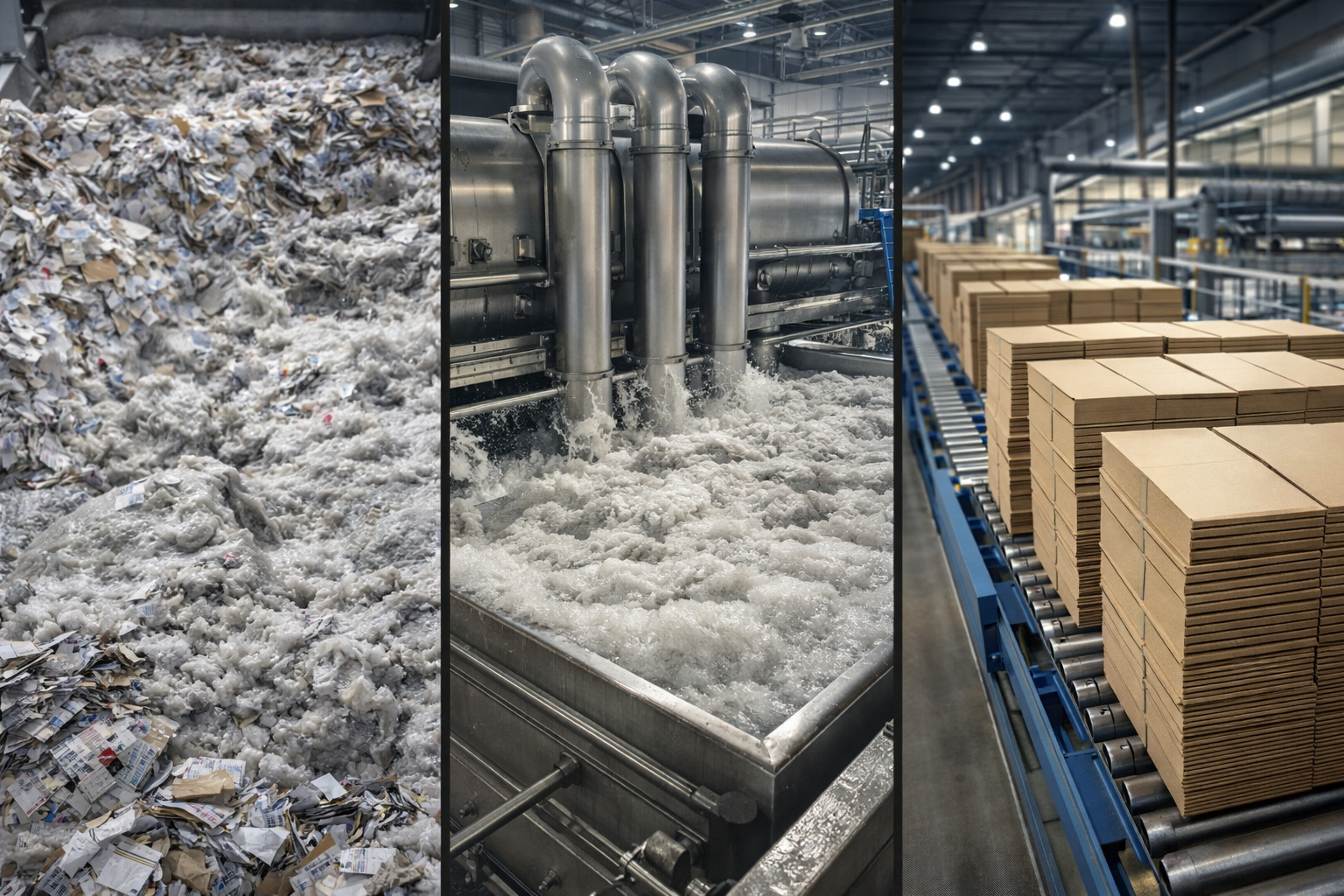
Understand How Used Paper and Cardboard Are Recycled on a Large Scale, from Disaggregation in Water to New Packaging That Drives Global Logistics.
Every day, billions of boxes, bags, printed sheets, and paper and cardboard packaging are discarded in homes, businesses, industries, and distribution centers around the world. What few people realize is that this continuous flow of waste supports one of the most silent and strategic industrial chains of the modern economy: the recycling of cellulose fibers. Without it, e-commerce simply would not exist at the current scale, global logistics would collapse, and the pressure on commercial and native forests would be much greater.
Paper recycling is not a simple or artisanal process. It is a heavy, highly mechanized industry that operates with thousands of tons per day, consumes large volumes of process water, uses advanced physical and chemical separation systems, and produces standardized raw materials for new packaging, technical papers, and graphic products. It is a complete industrial cycle, repeated millions of times a year.
The Starting Point: Collection and Sorting of Discarded Paper
The process begins outside the factories. Paper and cardboard need to be collected, separated, and classified. In Brazil, cooperatives of collectors, municipal selective collection systems, large commercial generators, and logistics centers are responsible for gathering this material. In Europe and parts of Asia, separation at the source is mandatory by law, which reduces contamination and increases the quality of the input.
-
Embrapa’s discovery reveals an unexpected advancement by allowing the production of seedlings from the caatinga using brackish water, opening a new frontier for farmers to face drought more efficiently.
-
6 sources of free fertilizer that you are throwing away every day and can transform your garden without spending anything.
-
With a water crisis on the radar, Sabesp invests in reclaimed water for data centers and transforms sewage treatment into a solution that saves millions of liters and protects public supply.
-
Foresea achieves 100% offshore waste reuse in 2025, eliminates landfill disposal, and consolidates sustainable strategy with 1,500 tons recycled.
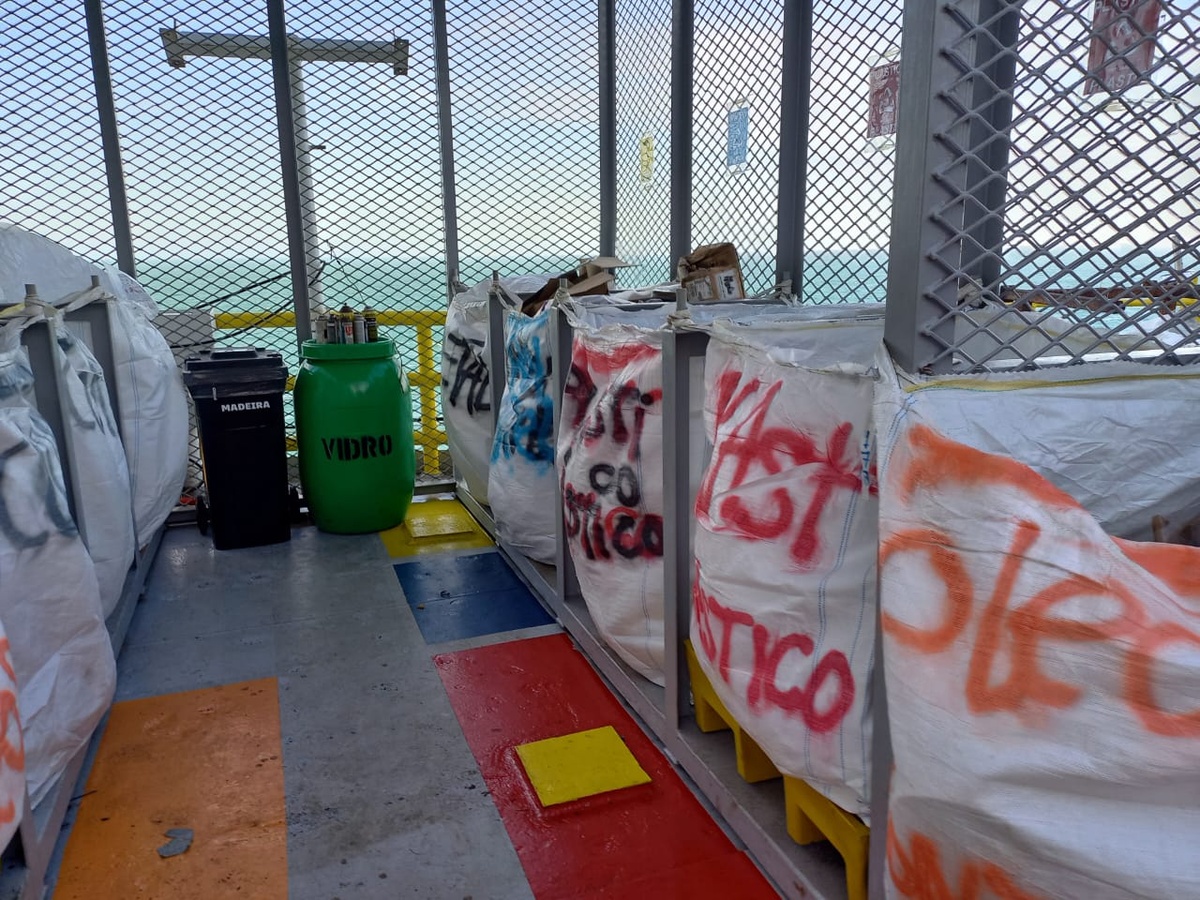


Not all paper is suitable for everything. Corrugated cardboard boxes, newspapers, magazines, office papers, carton packaging, and sanitary papers have different compositions of fibers, mineral fillers, and additives. Therefore, before entering the industry, the material goes through classification, separating white paper, mixed paper, corrugated cardboard, and special papers.
This care is essential because the type of fiber determines the final product. Recycled cardboard becomes new transport boxes. White paper can return as graphic paper or higher quality packaging. Contaminated papers with grease, organic residues, or chemicals are typically rejected.
Disaggregation in Water: Where Paper Ceases to Be Paper
Inside the factory, discarded paper enters huge tanks called hydrapulpers. There, large volumes of water are added, and rotating blades or high-power rotors promote the mechanical disaggregation of the material. The paper is not “melted,” but literally broken down into individual fibers.
At this stage, the paper returns to a state close to that of plant pulp. Staples, clips, plastics, adhesive tapes, and other non-fibrous contaminants begin to loosen and are removed by coarse sieve systems. In just a few minutes, tons of solid paper transform into a watery suspension of fibers.
This process consumes energy, but it is still much less intensive than producing paper from virgin wood. Moreover, a large part of the water used is reused internally, circulating in closed systems with continuous treatment.
Heavy Cleaning: Removing Everything That Is Not Fiber
After disaggregation, the pulp moves to a series of cleaning steps. Finer screens remove unwanted particles. Centrifugal separators use density differences to expel sand, glass, and heavy metals. Magnets capture remaining metallic residues.
This phase is crucial to ensure that the final material has industrial quality. Any contamination can compromise the strength of the packaging, cause structural failures, or damage equipment in subsequent stages.
In modern plants, optical sensors and automated systems continuously monitor the purity of the pulp, adjusting the process in real time.
Ink Removal: The Invisible Challenge of Printed Paper
One of the most sophisticated stages of paper recycling is ink removal, known as deinking. Newspapers, magazines, printed packaging, and office papers contain pigments, varnishes, and glues that need to be removed so that the fibers can be reused.
The most common method is flotation. Specific chemicals are added to the pulp, making the ink particles hydrophobic. Then, air bubbles are injected into the tank. The inks adhere to the bubbles and rise to the surface, forming a dark foam that is mechanically removed.
This process not only whitens the pulp but also improves the quality of the recycled fibers. Without it, the resulting paper would have uneven coloration and low industrial acceptance.
Recycled Fibers: How Long Do They Last?
A little-known fact is that paper fibers cannot be recycled indefinitely. With each cycle, they shorten and lose strength. On average, a fiber can be reused five to seven times before it becomes too short to make new paper.
Thus, the industry mixes recycled fibers with a portion of virgin fibers from planted forests. This balance maintains the mechanical strength of the packaging and ensures that the cycle is sustainable in the long term.
In corrugated cardboard used for transport boxes, for example, the proportion of recycled fibers can exceed 70%, depending on the application.
Formation of New Paper: From Pulp to Roll
After being cleaned, deinked, and adjusted, the pulp moves to the paper machine. There, it is spread over a moving screen, where water begins to be drained. Presses and heated rollers remove even more moisture, compacting the fibers into a continuous sheet.
In a few minutes, that watery suspension transforms into a solid strip of paper that can be several meters wide and kilometers long. This sheet is then rolled into large rolls, ready for cutting and conversion.
Depending on the destination, the paper may receive additional treatments, such as surface coating, weight adjustments, or application of layers to improve strength and performance.
Packaging That Sustains Global Logistics
A large part of recycled paper does not return as white sheets but as packaging. Corrugated cardboard boxes are the backbone of e-commerce, the food industry, pharmaceuticals, and consumer goods.
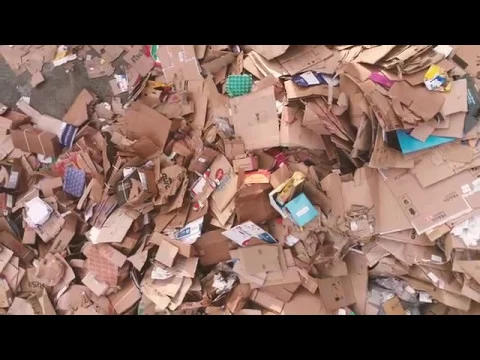
Without recycled paper, logistic costs would increase drastically. Plastics do not offer the same structural rigidity, and solid wood would be economically unviable. Recycled cardboard combines lightness, strength, low cost, and ease of recycling again after use.
Every box delivered by an e-commerce carries, in practice, fibers that have already circulated through the economy multiple times.
Real Environmental Impact: Less Trees, Less Energy, Less Emissions
Recycling paper significantly reduces the pressure on forests. Producing paper from recycled fibers consumes less energy and less water than producing it from virgin wood. It also reduces greenhouse gas emissions associated with logging, transporting, and processing wood.
Additionally, it prevents large volumes of paper from occupying landfills, where they would decompose slowly, releasing methane.
This system does not eliminate the need for planted forests, but transforms paper into a long-cycle material, reused multiple times before returning to nature.
An Invisible but Essential Industry
Paper and cardboard recycling rarely makes headlines, but it is a fundamental gear of the modern economy. It connects urban consumption, global logistics, heavy industry, and sustainability in a practical and continuous way.
While millions of people receive orders daily, few realize that each box is the result of a complex industrial process that begins in discarded waste and ends in high-speed production lines. It is a concrete proof that waste, when well-managed, is not the end of a cycle but the beginning of an even larger one.









-

-

2 pessoas reagiram a isso.