





 Portuguese
  English
  Spanish
 4 min of reading
  4 comments


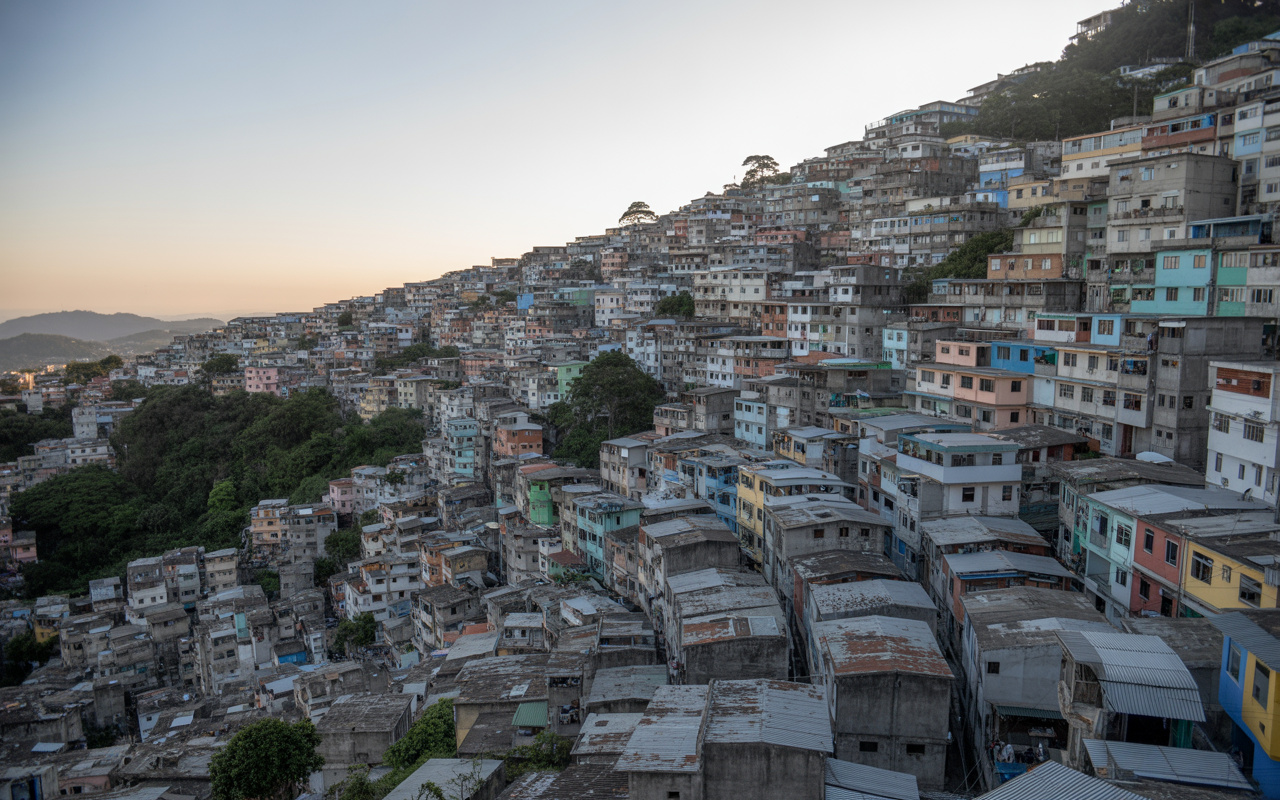


Rocinha, In The South Zone Of Rio de Janeiro, Houses Over 100 Thousand People In Less Than 1 Km², Making It The Densest And Most Vertical Community In Brazil.
Among the hills of the South Zone of Rio de Janeiro lies one of the largest expressions of urban density on the planet. In less than one square kilometer, a tangle of houses, staircases, and alleys houses over 100 thousand people, according to estimates from the City Hall and recent studies from PUC-Rio. This is Rocinha, the most populous and compact community in Brazil, where every square meter of land is contested and urban growth happens upwards, in a scenario of concrete upon concrete.
What began as a small cluster of houses in the 1930s has transformed into a pulsating urban organism— a territory with its own life, which grew without planning but with an impressive capacity for adaptation. The streets are narrow, some less than two meters wide, and the buildings rise one upon the other, without alignment, like pieces of an improvised mosaic that defies engineering logic.
One Of The Most Densely Populated Areas On The Planet
The average population density of Rocinha exceeds 40 thousand inhabitants per km², but in certain sections—like Rua 1, Rua Dionéia, and the Cachopa region— it surpasses 100 thousand people per km², a number comparable to overcrowded neighborhoods in Hong Kong, Manila, and Mumbai.
-
How an innovative city combines high technology, well-being, and sustainability to become the largest reference in clean energy on the planet.
-
Couple buys 1846 church in ruins for R$ 660,000, invests R$ 3.2 million in renovations, transforms it into a millionaire mansion, and even preserved a historic cemetery with over 300 graves.
-
He started running at 66 years old, broke records at 82, and is now a subject of study for having a metabolic age comparable to that of a 20-year-old, in a case that is intriguing scientists and inspiring the world.

-
Oldest tree on the planet reappears after 130 years of searches: Wattieza, 385 million years old, was 10 meters tall and had no leaves or seeds; Gilboa fossils in New York solved the mystery in 2007.


These figures are confirmed by surveys from the Instituto Pereira Passos (IPP) and the Brazilian Institute of Geography and Statistics (IBGE), which recognize Rocinha as the largest favela in the country. Even with only 0.84 km² of total area, it concentrates almost 70 thousand officially registered residents and tens of thousands unaccounted for, in constructions that multiply over the hills.

The improvised verticalization is one of the most striking characteristics of the landscape. The houses rise in concrete blocks, supported by exposed columns and reinforced by the residents themselves. It is common to find residences with five or six floors, where one family occupies each level, creating a microcommunity within the same building.
A Maze Where Space Is Never Enough
Anyone walking through the streets of Rocinha immediately perceives the challenge of mobility. Main streets quickly transform into narrow alleys, where only one motorcycle can pass at a time. Staircases crisscross in all directions, and electric cables overlap in webs that cover the sky.
The lack of space has led residents to reinvent land use. Small grocery stores, beauty salons, gyms, and even schools occupy the lower floors of the residences, while the upper floors expand on slabs, many of them turned into new levels. The result is a three-dimensional city where life occurs simultaneously on the streets, balconies, and rooftops.
Despite the density and challenges, Rocinha pulses with energy and vitality. There is a robust internal economy, with over 6 thousand small businesses, in addition to transport lines, bank branches, and even a popular shopping center. The neighborhood has become self-sufficient, a true city within a city.
Inequality Seen From Above
Rocinha is an extreme urban contrast. On one side, the sea, the beaches of São Conrado, and luxury buildings; on the other, concrete piling up the hillside. From above, it is possible to see the line that separates wealth from improvisation, asphalt from alleys, the planned from the spontaneous.
According to the Human Development Atlas, the local HDI hovers around 0.700, below the average for Rio de Janeiro, but above several peripheral regions of the country. This reveals a curious fact: even amidst the lack of infrastructure, there is an intense community effort to improve living conditions. Schools, NGOs, and cultural projects occupy spaces among the alleys, offering opportunities for education and income generation.
Growth Without Space And The Challenge Of The Future
The urbanization of Rocinha continues, but the physical space has reached its limit. The latest census showed that there are no more free areas for new horizontal constructions, and growth occurs almost exclusively through verticalization. This creates new structural risks and places pressure on essential services such as sanitation, energy, and transportation.

The Federal Government announced urbanization and land regularization projects, but the execution is progressing slowly. In the meantime, the population adjusts in the only way possible: building another floor, utilizing every slab, every square meter of available land.
A City Over Its Own Concrete
Living in Rocinha means coexisting with limits— the limits of space, silence, and even light. The sun barely touches the ground in the narrowest alleys, and the sounds of voices and motorcycles echo all day long. Still, there is a sense of belonging that runs through the neighborhood from end to end.
From afar, it looks like a pile of houses; up close, it reveals itself as one of the most complex and resilient communities on the planet, where improvisation has become architecture and coexistence is a daily art. Rocinha is more than a favela: it is a mirror of Brazilian urbanization— intense, unequal, yet alive.
Even compressed between walls and hillsides, this concrete city continues to grow, resist, and reinvent the meaning of what it is to live without space but with plenty of humanity.






Uma **** que fere a dignidade humana e desmoraliza o país.
Era pra desocupar as casas, demolir essa tralha toda e reurbanizar o local, como fez Portugal um tempo atrás… Agora, isso não passa de um antro dos barões das drogas…
Acabar com as favelas deveria já ter sido feita a tempo atrás por governos atrás, pois não é impossível é demorado como um grande projeto de nação com construção de casas em Vilas em regiões seguras bem construídas e empregar as pessoas em indústrias próximas juntas a iniciativa privada. As pessoas não precisariam se deslocarem como acontece atualmente que é um pesadelo.!!