





 Portuguese
  English
  Spanish
  6 min of reading
  0 comments


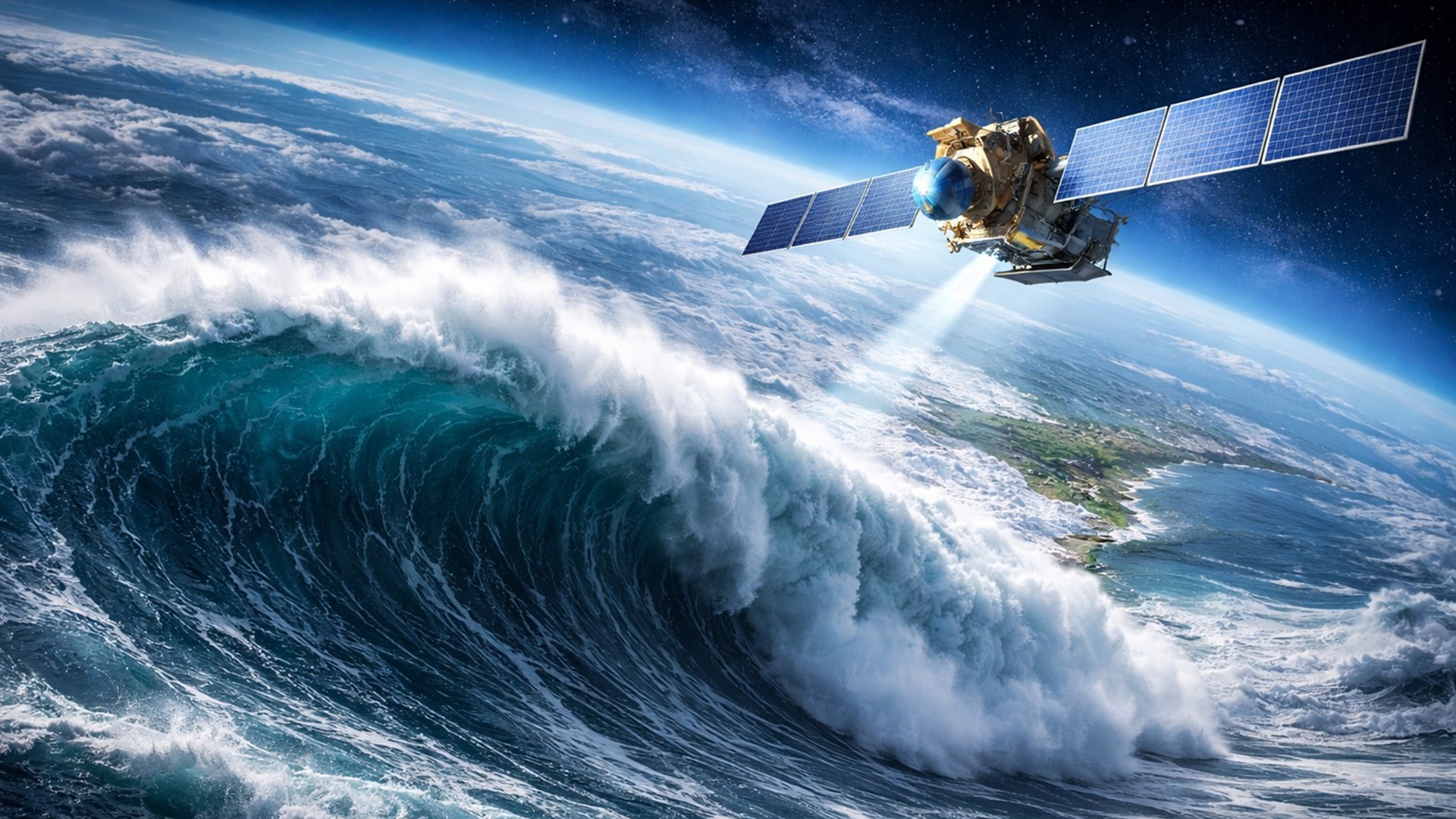
Satellite Data And Scientific Analyses Show That A Mega Storm In The Pacific, In December 2024, Generated Average Waves Of Almost 20 Meters, With Peaks Above 35 Meters, Whose Energy Traveled About 24 Thousand Kilometers Between Different Ocean Basins, Redefining Global Measurements Of Sea State
An Exceptional Storm In The Northern Pacific, In December 2024, Produced Unprecedented Ocean Waves, Observed By Satellite, With Averages Of 19.7 Meters And Peaks Above 35 Meters, Influencing Coasts Thousands Of Kilometers Away And Redefining Scientific Measurements.
Extreme Storm And Waves Visible From Space
In December 2024, A Massive Storm In The Pacific Triggered Waves Of Unprecedented Scale, Visible From Space Through Satellites In Orbit. The Measurements Documented The Largest Waves Ever Recorded By Direct Space Observation.
These Same Waves Provided The Energy Responsible For Two Landmark Events In Big Wave Surfing. Among Them Were The Eddie Aikau Big Wave Invitational, Held In Waimea Bay, Hawaii, And Record Descents At The Mavericks Peak In California.
-
Argentina achieves the unimaginable after more than 110 years and reintroduces the largest native herbivore of South America to the Chaco to restore a lost link in nature.

-
Returning to the Moon now costs a billion-dollar bill and reignites the competition between the USA and China for science, technology, and rare minerals on lunar soil.

-
While the world looks at oil, the war with Iran is already disrupting helium supply from Qatar, affecting car and iPhone chips, threatening AI expansion, and putting pressure on aluminum packaging at the highest value in four years.

-
Global warming will expose a treasure hidden under the ice of Antarctica and may spark an international dispute over gold and valuable minerals.


The Analyzed Data Was Released By The European Space Agency, Based On Measurements From The Surface Water And Ocean Topography Satellite, Known As SWOT. The Set Of Information Allowed For Accurate Assessment Of The Height And Propagation Of The Generated Waves.
The Analysis Indicated That, On December 21, 2024, The Waves Reached Average Heights Of 19.7 Meters, Equivalent To 65 Feet. Individual Waves Probably Exceeded 35 Meters, About 115 Feet, According To The Involved Scientists.
These Values Represent A Milestone In Satellite Ocean Observation. Until Then, There Had Been No Direct Spatial Records Of Waves With This Average Magnitude Associated With A Single Storm System In The Open Ocean.

Global Monitoring And Transoceanic Reach
According To The European Space Agency, Recent Observations Show That Ocean Waves During Major Storms Can Reach Unprecedented Heights. More Than Just Local Phenomena, These Waves Function As Messengers Of Distant Storms.
Even When The Storm Stays Far From The Coast, The Energy Generated Travels Immense Distances Across The Ocean. This Displacement Can Carry Destructive Power To Coastal Regions Located Thousands Of Kilometers From The Origin Point.
The Research Team Focused On The So-Called Eddie Storm, Identified As The Largest Storm In Average Wave Height Observed In The Last Decade. The System Was Continuously Analyzed Along Its Path.
The Scientists Were Able To Monitor The Swell Associated With The Storm For Approximately 24,000 Kilometers Of Ocean. This Monitoring Included Crossing The Northern Pacific And Passing Through Drake Passage.
After Crossing The Southern Tip Of South America, The Waves Reached The Tropical Atlantic. The Observation Period Extended From December 21, 2024, To January 6, 2025, According To The Consolidated Data.
This Reach Confirmed That The Energy Of Waves Generated By Major Storms Can Circulate Among Distinct Ocean Basins. The Phenomenon Reinforces The Need For Continuous Global Monitoring Of Sea States.
Historical Data And Satellite Integration
The Research Combined Measurements From SWOT With Decades Of Historical Records From The Sea State Project, Part Of ESA’s Climate Change Initiative. This Database Has Continuous Information Since 1991.
The Historical Set Incorporates Measurements From Various Satellites, Including SARAL, Jason-3, Copernicus Sentinel-3A And 3B, Copernicus Sentinel-6 Michael Freilich, CryoSat And CFOSAT. The Integration Allowed For Robust Comparisons Over More Than Three Decades.
This Expanded Database Made It Possible To Contextualize The 2024 Storm In Relation To Past Events. The Analysis Showed That, Although Extreme, It Fits Within A Limited History Of Very Large Ocean Storms.
According To The Researchers, The Combination Of Recent Observations And Historical Series Is Essential To Identify Recurrence Patterns. Storms Of This Magnitude Are Rare And Occur Approximately Once A Decade.
The Robustness Of The Data Also Allowed For A Review Of Numerical Models Used To Estimate Wave Energy. The New Direct Observations Served As Empirical Validation Under Extreme Conditions.
Energy Transport And Wave Dynamics
The Waves Generated By The Wind Reach Their Maximum Power During Intense Storms. However, The Greatest Risk To Coastal Areas Does Not Come From The Storm Itself, But From Long-Period Waves That Propagate Far Away.
These Waves Transport Energy Across Vast Ocean Distances, Surpassing The Immediate Reach Of The Weather System That Originated Them. Their Long Wavelengths Radiate Through Ocean Basins.
A Key Characteristic Of These Waves Is The Period, Defined As The Interval Between Successive Crests. This Parameter Provides Direct Information About The Size And Intensity Of The Generating Storm.
For Example, A 20-Second Period Indicates That A Large Wave Arrives Every 20 Seconds. The Longer The Period, The More Energy Is Transported During Propagation.
The Study Recently Published In PNAS Represents The First Direct Observational Validation Of Numerical Wave Models Under Extreme Conditions. This Led To Adjustments In The Energy Calculations Used Until Then.
The Scientists Already Knew That Very Long Waves Carried A Large Amount Of Energy. However, The New Measurements Revealed That Previous Models Systematically Overestimated This Energy Content.
Review Of Models And Scientific Implications
Based On SWOT Data, The Researchers Identified That A Larger Portion Of The Energy Is Concentrated In The Dominant Waves Of The Storm. Previously, It Was Believed That This Energy Was More Distributed Among Long Waves.
This Revision Alters The Understanding Of The Energy Dynamics Of The Oceans During Extreme Events. Although The Waves Remain Highly Destructive, Their Energy Distribution Is Now Described More Accurately.
The Researchers Compared The Phenomenon To A Boxer Who Concentrates Force In A Few Decisive Punches, Instead Of Spreading It Across Many Weaker Movements. The Analogy Helps To Explain The Observed Concentration.
This New Reading Improves The Ability To Forecast Coastal Impacts And Navigation Risks. Adjusted Models Tend To Provide More Reliable Estimates For The Arrival Of Large Swells.
The Direct Validation Also Strengthens The Use Of Satellites As Central Tools For Ocean Monitoring. Spatial Observations Now Play An Even More Relevant Role In Rare And Intense Events.
Historical Context And Previous Storms
The Historical Results Of The CCI Sea State Project Indicate That The Highest Waves In The Last 34 Years Occurred In January 2014. During That Episode, The Atlantic Storm Hercules Generated Waves Of 23 Meters.
These Waves Caused Significant Damage Across A Wide Stretch Of The Northeastern Atlantic, Affecting From Morocco To Ireland. The Event Remains A Historical Reference For Coastal Impact.
The Comparison Between 2014 And 2024 Shows Important Differences In The Distribution And Propagation Of The Waves. While Hercules Was Notable In The Atlantic, The Eddie Storm Stood Out For Its Transoceanic Reach.
Both Cases Reinforce The Rare Nature Of These Extreme Events. The Low Frequency Makes It Difficult To Identify Clear Trends Over Time, According To The Involved Researchers.
Still, The Expansion Of Observational Records Contributes To More Consistent Analyses. Each New Extreme Event Adds Crucial Data To The Understanding Of Ocean Behavior.
Future Perspectives And Climate Change
The Research Leader, Fabrice Ardhuin, Stated That The Next Step Is To Relate The Findings To Climate Change Through Modeling. The Goal Is To Test Possible Connections With Long-Term Trends.
According To Ardhuin, It Is Now Possible To Monitor Storm Intensity Over Time With Greater Accuracy. Climate Change May Be A Relevant Factor, But It Is Not The Sole Determinant.
Other Elements Also Influence Wave Behavior, Such As Seafloor Conditions In Coastal Regions. These Local Factors Can Amplify Or Attenuate The Effects Of Extreme Swells.
Additionally, The Rarity Of Major Storms Makes It Difficult To Draw Definitive Conclusions. Events Of This Magnitude Occur About Once A Decade, Limiting The Size Of Analyzed Samples.
Even So, The Findings Have Important Implications For The Protection Of Coastal Communities And Marine Infrastructure. As Global Climate Patterns Evolve, A Precise Understanding Of Waves Becomes Essential For Maritime Planning And Safety.
This Article Was Produced Based On Data From The European Space Agency And The Study “Sizing The Largest Ocean Waves Using The SWOT Mission,” Published In The Proceedings Of The National Academy Of Sciences.








-

Uma pessoa reagiu a isso.