





 Portuguese
  English
  Spanish
  5 min of reading
  1 comment


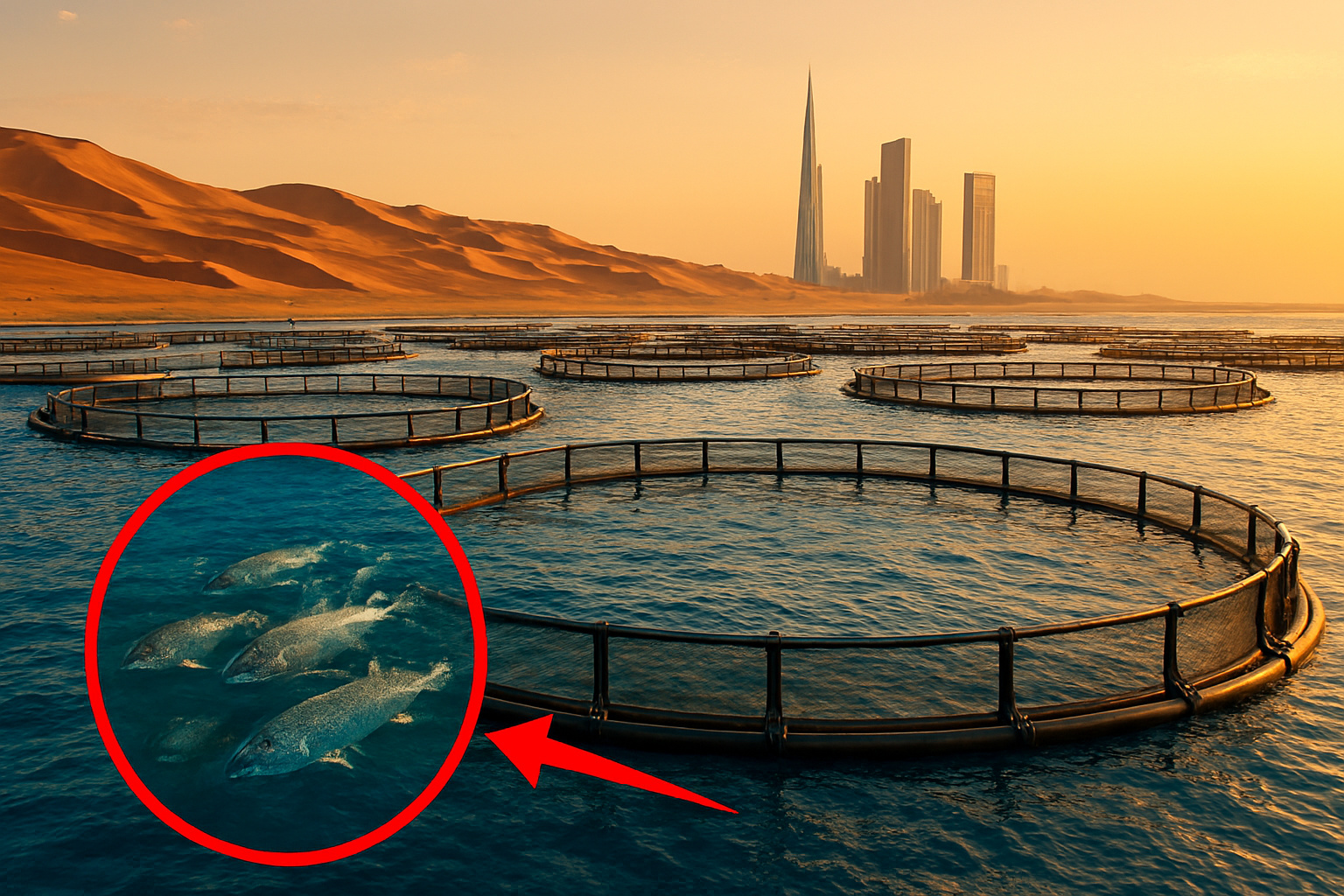


With Billions in Investments and Farms in the Red Sea, Saudi Arabia Advances in Farmed Fish to Reduce Imports and Ensure Food Security.
For decades, Saudi Arabia’s food supply has relied heavily on imports. A country with extreme desert climate, scarce rainfall, poor soils, and almost total absence of rivers had no natural conditions to sustain a significant animal protein production on a large scale. This scenario has begun to change radically in recent years. Today, the kingdom is investing billions of dollars to transform the coast of the Red Sea into one of the largest aquaculture hubs in the Middle East.
The goal is straightforward and strategic: reduce external food dependency, ensure food security, and create a new industrial chain based on farmed fish production, integrated into the Vision 2030 economic megaproject.
The Food Vulnerability of a Rich Oil Country but Poor in Water
Despite being one of the world’s largest energy powers, Saudi Arabia has always been extremely dependent on food imports. More than 80% of what the country consumes comes from abroad. Any logistical crisis, war, pandemic, or international sanction immediately exposes this structural weak point.
-
The water that almost everyone throws away after cooking potatoes carries nutrients released during the preparation and can be reused to help in the development of plants when used correctly at the base of gardens and pots, at no additional cost and without changing the routine.

-
The sea water temperature rose from 28 to 34 degrees in Santa Catarina and killed up to 90% of the oysters: producers who planted over 1 million seeds lost practically everything and say that if it happens again, production is doomed to end.

-
An Indian tree that grows in the Brazilian Northeast produces an oil capable of acting against more than 200 species of pests and interrupting the insect cycle, gaining ground as a natural alternative in soybean, cotton, and vegetable crops.
-
The rise in oil prices in the Middle East is already affecting Brazilian sugar: mills in the Central-South are seeing their margins shrink just as ethanol gains strength.

This vulnerability became even clearer during the pandemic and later with the global shocks in grain, meat, and fish trade. The government started to treat food production as a matter of national sovereignty, not just as an economic sector.
The Red Sea as a Strategic Asset for Saudi Aquaculture
With over 1,800 kilometers of coastline, the Red Sea provides an ideal environment for marine fish farming: warm waters, high oxygen content, good salinity, and great biodiversity. It was in this environment that Saudi Arabia decided to establish its largest marine aquaculture projects. State and private companies have begun to install:
- Large-scale coastal farms
- Floating tanks in open sea
- Water recirculation systems
- Fry breeding centers
- Marine feed factories
- Slaughterhouses and processing plants
Production is focused on high commercial value species, such as shrimp, bass, snapper, and other marine fish adapted to the tropical and subtropical climate of the region.
Billion-Dollar Investments to Create a New Productive Chain from Scratch
The advancement of Saudi aquaculture does not happen haphazardly. It is supported by billion-dollar investments, led by public funds and large conglomerates in the country. The government has created specific financing lines, credit guarantees, energy subsidies, and technology transfer programs.
A significant portion of these resources comes from the Public Investment Fund, the Saudi sovereign fund, considered one of the largest in the world. The goal is to transform aquaculture into one of the pillars of the new post-oil economy.
Producing Fish in the Midst of the Desert: The Role of Closed Systems (RAS)
In addition to coastal farms, Saudi Arabia is also heavily investing in aquaculture in closed water recirculation systems, known as RAS (Recirculating Aquaculture Systems). These systems allow fish to be raised in climate-controlled warehouses in the middle of the desert, with up to 99% of the water reused.
In this model, water is constantly filtered, treated, oxygenated, and reused. This drastically reduces water consumption, eliminates waste discharge into the environment, and allows complete control over temperature, oxygen, nutrition, and health. This technology is essential for making aquaculture viable in regions where water is the scarcest resource.
Food Security as a State Policy
The concept of food security has begun to be treated in the country with the same strategic importance as oil. The government has set concrete targets to increase domestic protein production, reduce imports, and stabilize internal prices.
Fish occupies a central position in this plan for three main reasons: high nutritional value, shorter production cycle than beef, and lower relative environmental impact.
The ambition is that, in the coming years, a significant portion of the fish consumed in the country is produced domestically, reducing dependency on international suppliers.
The Role of Aquaculture in the Post-Oil Economic Transition
Saudi Arabia knows that oil will not indefinitely sustain its economy. Therefore, the Vision 2030 strategy envisions the creation of new structuring industries capable of generating jobs, technology, exports, and long-term stability. Aquaculture fits into this context as:
- A sector of high future protein demand
- A technology-intensive industry
- Generator of coastal jobs
- Potential exporter to the Middle East, Europe, and Asia
- A sustainable alternative to traditional livestock farming in the desert
In practice, fish is starting to be treated as a strategic asset of the Saudi economy, just as oil was in the 20th century.
Jobs, Coastal Urbanization, and New Economic Dynamics
The establishment of farms along the Red Sea has caused a reorganization of the economy in various coastal regions. Cities that were previously dependent on artisanal fishing have begun to receive:
- Technical jobs
- Operators of automated systems
- Production engineers
- Aquaculture biologists and veterinarians
- Food processing technicians
- Logistics operators
This generates accelerated urbanization, increased income, and territorial redistribution of wealth, creating new productive hubs outside the country’s traditional large centers.
Environmental Challenges and International Pressure for Sustainability
The intensive farming of fish in sensitive environments like the Red Sea poses complex challenges. The region is home to extremely fragile coral reefs with unique biodiversity. Any management failure can lead to severe environmental impacts.
Therefore, projects are subjected to strict standards of environmental licensing, traceability, water quality monitoring, and effluent control. Importing markets also require environmental and sanitary certifications, which forces the country to adopt high standard practices.
The Geopolitical Chessboard of Protein in the Middle East
Food production in the Middle East is a sensitive geopolitical issue. Countries in the region, historically reliant on imports, have begun to compete for self-sufficiency as a way to reduce their strategic vulnerability.
In this chess game, Saudi Arabia seeks to lead not only in oil but also in animal protein production in extreme environments, something that few countries can achieve on a large scale.
If successful, the country could become an exporter of fish for the entire Middle East, a region traditionally deficient in farmed marine protein.
From Absolute Importer to Protagonist of New Desert Aquaculture
In just a few decades, Saudi Arabia has transitioned from being an almost total fish importer to positioning itself as a candidate for the new regional aquaculture power. This has only been possible thanks to a rare combination of factors: practically limitless capital, state planning, cutting-edge technology, and a still largely unexplored industrial maritime coast.
The Saudi case shows that aquaculture has ceased to be an activity restricted to humid tropical countries. Today, with technology, it is possible to produce fish in the midst of the desert, with industrial efficiency and environmental control.
This redefines the limits of food production in the 21st century. Fish, which has always been dependent on nature, is increasingly becoming a product of engineering, biotechnology, and geopolitics.







O governo ao invés de ficar nessa briga de comadre. Porque não presta atenção nessa reportagem e faz uma coisa que vale a pena. E que será um belo exemplo se for feita com exmero no Brasil!