





 Portuguese
  English
  Spanish
  5 min of reading
  0 comments


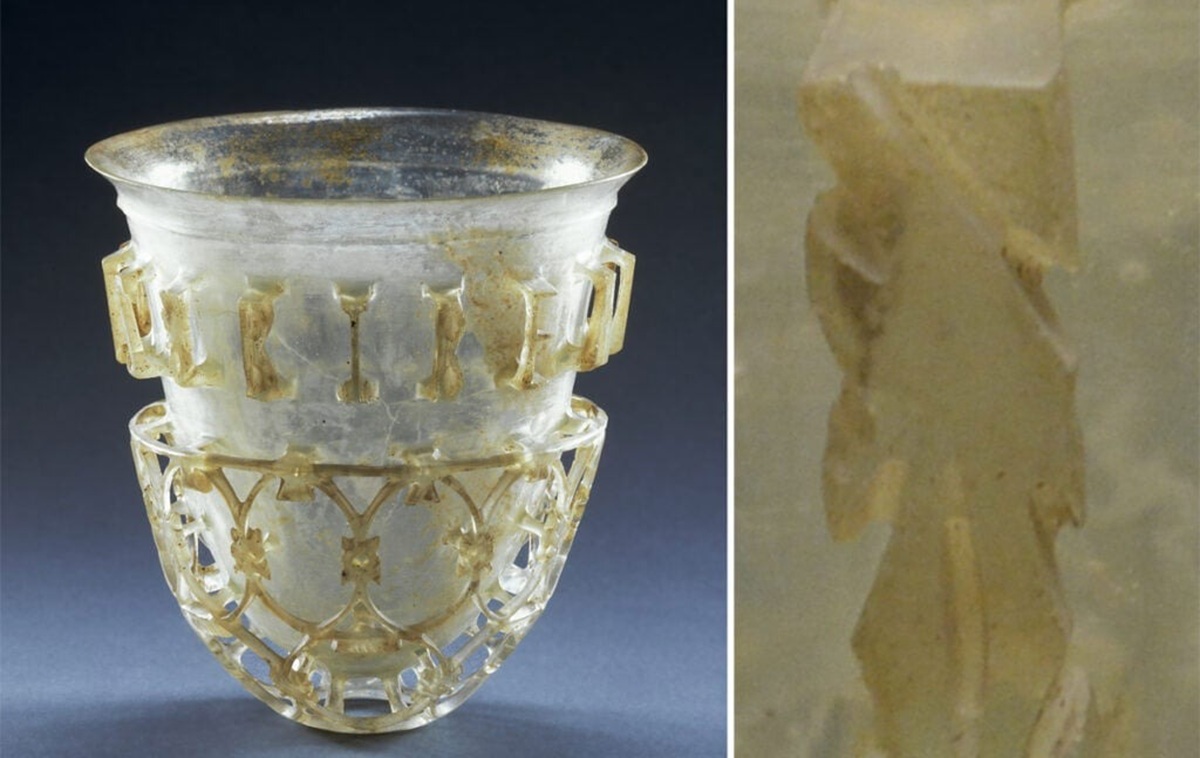
The Discovery Made by Hallie Meredith by Turning a Roman Cup at the Metropolitan Museum of Art Led to the Reinterpretation of Symbols Used Between 300 and 500 AD, Indicating Marks of Collective Workshops and Altering the Understanding of Authorship, Work Organization, and Craft Production of Glass in Late Antiquity
An observation made in February 2023 at the Metropolitan Museum of Art led to the reinterpretation of symbols on blown glass Roman cups from 300 to 500 AD, indicating marks of manufacturers and expanding the understanding of collective production, techniques, and authorship in Late Antiquity.
An Inverted Detail That Changed the Reading of the Objects
During a visit to a gallery in the museum, art historian and glassblower Hallie Meredith noticed a hidden detail when turning a Roman blown glass cup. The simple gesture revealed symbols blown on the back of the object, positioned near inscriptions wishing long life to the owner.
The observed motifs included abstract shapes like diamonds, leaves, and crosses, organized alongside votive inscriptions. For over a century, these elements had been treated by scholars as ornaments with no identifiable function.
-
With a cost per shot close to zero, the DragonFire laser could change naval warfare in 2027 and provide British ships with nearly unlimited defense against drones.

-
A British startup creates tires that generate electricity in electric vehicles when passing over potholes, speed bumps, and cracks.

-
Scientists have created robots made with living cells that have their own nervous system, swim on their own, explore the environment, and self-organize without any genetic engineering, and now they want to do the same with human cells.

-
Students create a solar-powered ambulance that operates without a plug, without fuel, and still keeps medical equipment running in remote areas.


The analyzed cup was part of a private collection of diatreta, luxurious vessels carved from single blocks of glass. Produced between 300 and 500 AD, these pieces are recognized for their external lattice connected to the inner body by delicate glass bridges.
The discovery did not arise from the use of new equipment or analytical methods. It emerged from a moment of curiosity informed by the craft practice of the researcher, who has been working with blown glass since college.
Symbols, Inscriptions, and the Identification of Workshops
On the back of a vessel from the late Roman period, Meredith identified blown symbols arranged beside an inscription wishing long life, such as “BIBE V[I]VAS I[..]A”. In another example, inscriptions in Greek offered similar wishes for the user’s continued well-being.
The comparative analysis revealed the repetition of these symbols across different blown glass pieces. By tracing the same motifs on other carved vessels, Meredith associated the patterns with a visual language shared by glassmakers between the 4th and 6th centuries AD.
The results were presented in two recent articles, one published in April in the Journal of Glass Studies and another in October in World Archaeology. In both, the researcher argues that the symbols functioned as marks of manufacturers.
According to the research, these marks did not identify isolated individuals, but workshops and production collectives. The interpretation aligns ancient symbols with the modern concept of institutional branding, used to identify origin and method of manufacturing.
Collective Production and the Diatretum Technique
The academic debate on how Roman blown glass vessels were produced extends over 250 years. Hypotheses focused on specific techniques, such as manual sculpture, casting, or blowing, rarely advancing beyond inscriptions.
Each diatretum began as a block of thick glass. The piece was carved into two concentric layers, joined by thin bridges that supported the external lattice, creating a structure that was both lightweight and strong.
Meredith’s research indicates that production required coordinated teams of engravers, polishers, and apprentices. The work could last for weeks, months, or even years, depending on the complexity of the object.
Tool marks, inscriptions, and unfinished fragments reinforce the interpretation of collective production. The blown symbols, once considered merely decorative, are now understood as signs of work organization and workshop identity.
Craft Experience as a Method of Investigation
Meredith’s experience as a glassblower adds a practical dimension to her research. Direct knowledge of the behavior of molten glass and the technical demands of the craft guided her reading of the material evidence preserved in Roman pieces.
At Washington State University, the researcher teaches a course titled “Experiencing Ancestral Manufacturing.” In the course, students 3D print versions of ancient works and experiment with craft processes.
An application developed by Meredith allows users to virtually dismantle artifacts, separating layers and production stages. The declared goal is not to achieve a perfect replica, but to develop empathy for the production processes of the past.
By experiencing the stages of manufacturing, students are led to understand the technical decisions and material limitations faced by ancient artisans. This approach bridges academic analysis and craft practice, enriching historical understanding.
Reformulation of a Longstanding Debate
The conclusions reformulate a consolidated debate by shifting the focus from isolated techniques to the people involved in production. Recognizing workshop marks implies acknowledging networks of work and knowledge circulation in Late Antiquity.
Meredith argues that the symbols did not function as personal autographs. They indicated collective production, acting as signs of belonging to a specific workshop and sharing technical practices.
This interpretation broadens the social reading of objects, placing them in a context of cooperation and task division. The diatretum ceases to be seen as the work of a solitary master and comes to represent the coordinated effort of multiple artisans.
The focus also helps explain the recurrence of similar visual patterns and inscriptions on pieces found in different regions of the ancient Roman Empire.
In-Progress Publication and Expansion of Scope
The researcher develops these conclusions in her upcoming monograph, “The Roman Craftworkers of Late Antiquity: A Social History of Glass Production and Related Industries,” currently in production by Cambridge University Press.
The book, scheduled for release in 2026 or 2027, expands the scope of analysis beyond glass, examining relationships between different craft industries and their social dynamics in Late Antiquity.
The work proposes a social history of craft production, based on material evidence such as marks, inscriptions, and traces of tools, integrating these data into a broader reading of work structures.
Restoring the Visibility of Ancestral Artisans
The central motivation of the research is to restore the visibility of anonymous artisans who shaped the ancient world. According to Meredith, traditional historiography has favored elites and patrons, sidelining those who performed the manual labor.
The systematic gathering of evidence suggests that more information is available about these artisans than was previously assumed. Marks neglected for centuries offer clues about organization, learning, and knowledge circulation.
In a new project, Meredith integrates art history and data science. With computer science students, she builds a searchable database to track non-standard writings on thousands of portable objects.
Spelling errors, mixed alphabets, and coded inscriptions, previously dismissed as incomprehensible, may indicate multilingual creators adapting writing systems to new audiences. What seemed like noise becomes evidence of cultural adaptation.
When light hits the lattice of a diatretum, the glass reveals more than a technical feat. It reflects the hands, skill, and imagination of teams of artisans whose marks have remained hidden for about 1,500 years, now reinterpreted by a simple gesture of careful observation.







-

-

2 pessoas reagiram a isso.