





 Portuguese
  English
  Spanish
  4 min of reading
  0 comments


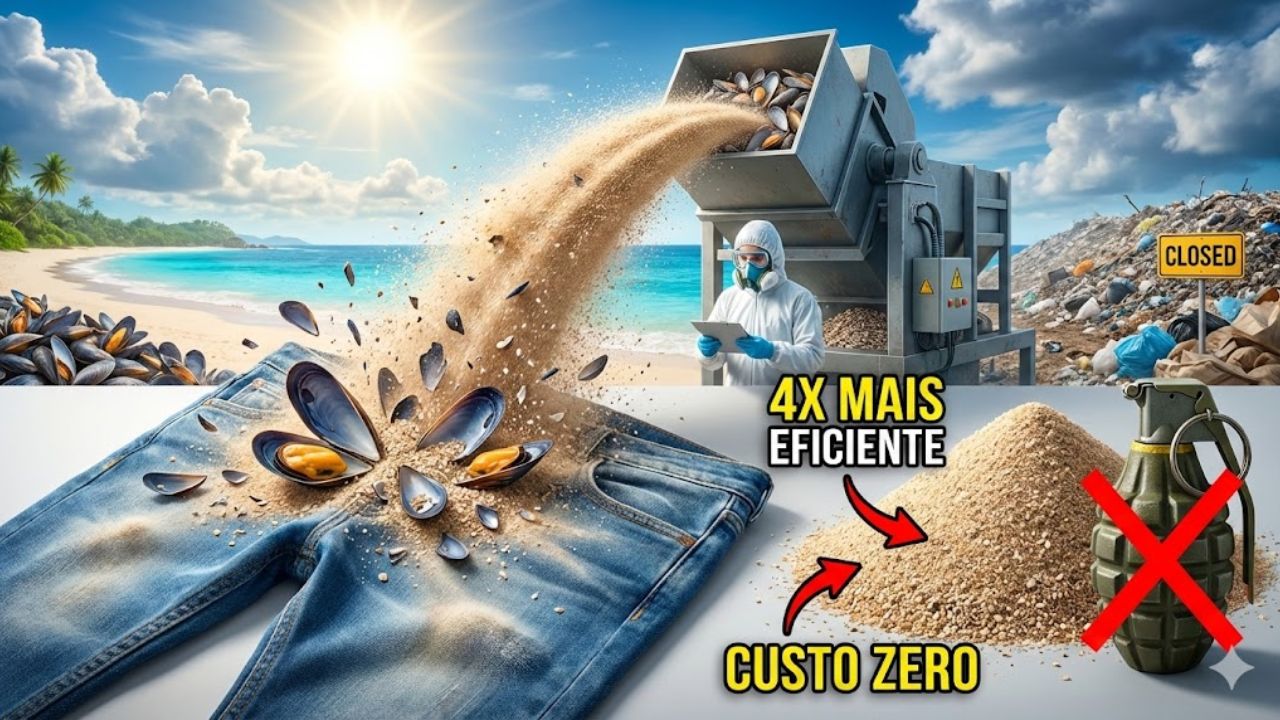
Mussel Shells in Sand for Blasting Jeans Diverts Waste from Landfills, Delivers Superior Performance to Garnet, and Leaves the Fabric with a Softer Touch
Transforming waste into an industrial solution has moved from rhetoric to a real process: mussel shells in sand for blasting jeans now serve as an alternative to creating a “worn” look more efficiently, with less material consumption and less waste.
The proposal addresses three issues at once: it reduces the volume of shells that would go to landfills, decreases the dependency on non-renewable abrasives, and maintains the appearance of jeans with a pleasant look and soft touch, according to tests described in the study.
Why Jean Blasting Has Always Been a Health and Cost Issue
Blasting is one of the most used treatments to give jeans a worn and modern appearance. In the past, the industry relied heavily on common silica sand, but it poses a serious risk: free silica can cause silicosis, a potentially fatal respiratory disease.
-
A strong earthquake in Indonesia affects houses and schools, causes panic, triggers a tsunami alert, and records a rise in sea level of up to 30 centimeters in some areas.

-
The Argentine government celebrates the lowest poverty rate in 7 years, but experts warn that the methodology has changed, real wages have fallen, unemployment has risen, and the number of people on the streets of Buenos Aires has increased by 57% since Milei took office.

-
7.8 magnitude earthquake in Indonesia frightens the population, triggers tsunami alert, and hits an island with over 200,000 inhabitants this Thursday.

-
Google will finally let you change that embarrassing Gmail address you created in your teenage years without losing any accounts, logins, or old emails: the feature is already available in the United States.

To reduce this risk, many factories switched to garnet sand, which virtually contains no free silica. However, garnet is a non-renewable resource and is significantly more expensive. The result is a safer process, but heavier on the budget.
How the Process That Transforms Shells into Abrasive Works

The team from the University of the Basque Country developed a direct and replicable method for creating the abrasive material. The shells are washed, undergo sterilization with thermal treatment, then are ground in a mill and sifted until the desired granulation is achieved.
The final material is applied to the jeans at high pressure using a conventional compressed air blasting gun. This is where mussel shells in sand for blasting jeans fit in without requiring a machine revolution, but rather a change in the input.
Why Shell Sand Can Surpass Garnet in Blasting
In the tests described, shell sand proved to be less brittle than garnet particles. This means it has a lower tendency to fragment during blasting.
In practice, this resistance reduces losses and improves yield: the process requires a smaller amount of abrasive to blast the same number of pants. Therefore, mussel shells in sand for blasting jeans appears as an option with performance advantages, not just as a “green” choice.
The Fabric Finish and the Advantage of Soft Touch
In addition to yield, the result on the jeans is a central part of the story. The fabric has a pleasant appearance and soft touch, which matters because the consumer notices the difference in daily use.
When the abrasive damages the fabric too much, the “worn look” can turn into a rough and artificial appearance. The proposal with shells seeks to balance wear and finish, maintaining a friendlier texture.
Reuse and End of Life: What Happens to the Abrasive After
Another practical difference lies in the use cycle. Shell sand can be collected and reused repeatedly in various blasting sessions until the particles become too small for reuse.
When it reaches this point, the material can be composted more easily than intact shells, as it is fragmented.
It’s a cleaner chain from start to finish, and this reinforces the appeal of mussel shells in sand for blasting jeans as a solution that reduces waste.
Other Applications Beyond Jeans: Where This Abrasive Can Enter
The study also points out that shell grain can serve other industrial tasks. The logic is simple: if the material works as an abrasive in a demanding process like blasting, it can have a place in uses like cleaning mechanical parts or even cleaning ships.
In other words, mussel shells in sand for blasting jeans could just be the first showcase of an abrasive with potential for other productive chains, especially where cost and reuse matter.
What This Idea Changes for Industry and Consumers
For the industry, the promise is clear: less input consumption, reuse for more sessions, and a way to reduce costs without sacrificing finish.
For the consumer, the change appears in the final product: jeans with a well-crafted appearance and more comfortable feel.
And in the background, there is a direct environmental gain: less shells in landfills, less pressure on non-renewable resources, and more circularity in a process known for generating waste.
And now the quick question: if you knew that your jeans were made with mussel shells in sand for blasting jeans, would that increase your willingness to buy, or would you still have some doubts about safety and quality?








-

-

3 pessoas reagiram a isso.