





 Portuguese
  English
  Spanish
  5 min of reading
  0 comments


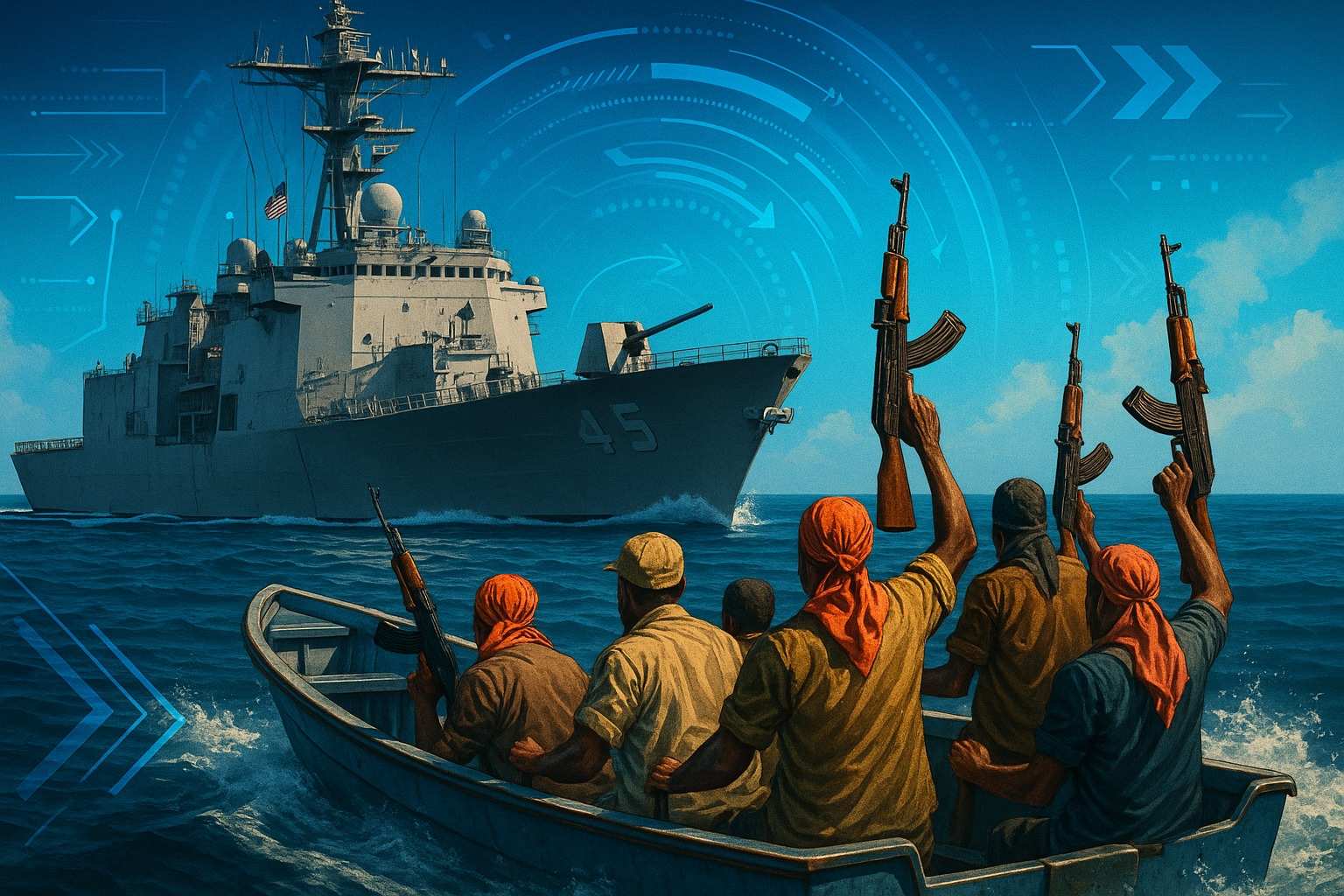
In 2010, six armed Somali pirates attacked the USS Ashland warship in the Gulf of Aden, but ended up being rescued and jailed after the crew responded with 25 mm cannon fire, ending the threat in seconds and taking those responsible to U.S. courts.
On the morning of April 10, 2010, six armed men in a high-speed boat advanced toward the USS Ashland, a Whidbey Island-class landing ship of the United States Navy.
They believed they were facing a vulnerable target and began firing with small arms at the port side of the vessel.
What they didn’t know was that the Ashland had been designed to withstand and respond to this type of threat.
-
Couple buys 1846 church in ruins for R$ 660,000, invests R$ 3.2 million in renovations, transforms it into a millionaire mansion, and even preserved a historic cemetery with over 300 graves.

-
He started running at 66 years old, broke records at 82, and is now a subject of study for having a metabolic age comparable to that of a 20-year-old, in a case that is intriguing scientists and inspiring the world.

-
Oldest tree on the planet reappears after 130 years of searches: Wattieza, 385 million years old, was 10 meters tall and had no leaves or seeds; Gilboa fossils in New York solved the mystery in 2007.

-
A 48-square-meter house assembled in hours with 4,000 bricks made of recycled plastic that does not absorb moisture, has natural thermal insulation, and costs less than 90,000 reais in a complete kit.


With over 16,000 tons of displacement when fully loaded, it carries Marines, armored vehicles, landing craft, and precision weapon systems.
Even before the shots were fired, the ship’s radars and observers had already detected the approach of the boat. The attack attempt did not catch the crew by surprise.
The Crew’s Response
As soon as the shots started, the Ashland crew followed the authorized engagement rules for attack situations.
The sailors positioned the MK-38 Mod 2 cannon, a remotely controlled and stabilized 25 mm system for precision firing at sea.
In seconds, two shots crossed the surface of the water and hit the boat. The enemy vessel caught fire and began to sink rapidly.
Faced with flames and imminent destruction, the six men jumped into the sea to try to save themselves. In just a few seconds, the attack attempt was over and the assailants were adrift.
Rescue Operation
Even though they were enemies, the six men were treated as survivors.
Once the threat was neutralized, the Ashland’s mission changed. Two rigid-hulled inflatable boats were launched with armed Marine teams. They approached cautiously, rescued each of the men, and brought them aboard the ship.
The ship’s medical team treated minor injuries and checked for signs of hypothermia caused by the water immersion. All were stabilized and placed in custody.
This type of response is provided for in the training of the United States Navy: eliminate the threat with proportional force and then preserve human lives whenever possible.
Who Is the USS Ashland
The USS Ashland (LSD-48) is a Whidbey Island-class landing ship, commissioned in 1989.
Its function is to transport and launch amphibious landing forces, armored vehicles, smaller boats, and Marines in combat operations.
With over 16,000 tons of displacement when loaded, the vessel features long-range sensors, advanced radars, and various weapon systems, including the MK-38 Mod 2 cannon used in the confrontation.
The crew consists of sailors and Marines trained for combat operations, rescues, and humanitarian missions in any region of the world.
Strategic Location of the Attack
The attack occurred in the Gulf of Aden, a maritime area located between the Horn of Africa and the Arabian Peninsula.
This region is one of the busiest shipping corridors in the world, with thousands of cargo ships and tankers passing through every year between Asia, the Middle East, Europe, and North America.
The intense circulation of commercial vessels, combined with political instability in parts of Somalia, created conditions that allowed for the emergence of organized piracy networks in the 2000s.
During this period, several merchant ships were targeted by similar attacks, prompting navies from different countries to increase their presence in the region.
Judicial Process in the United States
After the rescue and initial detention on the ship, the six suspects were transferred to legal custody and later taken to the United States for trial.
The case fell under the jurisdiction of U.S. federal courts, which have the authority to prosecute piracy crimes committed in international waters.
One of those involved, Mohamed Farah, was sentenced in 2017 to life in prison plus an additional 10 years for the attack on the USS Ashland. Other group members also received lengthy sentences.
The U.S. Department of Justice stated that the decision aimed to hold those involved accountable and demonstrate that attacks against military vessels would be treated with the utmost legal severity.
International Repercussions
The incident involving the Ashland occurred at a time when Somali piracy was receiving global attention.
Between 2008 and 2011, hundreds of commercial vessels were attacked in the region. The kidnappings caused billions in losses and led shipping companies to alter routes, hire armed escorts, and reinforce onboard security.
International organizations such as NATO, the European Union, and Task Force 151—a multinational coalition for combating piracy—began to constantly patrol the Gulf of Aden and the western Indian Ocean.
Despite these measures, attacks continued to occur in 2010 and 2011, though at a reduced rate after the increased patrols and private armed escort in the following years.
Decline and Reemergence of Piracy
In the years following the incident, Somali piracy significantly decreased.
The strengthening of naval patrols, the use of protected convoys, and the presence of armed security teams aboard commercial ships contributed to reducing the number of attacks.
International reports indicated that starting in 2012, the number of successful kidnappings dropped dramatically, and the Gulf of Aden ceased to be classified as the most dangerous shipping route in the world.
However, recent episodes showed that the threat has not disappeared. In 2024, for example, Indian naval forces captured 35 suspected pirates after liberating a hijacked bulk carrier, in what was considered the largest such case in years.
Experts warn that piracy could resurge in contexts of political instability and extreme poverty in the region.
Importance of the Ashland Case
The attack on the USS Ashland became an example of a quick and coordinated response by the United States Navy to threats in strategic waters.
The episode demonstrated that military vessels were prepared not only to defend themselves but also to capture suspects and subject them to justice under international law.
Moreover, it highlighted the importance of a constant naval presence in the region to protect global trade routes and ensure the safety of international navigation.
For U.S. authorities, the message was clear: attacks on military or commercial vessels would not go unanswered and could result in severe arrests and convictions.








Seja o primeiro a reagir!