





 Portuguese
  English
  Spanish
  4 min of reading
  0 comments


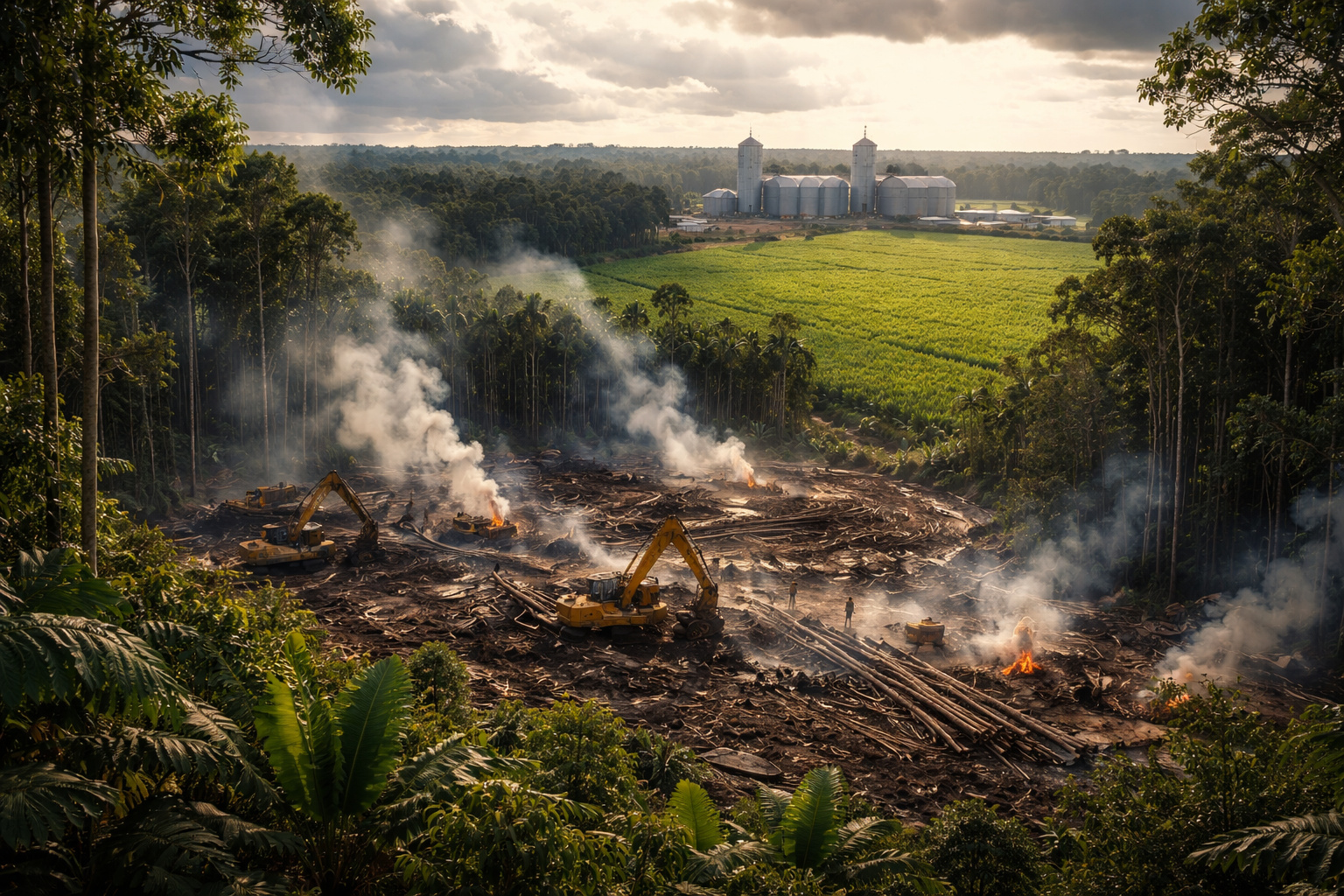
Exit of Large Tradings from the Environmental Agreement, After the Enactment of the State Law in Mato Grosso, Increases Deforestation Risks, Pressures Climate Goals, and Exposes Weaknesses of Brazilian Environmental Governance
Since January 2026, a significant change began to directly affect Brazilian environmental policy. On January 5, 2026, the Brazilian Association of Vegetable Oil Industries announced its exit from the Soy Moratorium, an agreement created in 2006 to curb the advance of deforestation in the Amazon.
With this decision, companies such as Bunge, Cargill, and Amaggi no longer committed to not purchasing soy grown in deforested areas after July 22, 2008.
State Law of Mato Grosso Alters Incentives and Pressures the Sector
The exit from the agreement occurred, above all, as a direct consequence of the State Law No. 12,709/2024, enacted at the end of 2024 and in effect since January 1, 2026. The norm began to restrict tax benefits to companies signatory to the moratorium.
-
The eggshell that almost everyone throws away is made up of about 95% calcium carbonate and can help enrich the soil when crushed, slowly releasing nutrients and being reused in home gardens and vegetable patches.

-
This farm in the United States does not use sunlight, does not use soil, and produces 500 times more food per square meter than traditional agriculture: the secret lies in 42,000 LEDs, hydroponics, and a system that recycles even the heat from the lamps.

-
The water that almost everyone throws away after cooking potatoes carries nutrients released during the preparation and can be reused to help in the development of plants when used correctly at the base of gardens and pots, at no additional cost and without changing the routine.

-
The sea water temperature rose from 28 to 34 degrees in Santa Catarina and killed up to 90% of the oysters: producers who planted over 1 million seeds lost practically everything and say that if it happens again, production is doomed to end.


This impact falls on the country’s main production hub. According to data released in July 2025 by the National Supply Company, Mato Grosso accounts for approximately 29% of the national soy production.
Experts Warn of Environmental and Climate Risks
In light of this new scenario, environmental entities reacted with concern. In a statement released in January 2026, the Forest Management and Certification Institute, with 30 years of experience, warned that the weakening of the moratorium tends to increase deforestation and greenhouse gas emissions.
According to the institute, this change directly compromises the climate goals assumed by Brazil under the Paris Agreement, which foresee a reduction of 59% to 67% of emissions by 2035, according to already established international commitments.
State Government Defends Forest Code as the Only Parameter
Despite the warnings, the governor of Mato Grosso, Mauro Mendes, characterized the decision as a victory. In an official statement, he asserted that companies will only need to comply with the Brazilian Forest Code.
The code establishes a limit of 20% deforestation on rural properties in the Amazon, being, according to the state government, the main environmental benchmark for productive activities in the territory.
Data Shows That the Legislation Does Not Guarantee Total Preservation
In practice, however, studies indicate weaknesses in the implementation of the law. A survey by the Center for Life Institute showed that 91% of the deforestation recorded between August 2023 and July 2024 was illegal.
This data reinforces difficulties in environmental enforcement. Moreover, it points to the limitations of the legislation when applied without additional control instruments and economic pressure.
Environmental Registration Still Faces Operational Barriers
For Lisandro Inakake, public policy manager at Imaflora, the Forest Code is essential, but it relies on effective implementation. According to him, most Rural Environmental Registries (CAR) remain without analysis and validation.
The CAR is a self-declaratory instrument, used to identify properties and allow for enforcement. Without validation, its effectiveness remains limited, according to experts.
Moratorium Functioned as an Additional Brake on Deforestation
In this context, Rômulo Batista, coordinator of the Solutions for the Forest front at Greenpeace Brazil, assesses that the Forest Code, in isolation, is insufficient.
According to him, the moratorium always served as an additional pressure mechanism, inducing producers to maintain crops in already cleared areas, preventing expansion into new forest areas.
Political and Legal Pressures Weaken the Agreement
Pressures against the moratorium intensified since 2024. In addition to the state law, in 2025, the Administrative Council for Economic Defense suspended the agreement after a representation from the House of Representatives’ Agriculture Committee.
The committee was chaired by deputy Rodolfo Nogueira, a soy producer. The decision opened the possibility of penalties for participating companies.
Legal Validity Remains Recognized by the STF
Even in the face of pressures, the state law does not formally extinguish the Soy Moratorium. The agreement remains valid and has already been recognized as legal by the Supreme Federal Court.
Furthermore, the state norm is the subject of a Direct Action of Unconstitutionality, the merits of which have not yet been judged by the Supreme Court.
Deforestation Returns to the Center of the Climate Debate
Experts emphasize that deforestation is the main source of CO₂ emissions in Brazil. Since 2023, extreme weather events have become more frequent, increasing the risks associated with the loss of forest cover.
Given this scenario, a central question arises for the country: Will Brazil be able to move towards zero deforestation only with the Forest Code, or will it need to strengthen additional mechanisms, such as the soy moratorium, to protect the Amazon and meet its climate goals?









-

Uma pessoa reagiu a isso.