





 Portuguese
  English
  Spanish
  3 min of reading
  0 comments


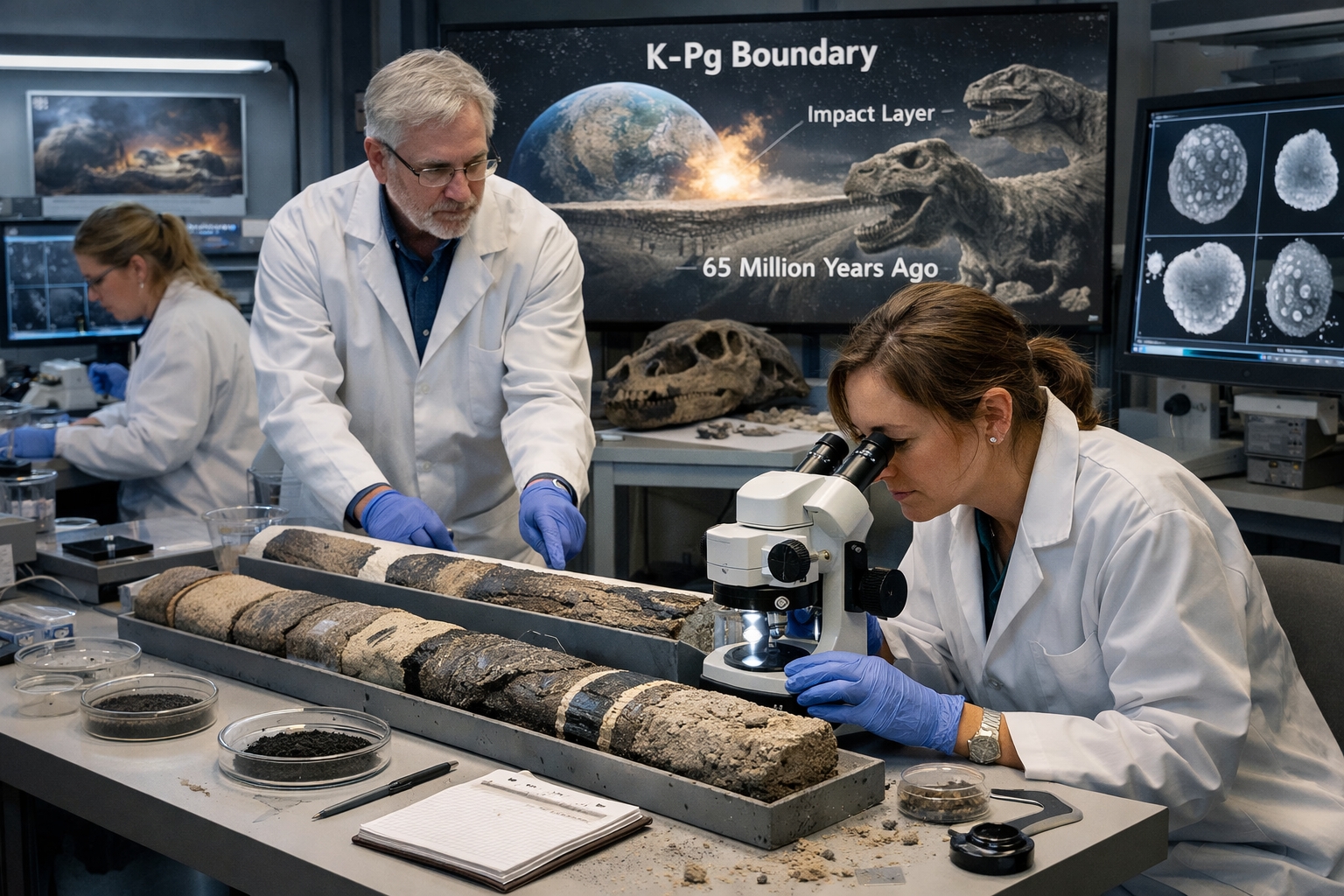
A Hidden Trick in Sediments Uses Space Dust as a Natural Clock and Indicates That Some Organisms Have Started to Evolve at a Surprising Rate Right After the Chicxulub Impact on a Still-Broken and Unstable Planet.
The story of the dinosaurs’ end is well-known: an impact, darkness, food collapse, mass extinction. What changes here is the “timer” used to measure what came next. Instead of working only with rock layers and broad estimates, researchers used space dust accumulated at the ocean floor as a type of natural clock. And it points to a biological recovery much faster than many think.
The logic is simple and brilliant. Space constantly bombards micrometeorites onto Earth. They fall all the time, at a relatively constant rate.
Within these little grains comes a rare element here, helium 3. If you measure how much helium 3 appears in a sediment layer, you can estimate how long it took for that layer to form, like it’s the planet’s hourglass.
-
With a cost per shot close to zero, the DragonFire laser could change naval warfare in 2027 and provide British ships with nearly unlimited defense against drones.

-
A British startup creates tires that generate electricity in electric vehicles when passing over potholes, speed bumps, and cracks.

-
Scientists have created robots made with living cells that have their own nervous system, swim on their own, explore the environment, and self-organize without any genetic engineering, and now they want to do the same with human cells.

-
Students create a solar-powered ambulance that operates without a plug, without fuel, and still keeps medical equipment running in remote areas.


With this, the team was able to “slice time” right after the Chicxulub impact, the asteroid associated with the boundary between the Cretaceous and Paleogene.
And here comes the surprising part: some forms of life, especially marine microplankton, seem to have diversified and changed in a matter of thousands of years, not millions.
In geological terms, this is practically a blink of an eye.
What Space Dust Resolves in This Story
The post-impact period is a nightmare to date accurately. The planet became chaotic: erosion, tsunamis, shifts in ocean currents, sediments moving back and forth. Layers can become “messy,” and this scrambles the traditional clock.
Space dust enters as an external standard. Nobody controls the rate of micrometeorites. So, when you find helium 3 in the right layers, it acts as a time marker that is less dependent on the local environmental confusions.
What They Saw When They Put This “Clock” to Work
In the midst of this key turning point, the University of Texas at Austin describes that the method suggests a scenario of rapid recovery and diversification in marine organisms after the impact, using helium 3 to estimate the sediment deposition rate and, with that, the time scale of the observed evolution.
Other articles that reported on the study highlight the same point: instead of a slow and “dragged out” recovery, certain groups seem to have found ways to occupy empty niches quite early while the planet was still adjusting.
Why This Matters Now
Because it alters the basic intuition about life reconstruction after disaster. The extinction was brutal, yes. But recovery doesn’t always have to be a slow-motion film.
When the ecosystem opens up, the pressure to fill that space can become an evolutionary accelerator.
And there’s another, more modern interpretation: if the planet is changing rapidly today due to human reasons, this type of study isn’t “good news,” but rather serves as a warning.
Life can respond, but it responds with a swap of parts. What disappears may not return. What takes its place could be a whole different game.







Seja o primeiro a reagir!