





 Portuguese
  English
  Spanish
  5 min of reading
  0 comments


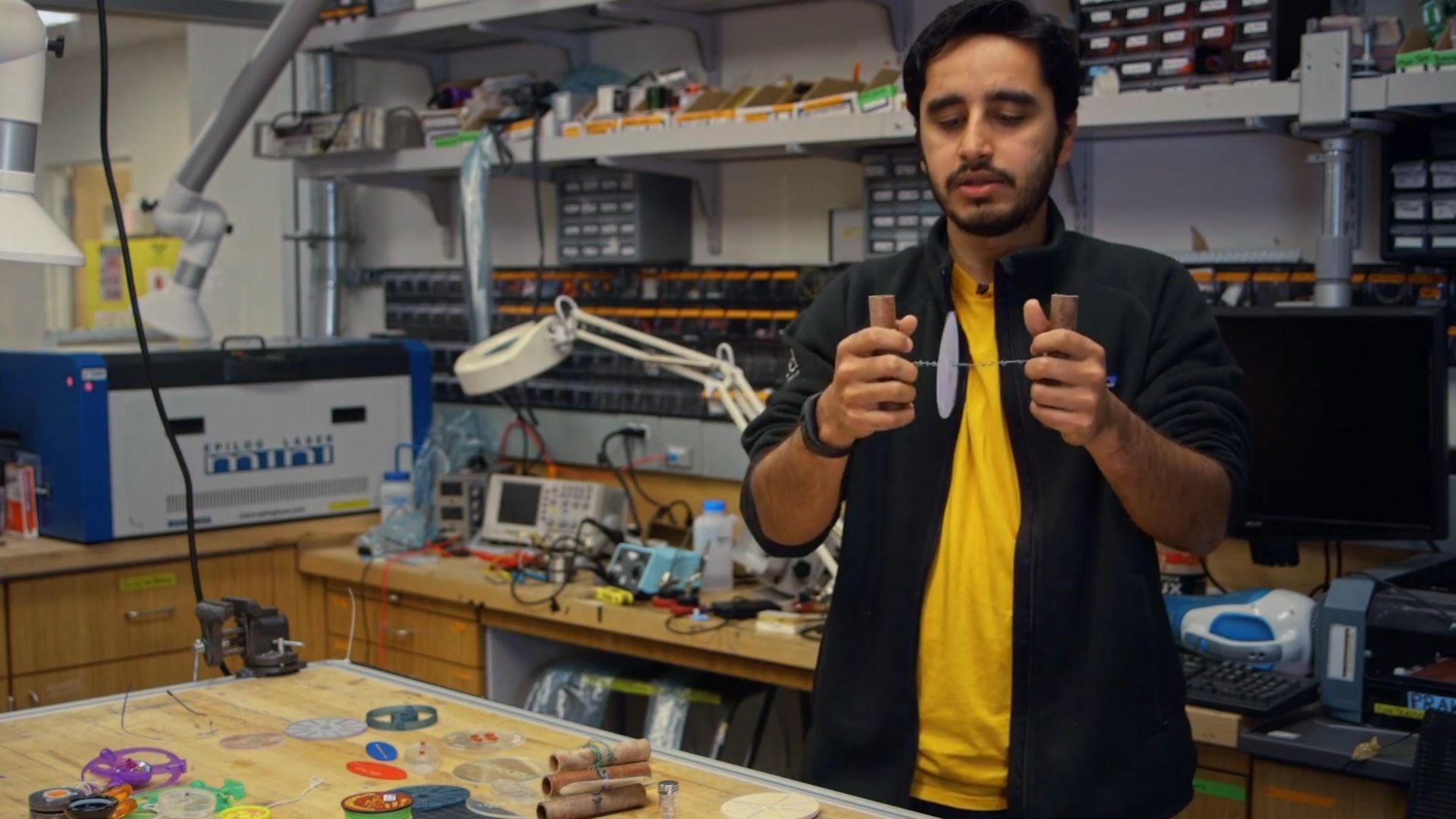
Idea for Pocket Laboratory Uses Paper and Twine to Spin Samples at High Speed, Dispenses Electricity and Shortens a Common Step in Blood Analysis, with Results Described by Researchers and Covered by Scientific Institutions.
Researchers associated with Stanford University described an ultra-compact centrifuge made from simple materials, powered by human force and capable of reaching 125,000 revolutions per minute, performance comparable to benchtop equipment used in laboratories.
Nicknamed “paperfuge”, the device was presented as a low-cost alternative for basic sample preparation steps, such as separating plasma from blood in less than 1.5 minutes, without relying on electricity.
Why Centrifugation Becomes a Bottleneck Without Infrastructure
The centrifuge is one of the most common instruments in laboratory routines and healthcare services because it allows for the separation of components from a sample, such as cells and liquids, through high-speed rotation.
-
The Himalayas continue to grow to this day, with tectonic plates advancing 5 cm per year, mountains rising up to 10 mm annually, and the 2015 earthquake that killed 9,000 people may have increased the risk of an even larger seismic mega-event.

-
At an altitude of 400 km by astronauts from the International Space Station, Paris transforms at night into a golden mesh so precise that it reveals the outline of the Seine River, avenues, and entire neighborhoods like a luminous map drawn over the Earth.

-
iPhone 17 reaches historic low price with 256 GB, 120 Hz display, and drops to R$ 5,703 on Shopee, featuring A19 chip, dual 48 MP cameras, battery life of up to 30 hours, and advanced AI features.

-
Trip to Mars getting closer: Pulsar Fusion, from the UK, advances with plasma ignition in fusion engine and could drastically reduce space travel time, making crewed missions faster, safer, and economically viable.


In places where electrical power is unstable, where equipment and maintenance are lacking, or where transporting heavy machines is unfeasible, this step can become a bottleneck for tests that require processing of collected material.
In presenting the paperfuge, the authors highlighted this scenario of limited infrastructure as motivation for seeking a simple, portable mechanism at a much lower cost than conventional centrifuges.
Ancient Toy Inspires the Mechanism of the Paperfuge
The project was inspired by the mechanics of an old toy known in different countries as “whirligig” or “buzzer,” formed by a disk threaded with a cord that winds and unwinds when a person pulls the ends.
The team applied this principle to a lightweight disk that holds small samples, such as capillaries used in blood tests, and reported optimizing dimensions and materials to maximize the rotation generated by repeated pulling action.

In publications and institutional communications, the paperfuge is described as a “pocket” centrifuge built from simple items like paper, twine, and small plastic parts, with an estimated cost of about US$ 0.20 and a reported weight of approximately 2 grams.
125,000 RPM and 30,000 G: Performance Numbers
The performance numbers presented as a result of testing and modeling are at the center of the impact of the work.
According to the scientific description of the device, the paperfuge reaches 125,000 revolutions per minute and a centrifugal force equivalent of up to 30,000 times the force of gravity, a parameter used to compare its separation capacity with that of traditional equipment.
In promotional notes associated with the study, the researchers reported using high-speed camera recordings to measure the rotation achieved through human power.
Plasma Separation in 1.5 Minutes and Applications Mentioned in the Study
In the most cited demonstration, the paperfuge was able to separate plasma from whole blood in less than 1.5 minutes, a timeframe compatible with routines where obtaining plasma is necessary for further analysis.
The work also mentions the possibility of isolating malaria parasites in approximately 15 minutes, still as part of the sample processing that, under conventional conditions, depends on centrifuges and laboratory infrastructure.
The authors presented these results as examples of the type of preliminary step that can be completed even in resource-limited environments, provided there is proper sample collection and handling by trained professionals.
Modeling and Validation: From Improvisation to Engineering
The study describes that the performance did not come solely from trial and error.

The team developed and validated a theoretical model of the “whirligig” motion, treating the system as a nonlinear oscillator, to understand why certain adjustments increase rotation and how to reduce energy losses.
With this, it was possible to guide design choices such as disk radius, material width, and cord characteristics, seeking greater stability and repeatability in rotation.
This approach was presented as a way to transform a simple mechanical principle into a tool with controllable parameters, closer to the demands of use in health and research procedures.
Frugal Science and Access to Scientific Instruments
The institutional release from Stanford framed the paperfuge as part of a line of “frugal science”, which aims to reduce costs and barriers to access to scientific instruments without depending on complex infrastructure.
In this context, the paperfuge was described as an example of how a known mechanism for centuries can be reconfigured to address a contemporary problem: bringing basic sample preparation steps to regions where expensive, heavy, and energy-dependent equipment does not easily reach.
What Did the NIH Say About the Paper Centrifuge
The NIH in the United States also summarized the work by highlighting that the ultra-lightweight and ultra-low-cost centrifuge, based on a toy, can separate blood components in less than two minutes.
The note reinforces the prototype character oriented toward global scenarios of low resource availability, not treating the device as a direct replacement for complete medical infrastructure, but as a potential facilitator for specific steps in diagnostic flows.
Role of the Paperfuge in Sample Preparation, Without Promises Beyond What Has Been Published

Although the rotation and separation times attract attention, the authors describe the paperfuge as a sample preparation tool and not as a test itself.
In laboratories, centrifugation is often just a preceding step to analysis in appropriate equipment or readings in specific systems.
In remote areas, the proposal discussed in publications is to reduce the number of barriers to carrying out this first step, bringing the capacity for sample processing closer to where the patient is, when safety, storage, and forwarding conditions are adequately met.
Engineering, Reliability, and Adoption Limits
The presentation of the paperfuge also rekindled an ongoing discussion in the field of technology applied to health: to what extent can engineering simplify essential steps without losing reliability.
In this case, the bet was to use a known mechanical principle and detail its limits through modeling and experimental validation, instead of relying solely on improvisation.
At the same time, adoption in real scenarios requires integration with protocols, training, biosafety, and supply chain elements that are not resolved merely with a cheap device, but can be impacted when an expensive, energy-dependent step is no longer a blockage.
If a centrifuge made from simple materials can fulfill a critical step in sample processing without electricity, what other laboratory equipment could be reinvented to function under minimal conditions without losing practical utility?






Seja o primeiro a reagir!