





 Portuguese
  English
  Spanish
  3 min of reading
  0 comments


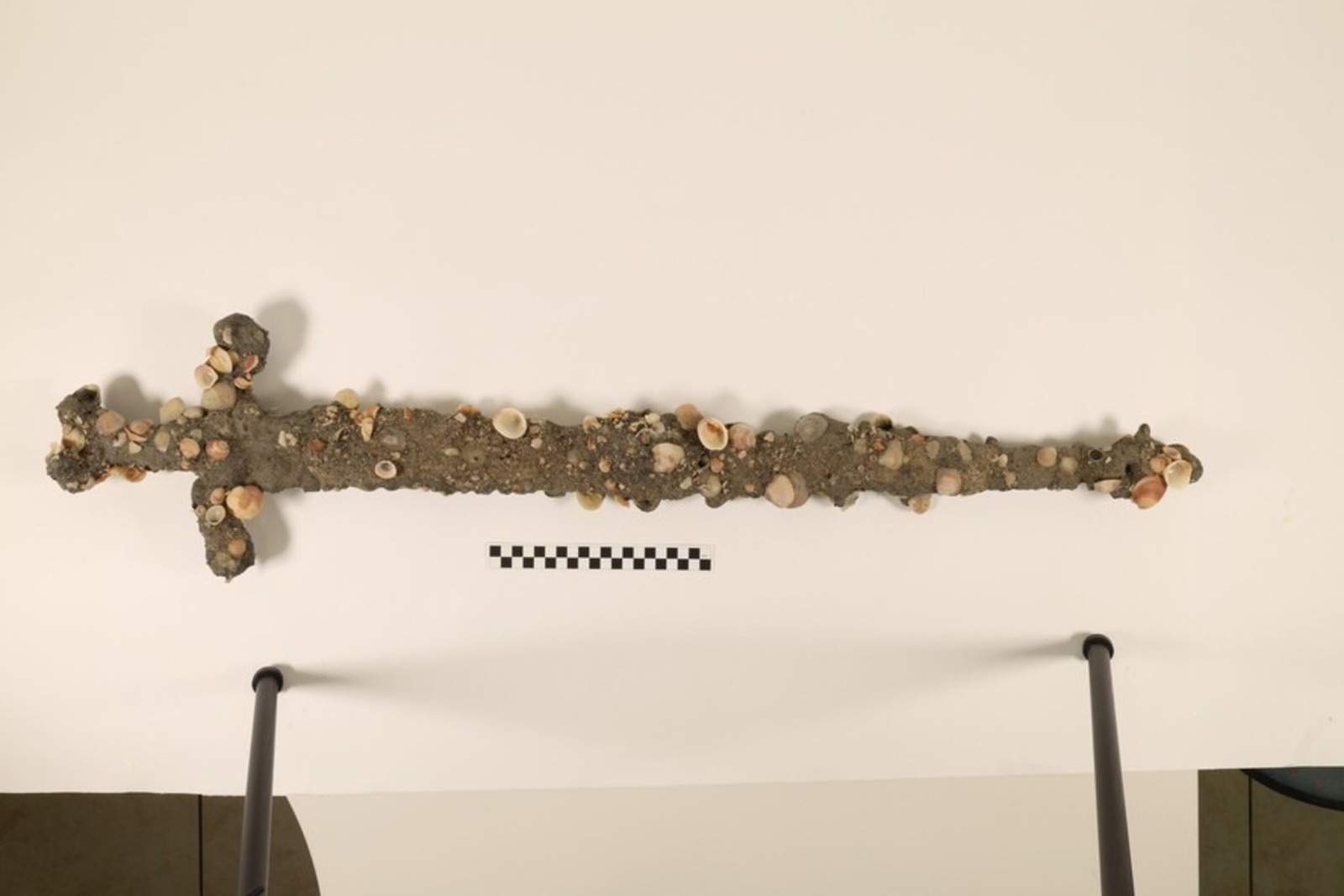
Medieval Sword About 1 Meter Found by University of Haifa Student at Bottom of Sea May Reveal Details About European Crusaders and Anchors Used in Medieval Mediterranean
A student from the University of Haifa discovered a medieval sword about 1 meter long at the bottom of the sea off the Mediterranean coast of Israel. The find, dated to the 12th century, may enhance the understanding of European crusaders in the region.
Discovery Occurred During Diving Off Coast of Israel
The artifact was found by Shlomi Katzin, a graduate student in the Department of Maritime Civilizations at the University of Haifa.
He was swimming in the area when he noticed a group of divers using metal detectors.
-
If Ormuz closes, the world freezes: the 1,200 km Saudi Petroline transports oil from the Gulf to the Red Sea, operates near 7 million barrels/day, and becomes a geopolitical weapon in the crisis with the US.

-
Scientists restore seagrass meadows in the open sea.

-
Scientists find about 1 million giant live eggs hatching in an active underwater volcano, discover a natural furnace on the ocean floor, and reveal one of the most unlikely nurseries ever seen in the ocean.
-
Scientists launched a bait camera to the bottom of the Pacific Ocean and saw something that no one expected.

Katzin suspected the divers might be trying to illegally retrieve historical artifacts.
After the group left the site, he noticed the hilt of an ancient medieval sword partially buried in the sand.
The object was covered with sand and barnacles accumulated over centuries at the bottom of the sea. Even so, its shape allowed for quick identification as a potentially important historical artifact.
Student Had Already Found Similar Object
This was not the first time Katzin identified an artifact of this type in the same area. In 2021, he had already located another sword related to the medieval period in the coastal region.
As soon as he realized the archaeological significance of the find, the student immediately informed nautical archaeologist Deborah Cvikel, who is also a researcher at the University of Haifa.
After the communication, the Israel Antiquities Authority authorized a controlled excavation to recover the weapon from the bottom of the sea and allow for detailed scientific studies.
Historical Importance of the Medieval Sword Found
According to Deborah Cvikel, the discovery represents an extremely rare find related to the presence of European crusaders along the Israeli coastline during the Middle Ages.
The researcher explained that only a small number of swords from this period, between 1095 and 1291, have been identified in the territory of Israel to date.
According to Cvikel, this type of artifact helps archaeologists better understand the functioning of maritime anchors and the daily life of warriors during the Crusades.
Examinations Reveal Damage Caused by the Sea
After recovery, researchers used hospital computed tomography to analyze the interior of the medieval sword without removing the thick layer of accumulated sediments.
The examination revealed that a significant part of the iron core of the blade had deteriorated due to prolonged exposure to seawater.
The researchers also identified structural fractures in the weapon, indicating that corrosion over the centuries compromised part of the integrity of the original material.
Despite this, the data allowed for recognition of important characteristics. The sword was designed for one-handed combat, a common standard among medieval knights.
The shape and construction suggest that the weapon may have belonged to a Frankish crusader, one of the European warriors who participated in military campaigns in the so-called Holy Land.
Swords Had Military and Symbolic Functions
During the Crusades, Christian knights from primarily Western Europe waged religious wars against Muslim forces for control of the region.
In this historical context, the medieval sword held not only military utility but also significant symbolic value for Christian knights.
Researcher Sára Lantos explained that, in the Middle Ages, the sword became a symbol of chivalry and also of Christian faith among European warriors.
According to archaeologists, it is unlikely that the weapon was deliberately discarded. Metal was valuable and frequently recycled during that period.
Therefore, researchers consider it more likely that the sword was lost at sea during a battle, a shipwreck, or an accident at a coastal anchorage.
With information from Galileu Magazine.







-

-

-

-

-

18 pessoas reagiram a isso.