Portuguese
  Spanish


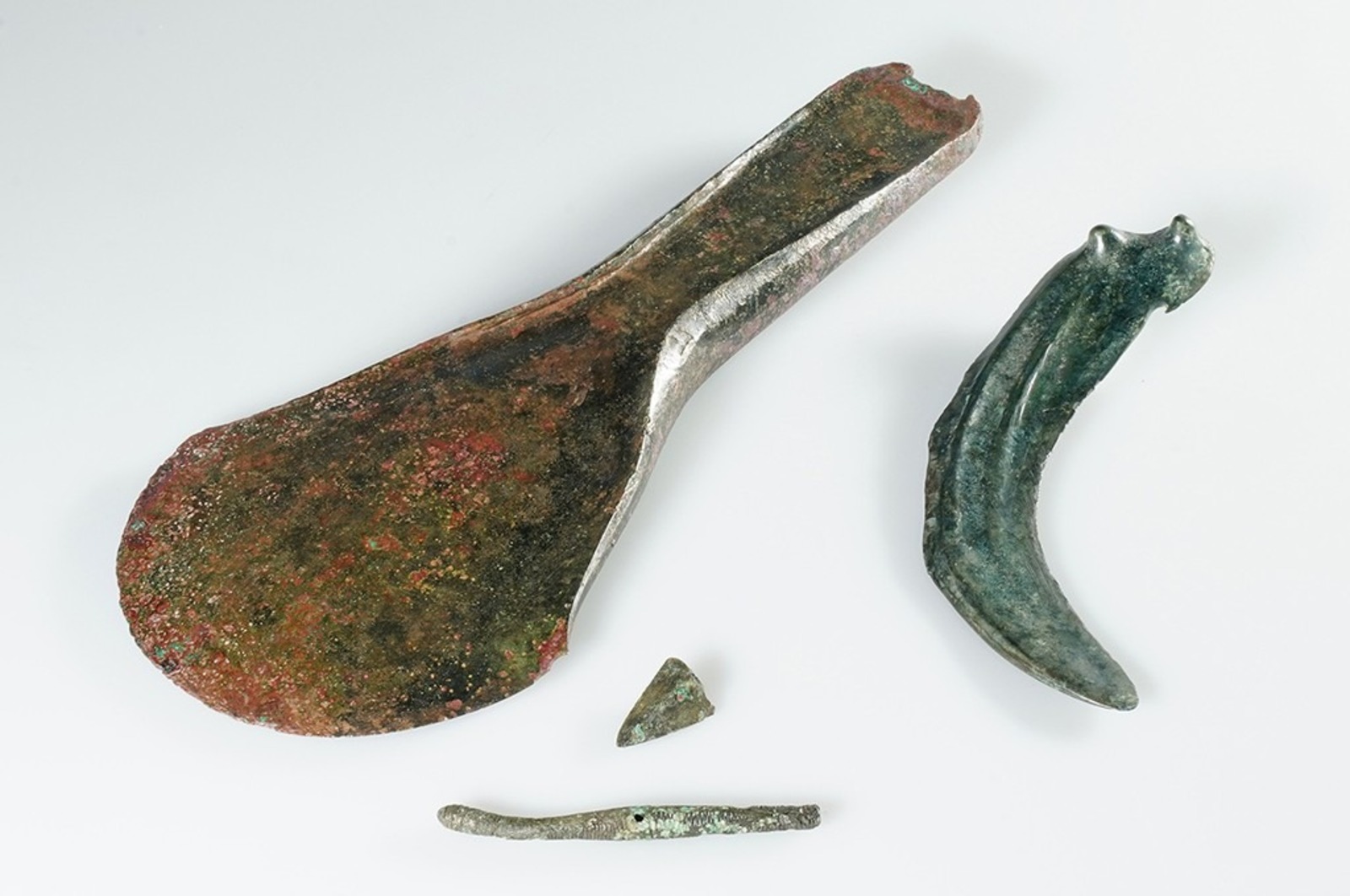


3,500-Year-Old Bronze Axe with 22 cm and Metal Pin Found on the Slope of Schlossfelsen in the Leimental Valley, Switzerland, During Archaeological Survey Conducted in the Summer of 2024
A 3,500-year-old bronze axe was discovered in the Leimental Valley, in northwestern Switzerland, during an archaeological survey in 2024. The find, which also includes a metal pin, reinforces the regional significance of the Bronze Age discovery.
The discovery was announced by Archäologie Baselland after a field survey conducted in the summer of 2024.
The artifacts were found on the steep slope below Schlossfelsen, a rocky outcrop located above the border village of Burg im Leimental, near France.
-
Artist’s 15-Meter Lighthouse in the Mojave Desert, 160 km from the Sea, Intrigues Visitors with 19 km Range After Years of Bureaucracy

-
Bluetti AC70 Solar-Powered Station: Powers Fridge and Wi-Fi During Blackouts, Delivers 1,000W, 3,000 Charge Cycles, Priced at $900

-
Enormous Black Hole Phoenix A* Challenges Scientific Understanding with Mass of 100 Billion Suns, Surpassing Famous TON 618 in One of the Largest Known Galaxy Clusters
-
Say Goodbye to Storing Wine in a Regular Fridge: Midea’s Climate-Controlled Cellar Holds 34 Bottles, Maintains 5-18°C, and Uses Only Half a kWh Daily


The axe measures approximately 22 centimeters in length. Despite its relatively compact size, the object is quite heavy due to its solid bronze construction and has an exceptional finish.
The set of characteristics makes the piece regarded as one of the most remarkable discoveries of the Bronze Age in the region.
In addition to the axe, a bronze clothing pin was also identified. The proximity between the two objects suggests that they may have been deposited together in the past.
Context of the Bronze Age Discovery at the Site
The find was made by a volunteer researcher participating in a systematic archaeological survey using a metal detector. While scanning the steep terrain, he first located the solid bronze axe.
A short distance from the first object, the researcher found the clothing pin. Both were hidden in the rocky slope, within a cavity filled with earth.
According to archaeologists, the site had previously provided archaeological remains. In 1858, a bronze sickle was discovered in the same area of Schlossfelsen.
All objects found there date back to the Middle Bronze Age, a period approximately around 1500 BC. This history increases scientific interest surrounding the Bronze Age discovery.
Possible Ritual Treasure Buried
Researchers believe that the objects may have belonged to a larger set of metal artifacts.
The hypothesis raised is that the site may have housed a broader treasure that ended up being looted or dispersed over time.
During the Bronze Age in Europe, it was common for communities to intentionally bury deposits of metal objects. These deposits are known as archaeological treasures.
Some of these sets contained dozens or even over a hundred items, including tools, weapons, and jewelry. Many researchers interpret these deposits as ritual offerings intended for deities.
These objects could be buried in the ground, placed in rock crevices, or deposited in rivers and marshes. The rituals likely had spiritual significance for the communities of the time.
The axe from Burg was found inside a cavity in the rock, which may indicate that it was deliberately deposited.
Nevertheless, the presence of other artifacts at the site prevents archaeologists from ruling out the possibility of a larger treasure.
The Axe Classified as “Grenchen Type”
The newly discovered object belongs to the category known as flange axe of the so-called Grenchen type. This classification originates from a discovery made in 1856.
That year, works at a spring in the city of Grenchen revealed a deposit containing four axes, four sickles, and a fragment of a sword.
Since then, the specific shape of these axes has been identified as Grenchen type, in reference to the site of the first discovery.
The specimen found in Burg reinforces evidence that this model was widely spread in the Jura region during the Middle Bronze Age.
The repetition of this type of artifact in northwestern Switzerland suggests the existence of regional connections between communities of the time. These connections likely involved trade routes through the Jura mountains.
Region with Increasing Archaeological Importance
Currently, Burg im Leimental is a small village located near the border between Switzerland and France. However, its geographical position may have been of great importance during prehistoric periods.
The area is situated in a fertile landscape that connects natural routes towards the Rhine and Rhône valleys.
Archaeological discoveries made in Rodersdorf and other nearby locations confirm that the region was inhabited during the Middle Bronze Age.
In 1998, a larger Bronze Age treasure was discovered in Biederthal, France. The site is just one kilometer from the location of the current Bronze Age discovery.
Together, these findings indicate that the area between the Sundgau plain and the northern slopes of the Jura played a significant role for Bronze Age populations. The region may have functioned as a settlement area, trade corridor, or ritual landscape.
Public Exhibition of the Artifacts
The bronze axe and the clothing pin are now on public display. The pieces are part of the special exhibition “Schatzfunde,” which means “Treasure Finds.”
The exhibition takes place at the Basel Historical Museum, located in the Barfüsserkirche.
In addition to the newly discovered objects, the exhibition features Celtic coins made of gold and silver recently found in Arisdorf.
With the new Bronze Age discovery, Burg im Leimental is added to a growing list of significant archaeological sites in Switzerland.
Ongoing research may determine whether the axe represented an isolated ritual offering or if it is the last remnant of a much larger treasure buried there about 3,500 years ago.
With information from Arkeonews.