





 Portuguese
  English
  Spanish
  7 min of reading
  1 comment


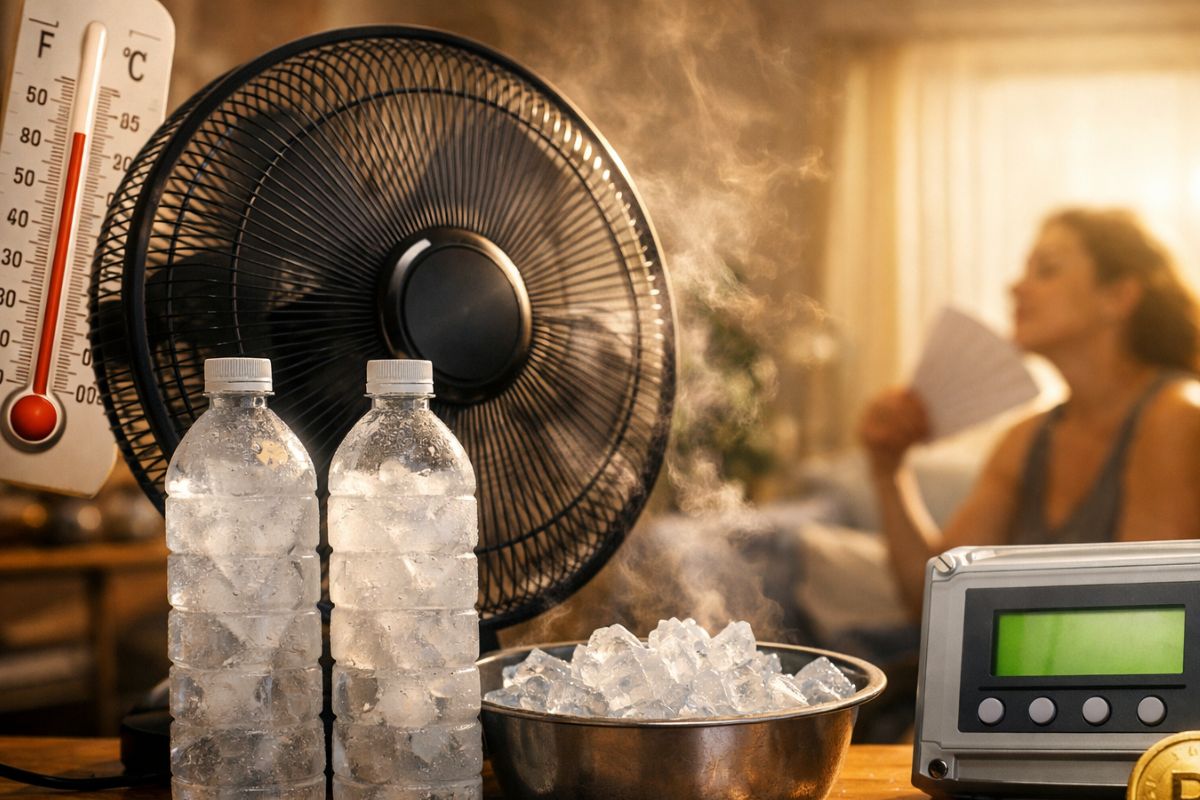


Trick Uses Evaporation to Boost a Regular Fan: Wet Towel with Cold Water Near the Front or Back of the Unit. The Air Passes Through the Moisture and the Feeling of Heat Decreases. The Rule is Safety: Towel Away from the Grille and the Blades, Changed Every 2 or 3 Hours.
By the end of December 2025 and in the first days of January 2026, with summer just starting and the heat rising indoors, many people started looking for alternatives to cool down without relying on air conditioning. In this scenario, the trick of the boosted fan gained traction for being simple and economical.
The idea is to take advantage of evaporation to make the breeze more pleasant and reduce that “oven” feeling, keeping energy consumption much lower than that of a mid-sized air conditioner. However, for it to work well and without surprises, the trick requires extra care: the fabric must never get close to the blades.
What is the Boosted Fan Trick and Why So Many People Try It
The trick transforms a regular fan into something that resembles a cooler, without buying a new unit.
-
The Himalayas continue to grow to this day, with tectonic plates advancing 5 cm per year, mountains rising up to 10 mm annually, and the 2015 earthquake that killed 9,000 people may have increased the risk of an even larger seismic mega-event.

-
At an altitude of 400 km by astronauts from the International Space Station, Paris transforms at night into a golden mesh so precise that it reveals the outline of the Seine River, avenues, and entire neighborhoods like a luminous map drawn over the Earth.

-
iPhone 17 reaches historic low price with 256 GB, 120 Hz display, and drops to R$ 5,703 on Shopee, featuring A19 chip, dual 48 MP cameras, battery life of up to 30 hours, and advanced AI features.

-
Trip to Mars getting closer: Pulsar Fusion, from the UK, advances with plasma ignition in fusion engine and could drastically reduce space travel time, making crewed missions faster, safer, and economically viable.

Instead of just pushing hot air back and forth, you place a damp towel in the airflow path.
When the fan pulls in air and blows it back out, part of that air passes through the moisture of the towel, helping to decrease the feeling of heat in the environment.
The key point of the trick is evaporation. The water in the fabric disperses in particles in the airflow and this, in practice, can create the impression of a “cooler” breeze, especially on intensely hot days.
It is not air conditioning, but it typically provides quick relief at a lower cost.
What You Need to Do the Trick Right
You do not need any sophisticated equipment. The trick works with simple items:
- Regular fan (floor or other type, as long as it has a grille and a constant airflow)
- Clean towel that can retain moisture without dripping too much
- Water, preferably cold, for a more noticeable effect
- If using at the front, hooks or some secure way to keep the fabric from falling into the grille
Here, a practical rule applies: the trick does not rely on “brute force”, but rather on positioning and safety. A well-placed towel is more effective than a rushed improvisation.
Step-by-Step to Boost the Fan with the Wet Towel
Below is a detailed step-by-step guide to apply the trick with more control.
1) Prepare the Towel the Right Way
Wet the towel and, if possible, use cold water. The towel needs to be damp but not so much that it drips constantly.
The idea of the trick is to have moisture in the airflow, not water dripping on the unit.
Phrase to Remember: damp towel is the goal, soaking wet is a risk and a mess.
2) Choose Where to Position: Back or Front
The trick can be applied in two ways, and each requires specific attention.
Option A: Towel Behind the Fan
Position the towel at the back of the unit, near the area where the fan pulls in air before blowing it out.
When the air is pulled in, it passes close to the damp towel and carries some of that moisture into the airflow coming out the front.
Option B: Towel in Front of the Fan
Here, the towel is in front but needs to be securely held, usually with hooks, so it does not sway or touch the grille.
The airflow hits the damp towel and “carries” moisture into the environment.
This version of the trick can work well but requires extra attention to prevent the fabric from getting near the blades.
3) Adjust the Fan for a Constant Flow and Observe
Turn on the fan and see if the breeze is continuously passing through a damp area. The trick works best when the flow is uninterrupted and when the towel remains stable, without moving toward the grille.
If the towel sways too much, reposition it. If it gets too close to the grille, stop and adjust immediately. Safety comes before comfort.
The Extra Care That Cannot Be Ignored: Blades and Grille
The most important part of the entire trick is this: the towel must never touch the grille or blades.
If the fabric is pulled by the airflow and “sucked” toward the motor, a series of problems can occur:
- jam the unit
- strain the motor
- cause overheating
- burn out the fan
- lead to domestic incidents
Therefore, maintain a safe distance between the towel and the fan grille. The trick does not depend on touching the unit. It relies on the air passing through the moisture, and this is possible without contact.
If you choose to place the towel in front, the hooks or fastening system must serve a very clear purpose: to hold the fabric firmly and away from the blade area.
If it cannot be ensured, the back option is usually more manageable.
How to Maintain the Trick’s Effect Throughout the Day
The trick has a “time of efficiency” because the towel will dry out. To maintain the enhanced effect, the recommendation is to change the towel every 2 or 3 hours, keeping the moisture consistent.
This does not mean replacing the fan, changing parts, or getting creative. It simply means keeping the fabric damp so the air can continue passing over a surface that still provides evaporation.
A practical point: when the towel dries, you revert to the regular fan. So, if the idea is to use the trick for a longer period, plan this change as part of the process.
What Really Changes in the Environmental Feel
It is important to align expectations so the trick does not lead to frustration.
- The boosted fan can provide a more pleasant airflow and reduce the discomfort of intense heat.
- It can resemble a cooler precisely because it uses moisture in the flow.
- It does not become an air conditioner. It is not a closed cooling system, nor does it have the same capacity to cool a room as a dedicated unit.
In other words, the trick is about comfort and savings, not about “cooling the house” like an air conditioner would.
Real Savings: Why So Many People Prefer the Trick Over Air Conditioning
The major competitive advantage of the trick lies in its cost-effectiveness. Technically, a regular fan uses about 10 times less energy than a mid-sized air conditioner.
This impacts the electricity bill, especially during frequent usage periods.
What makes the trick appealing is the combination of three factors:
- you use an appliance you already have at home
- you do not need to buy new equipment to feel some relief
- it keeps consumption well below that of air conditioning, with a more comfortable feel than just “hot wind”
For many people, the trick fits as an emergency solution or as an alternative for times when turning on the air conditioning would be expensive or unfeasible.
Common Mistakes That Make the Trick Go Wrong or Become Dangerous
When the trick does not work or causes concern, it is almost always due to positioning and control errors. The most common issues are:
Towel Touching the Grille
Besides reducing stability, this increases the risk of the fabric being pulled. Grille is not a towel support.
Loose Towel Without Fastening, Swaying in the Wind
If the cloth keeps moving, it may gradually drift closer to the blades. The trick needs stability.
Excess Water Dripping
Soaking wet towel is not “more powerful.”
It creates more mess and more risk. The idea is moisture in the air, not water flowing into the unit.
Forgetting to Change the Fabric
Without changing, the towel dries and the trick loses its effect. If the intention is to maintain comfort, changing it every 2 or 3 hours becomes part of the usage.
Quick Safety Checklist Before Turning On
Before using the trick, mentally go through this checklist:
- Is the towel firm and stable?
- Is it away from the grille and blades?
- Is there no chance of the cloth being pulled by the airflow?
- Is the towel damp without water dripping onto the fan?
- Can you observe the setup for a few minutes at the beginning to ensure nothing moves?
If any answer is “no”, adjust it first.
The trick is only worthwhile when it is comfortable and safe at the same time.
How to Better Enjoy the Boosted Fan Without Getting Creative
Without creating new “makeshift solutions,” you can enhance the experience of the trick just by paying attention to its use:
- Direct the airflow to where people actually stay, instead of blowing into an empty corner.
- If opting for the towel in front, use hooks or fastenings that keep the fabric away from the grille at all times.
- Change the towel at the recommended interval to avoid losing the effect.
- Prioritize stability: the trick works best when the setup remains still and predictable.
Have you tried this trick of the boosted fan with a wet towel and truly felt a difference, or did it just feel like “wind with moisture” and nothing really changed for you?










Puxei3 anos e meiono fechado. Eu pegava minha tolha grande, nolhava, torcia e pendurava estendida sobre a cortina da jega. O ventiladorzinho jogava o vento que batia nela e espalhava e era fresquinho.