





 Portuguese
  English
  Spanish
  5 min of reading
  0 comments


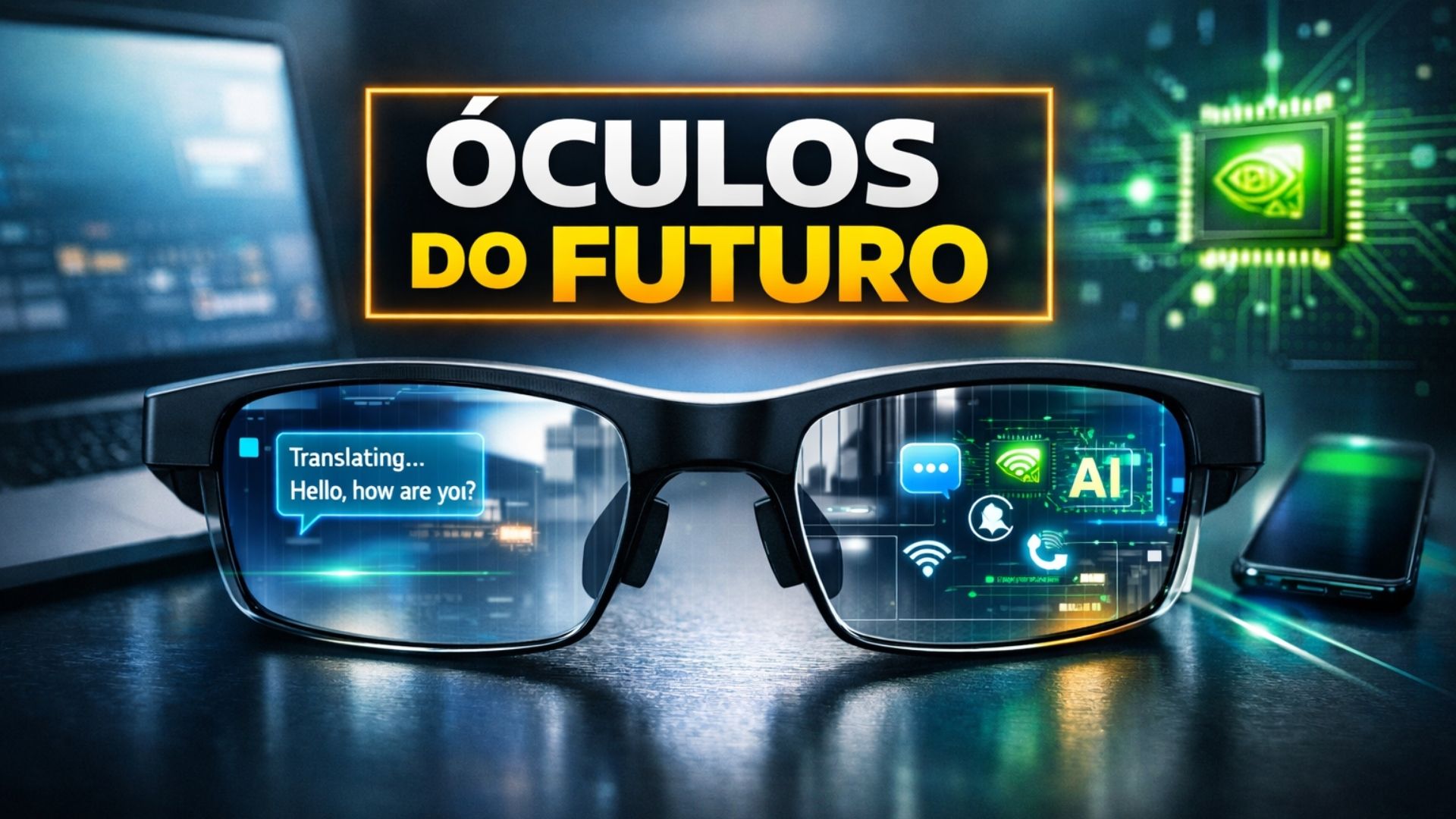
Concept of Smart Glasses, Local AI Hub and Context-Sensitive Displays Integrate Strategy Presented as Proof of Concept, Focused on Distributed Personal Computing, Local Processing and Integration Between Devices, According to Information Published by the Windows Latest Site.
Lenovo is preparing a comprehensive presentation of concepts related to personal computing with artificial intelligence for CES 2026 in Las Vegas.
According to the information released, the company is expected to place at the center of its strategy a model of smart glasses aimed at everyday use, with direct connection to smartphones and computers.
The information was published by the Windows Latest site, which describes a series of interconnected proofs of concept.
-
The Himalayas continue to grow to this day, with tectonic plates advancing 5 cm per year, mountains rising up to 10 mm annually, and the 2015 earthquake that killed 9,000 people may have increased the risk of an even larger seismic mega-event.

-
At an altitude of 400 km by astronauts from the International Space Station, Paris transforms at night into a golden mesh so precise that it reveals the outline of the Seine River, avenues, and entire neighborhoods like a luminous map drawn over the Earth.

-
iPhone 17 reaches historic low price with 256 GB, 120 Hz display, and drops to R$ 5,703 on Shopee, featuring A19 chip, dual 48 MP cameras, battery life of up to 30 hours, and advanced AI features.
-
Trip to Mars getting closer: Pulsar Fusion, from the UK, advances with plasma ignition in fusion engine and could drastically reduce space travel time, making crewed missions faster, safer, and economically viable.


The set includes the Lenovo AI Glasses, a local AI hub, and new types of context-sensitive monitors.
According to the publication, the initiative indicates a different approach than that adopted by more robust mixed reality headsets.
Instead of larger, standalone devices, Lenovo would be exploring a wearable with an appearance closer to that of conventional glasses.
This accessory would be integrated into an ecosystem of processing and AI services running outside the frame.
Smart Glasses Connected to Smartphones and PCs
According to Windows Latest, the Lenovo AI Glasses Concept was designed as a constantly connected accessory.
The focus would be on productivity and quick information consumption.

The material indicates that the device communicates wirelessly with smartphones and PCs.
Among the described functions are answering calls, controlling music, and accessing data through voice commands or touches on the frame.
This proposal would reduce the need for constant interaction with other devices.
The publication also describes a feature aimed at professional use.
It consists of an integrated teleprompter mode, aimed at presentations, lectures, and live broadcasts.
The proposal, according to the leak, is to provide visual support directly in the field of view, discreetly.
The idea arises as an alternative to using external screens or additional devices.
In the physical aspect, the concept prioritizes lightweight and autonomy.
The information indicates an approximate weight of 45 grams.
The estimated autonomy is up to eight hours of usage in a scenario considered “mixed,” combining work and entertainment.
The internal tests mentioned would have been conducted with screen brightness around 50%.
This factor suggests variations depending on the usage standard and operating conditions.
Distributed AI Architecture and Near Real-Time Translation
The artificial intelligence experience described in the leak relies on an assistant called Lenovo Qira.
This assistant has not yet been officially announced by the company.
According to Windows Latest, the processing of tasks would not occur in the glasses.
Operations would be carried out on connected devices, such as smartphones, PCs, or a dedicated hub.
This architecture would require compatibility with the platform.

According to the investigation, this model would allow for near real-time simultaneous translation.
Also mentioned are features of image recognition from a front-facing camera.
Another point mentioned is the provision of contextual information about the environment.
In this model, the glasses would serve as visual interface and command input.
The processing capacity would be centralized in other devices.
Local AI Hub and the Concept of Project Kubit
The glasses do not appear in isolation in the set of ideas described.
Lenovo is also expected to present a concept called Personal AI Hub.
Internally, the project is known as Project Kubit.
It is defined as a kind of personal edge cloud.
The proposal, according to Windows Latest, is to reduce dependence on public clouds.
Another goal would be to keep sensitive data processed locally.
The information indicates that Project Kubit would consist of two compact ThinkStation PGX stations.
These stations would be based on the NVIDIA GB10 Grace Blackwell superchip.
The mentioned configuration promises up to one petaflop of AI performance per system.
Support would be for models of up to 200 billion parameters.
When two units operate together, the limit could exceed 400 billion parameters.
The existence of the ThinkStation PGX has already been publicly confirmed by Lenovo.
The general specifications of the GB10 chip have also been released by NVIDIA.
The leak associates this hardware with the role of core of the ecosystem.
This core would concentrate and process data coming from PCs, smartphones, wearables, and smart home devices.
The glasses themselves would also be part of this data flow.
In this scenario, the hub would function as a central layer of personal AI.
The system would have continuous learning based on usage.
The control would combine voice commands and interaction with a transparent touchscreen.
The proposal is to facilitate task management.
Smart Displays and Integration Between Devices
Another element mentioned in the investigation is the Smart Sense Display Concept.
The device is described as a 27-inch UHD monitor.
It would automatically connect, wirelessly or wirelessly, to different devices.
The idea presented involves facilitating multitasking.
Control by natural language is also mentioned.
This display would integrate into the same environment of personal AI described in the leak.
With this, Lenovo, according to the set of disclosed information, would be exploring a strategy based on three fronts.
The first involves a lightweight wearable as an interface.
The second is a local AI core running on dedicated hardware.
The third includes displays and peripherals to unify the experience between devices.
As these are proofs of concept, uncertainties remain about commercial launch, pricing, and availability.
The company has not yet officially confirmed the Lenovo AI Glasses, the Project Kubit, the cited assistant, or the new displays.
CES typically features demonstrations that do not always turn into final products.
How will the market react to a proposal that distributes artificial intelligence across multiple devices, rather than concentrating it in a single headset?









-

-

3 pessoas reagiram a isso.