





 Portuguese
  English
  Spanish
  3 min of reading
  0 comments


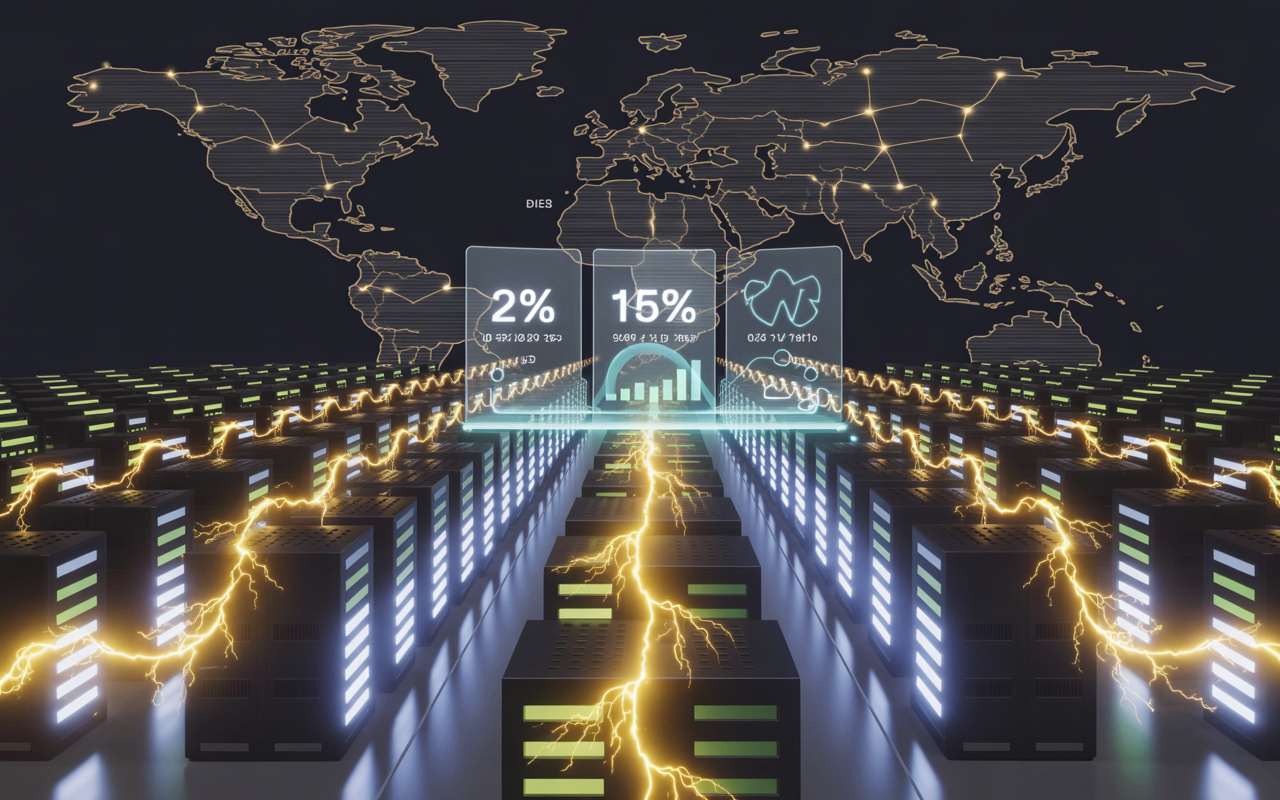
Data Centers Already Use Up to 2% of the World’s Electricity and Grow 15% Per Year, Revealing the Hidden Energy Cost of the AI Revolution.
For years, artificial intelligence has been treated as an essentially digital revolution, almost “invisible” from a physical standpoint. But supercomputers and state-of-the-art data centers have begun to reveal a less-discussed face of this advancement: the colossal energy cost that sustains increasingly larger AI models. Recent studies compiled by organizations like the International Energy Agency and analyses from MIT Technology Review show that data centers already account for about 2% of all electricity consumed in the world, a share comparable to the annual demand of medium-sized countries.
This number alone is impressive. What concerns experts is the speed of growth: energy demand linked to high-performance computing and AI is advancing at rates exceeding 15% per year, driven by increasingly complex models, continuous training, and applications on a global scale.
Why Does Training AI Consume So Much Energy?
Modern AI models, especially those focused on language, computer vision, and advanced data science, require billions or even trillions of mathematical operations. Each training step involves thousands of GPUs or specialized accelerators working simultaneously for weeks.
-
The gigantic steel shell built to contain Chernobyl for a century has been pierced by a drone, exposing a critical system and creating a hole that could cost over 500 million euros to repair.

-
Brazilian Navy reaches a new level by taking over an airport with a 1,600-meter runway used by 1,800 military personnel and autonomous attack drone testing.

-
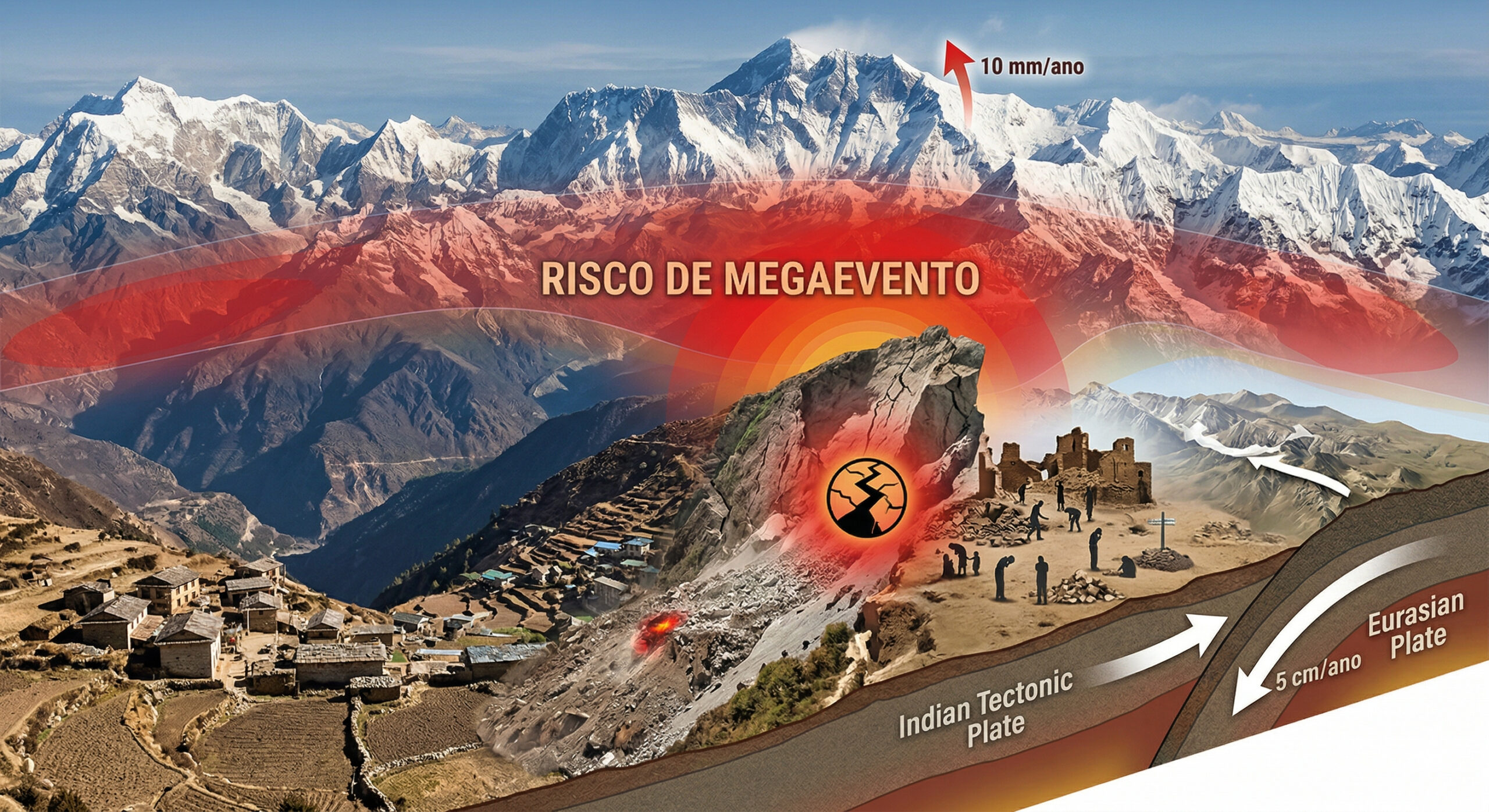
The Himalayas continue to grow to this day, with tectonic plates advancing 5 cm per year, mountains rising up to 10 mm annually, and the 2015 earthquake that killed 9,000 people may have increased the risk of an even larger seismic mega-event.
-
At an altitude of 400 km by astronauts from the International Space Station, Paris transforms at night into a golden mesh so precise that it reveals the outline of the Seine River, avenues, and entire neighborhoods like a luminous map drawn over the Earth.




These supercomputers operate in highly controlled environments, with continuous cooling systems, electrical redundancy, and infrastructure that needs to function 24 hours a day.
In many cases, the energy spent to cool the servers approaches or even exceeds the energy used in processing itself. This means that a single large data center has consumption comparable to that of entire cities.
When Data Centers Begin to Rival Countries
Technical reports indicate that the aggregated consumption of data centers in regions like the United States, Western Europe, and East Asia already rivals the annual expenditure of entire nations. In some U.S. states, data centers have become the largest individual consumers of electricity, straining local grids and forcing urgent investments in generation and transmission.
In practice, this means that the advancement of AI has ceased to be just a software issue and has become an energy and industrial problem.
Governments and utilities need to plan new plants, strengthen transmission lines, and deal with demand spikes that did not exist a decade ago.
Climate Impact: The Invisible Link Between AI and Emissions
The energy issue of AI is not limited to the volume of electricity but to the source of this energy. In regions where the electrical matrix still heavily relies on coal and natural gas, the explosive growth of data centers can significantly raise carbon emissions.
According to analyses compiled by the International Energy Agency, if the current expansion continues without a proportional transition to clean sources, the data center sector could become one of the fastest-growing vectors of emissions associated with technology.
This paradox is concerning: the same AI used to optimize electrical grids and predict climate changes can, indirectly, worsen the problem it tries to solve.
The Race for Clean and Dedicated Energy
In light of this scenario, technology giants have begun searching for their own solutions. Cloud computing and AI companies are investing billions in solar, wind, and nuclear energy contracts, trying to secure stable supply and reduce their carbon footprint.

In some cases, data centers are being built close to dedicated renewable sources, transforming entire regions into energy hubs almost exclusively focused on computing. Still, experts warn that the rapid expansion of AI occurs so quickly that, even with clean energy, the scale challenge remains.
A New Dilemma of the Digital Age
What supercomputers are showing is that artificial intelligence is not just an algorithmic advance but a global physical infrastructure, with a direct impact on energy, climate, and urban planning. As models become larger and more integrated into everyday life — from autonomous cars to financial and scientific systems — the debate over energy limits is no longer theoretical.
The AI revolution continues to accelerate, but now carries an unavoidable question: Will the planet be able to sustain, in terms of energy, the intelligence we are creating?








-

-

-

-

5 pessoas reagiram a isso.