





 Portuguese
  English
  Spanish
  6 min of reading
  9 comments


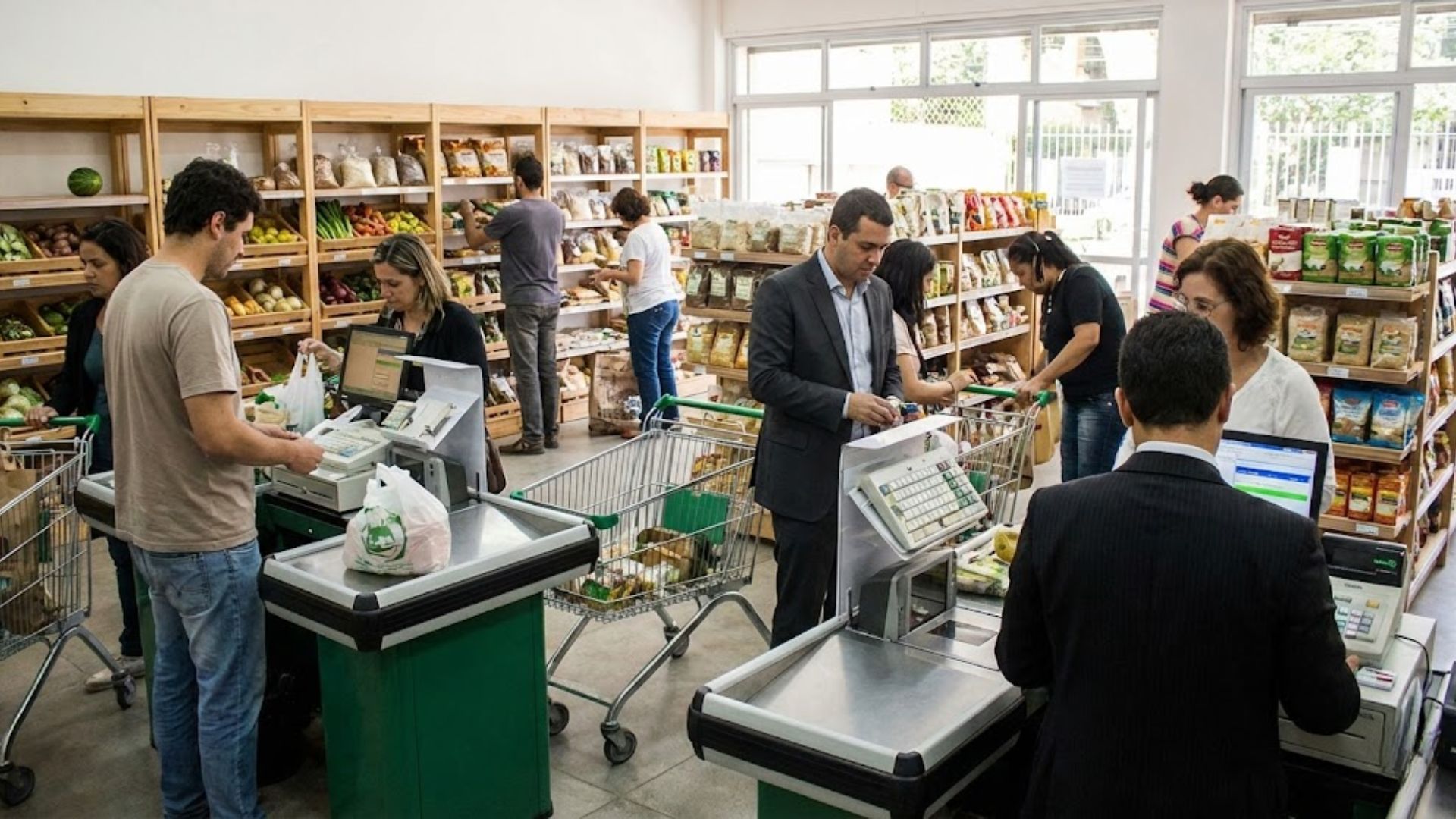


Participatory Market Model Debuts in São Paulo With a Focus on Consumer Collaboration, Exclusive Discounts, and the Offering of Sustainable Products, Following References From Cooperatives in the United States and Europe.
A new format of consumption is being tested in downtown São Paulo with the arrival of Gomo Coop, a cooperative that presents itself as the first participatory supermarket in Brazil.
In this model, the customer who becomes a member takes on a shift of about three hours of work every four weeks in routine tasks, such as cleaning, restocking goods, organizing inventory, and operating the cash register.
In return, they gain access to products at reduced prices compared to the general public.
-
The institute that trained the greatest aerospace engineers in Brazil has just opened its first campus outside São Paulo after 75 years: ITA Ceará will have R$ 445 million, new courses in energy and systems, and classes are expected to start in 2027.

-
Luciano Hang, owner of Havan, goes to Juiz de Fora after the tragedy in February, brings R$ 1 million, hands out R$ 2,000 cards, and donates up to R$ 15,000 to victims in the region.

-
The Brazilian passport allows legal residence in dozens of countries without the need for a prior visa, and most Brazilians are unaware that they can apply for residency directly upon arriving in nations in South America, Africa, and even Europe.

-
Petrobras sends a message to Brazilian truck drivers after fuel collapse and reveals plan to have 100% domestic diesel.


The first unit of Gomo Coop is located in the República area, the central part of the city, in a renovated warehouse.
The expectation is that the operation will open to the public in the first half of January, in an open manner, and will remain accessible to any consumer for at least six months, with different price levels between members and non-members.
The idea is to use this initial period to present how the system works and facilitate the onboarding of new participants.
How the Participatory Supermarket Works

In practice, Gomo Coop is organized as a participatory consumer cooperative.
To purchase with discounts, it is not enough to simply register: one must become a member, which involves acquiring a capital share worth R$ 100 and committing to periodic work shifts.
The member takes on a shift of about three hours every four weeks, on a schedule defined by the cooperative itself, and can perform different internal functions.
Among the expected activities are cash handling, shelf organization, receiving goods, cleaning the space, and administrative support.
There is no employment relationship with Gomo Coop: this is a requirement for participation in order to have the right to purchase at lower prices and to vote on cooperative decisions.
Before starting, interested individuals must participate in a welcome meeting, held online, on dates announced through the initiative’s official channels.
In these meetings, the coordination details rules, obligations, rights of members, and the content of the Member’s Manual, a document that consolidates internal norms and guides the operation of the market.
Practical workshops are also planned to teach operational and customer service tasks, without requiring prior retail experience.
Discounted Products and Sustainable Offering
Besides the work format, Gomo Coop aims to differentiate itself by its offering.
The proposal is to facilitate access to agroecological products, items from family farming, sustainable extractivism foods, and products from indigenous peoples and networks linked to agrarian reform.
In much of traditional retail, these items are often perceived as high-value, with prices above the average of conventional products.
By reducing the fixed structure of employees and transferring part of the daily tasks to the members, the cooperative claims it can cut operational costs and thus offer lower prices on the shelves for those participating in the model.
At the same time, it aims to maintain a selection that also includes industrialized and conventional products, with different price ranges, so as not to limit the public only to organic or niche items.
The decision on what goes in or out of the shelves should follow a collective process.
The idea is for members to suggest the inclusion or removal of products, discussing together when an item sells poorly or takes up space without return.
According to the coordination, the goal is to align assortment, price, and demand, considering that stagnant stock represents a cost for the entire base of members, not just for management.
Differences From Traditional Retail
While using the legal structure of a cooperative, Gomo Coop adopts a model distinct from that seen in many known consumer cooperatives in the country.
In much of these models, the cooperating customer does not directly participate in the daily operation of the store, limiting themselves to obtaining benefits in the form of returns on surpluses, loyalty programs, or participation in periodic assemblies.
In the participatory supermarket, the logic is different: the members themselves become co-responsible for the operation, taking on roles that, in a traditional supermarket, would be exclusively occupied by hired workers.

At the same time, the store does not position itself as a restricted market from the beginning.
Opening to the general public, even with different prices, is presented as a transitional stage until the member base is sufficient to sustain a more closed operation, primarily focused on members.
The declared strategy of Gomo Coop is to bring consumers closer to the concept, allowing them to make a first purchase without commitment to the work shift.
From this experience, the cooperative hopes that part of this public will choose to formally join the initiative and take on the routine of three hours of periodic collaboration.
International References of the Model
The São Paulo project was not designed from scratch.
Gomo Coop is inspired by Park Slope Food Coop, founded in 1973 in Brooklyn, New York, a global reference in cooperative and participatory supermarkets.
There, members also need to dedicate some hours of work in regular cycles to be able to shop on-site, at prices lower than those in conventional retail.
Similar experiences have spread to other cities over the past few decades, with initiatives like La Louve in Paris, Bees Coop in Brussels, and projects in Lisbon and Berlin.
Common to these markets is that they maintain a cooperative legal structure, base their operation on the collaborative work of members, and emphasize sourcing local, organic, or fair trade products.
By launching in São Paulo, Gomo Coop presents itself as the first cooperative and participatory supermarket in Latin America to adopt this model.
Operational Structure With Only Four Employees
While food retail networks generally operate with dozens of employees at each unit, Gomo Coop reports that it will begin operating with only four hired employees.
These professionals will perform functions that require continuity or greater specialization, in addition to supporting the organization of shifts and compliance with labor and cooperative regulations.
All other routine activities will be distributed among the members, on a monthly scale.
This includes cleaning the sales floor, organizing inventory, cash handling, checking product expiry dates, and other operational tasks.
According to the disclosed proposal, this participation does not constitute formal employment and does not generate monetary compensation, being compensated by the right to purchase at reduced prices and the opportunity to participate in the cooperative’s collective decisions.
At the same time, the model is being presented by Gomo Coop as a way to bring consumers closer to retail management, providing greater transparency regarding costs, margins, and assortment choices.
Instead of merely observing the final prices on the shelf, the member begins to follow internal processes and share responsibilities for the results of the operation.
If part of the monthly bill directly depends on three hours of work within the store, to what extent will Brazilian consumers be willing to exchange a slice of their own time for discounts and active participation in the management of the place where they shop?









Fala sério. Já pagar mal . Ainda quer mão de obra de graça. Kkkkk…
Surpreso com as pessoas querendo trabalhar de graça e achando isso maravilhoso, aposto que são bots da própria empresa aí.
Concordo plenamente. Trabalho em troca de comida é trabalho escravo
O brasileiro precisa ser estudado.
Eu li tudinho, super interessada, já querendo me cadastrar, chega no final cadê o mais importante? Como participar?