





 Portuguese
  English
  Spanish
  8 min of reading
  0 comments


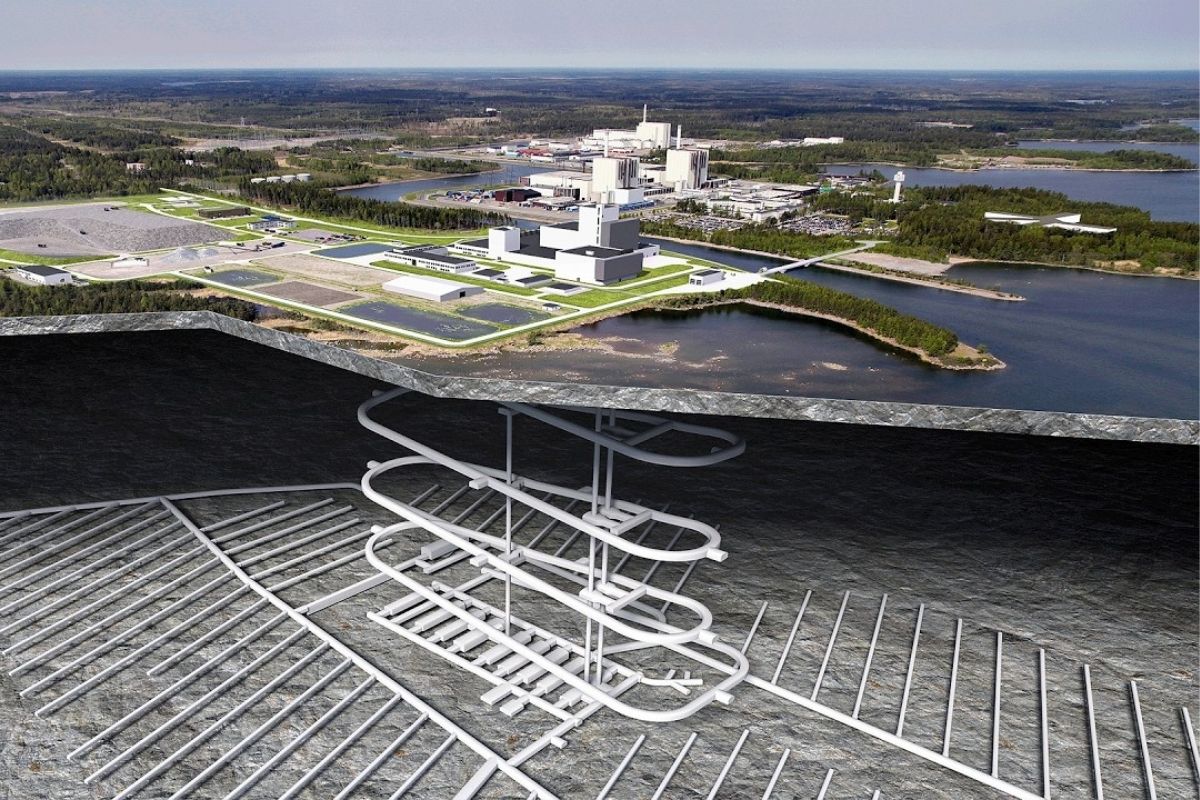
More Than 500 Meters Deep, Forsmark, Sweden, Begins Excavations to Create 66 km of Tunnels to Host 6,000 Copper Capsules with Irradiated Fuel and Seal Nuclear Waste for 100,000 Years, in a Project Estimated at US$ 1 Billion That Will Only Be Completed When It Disappears from the Country’s Official Map.
In Forsmark, Sweden, the decision to bury nuclear waste more than 500 meters deep has become a project: a network of tunnels is being excavated in the rock to store irradiated fuel for up to 100,000 years, with an estimated cost of just over US$ 1 billion and a timeline that spans generations.
The plan arises from the long-standing impasse of nuclear energy since the early commercial plants of the 1950s: today, this source accounts for about 10% of the world’s electricity, produced by over 400 plants, but still relies on temporary solutions for high-activity material, which remains highly radioactive for hundreds of thousands of years.
The Problem That Doesn’t Fit in Pools or Promises

The discussion about nuclear waste begins with the scale of time, not the scale of volume.
-
With a cost per shot close to zero, the DragonFire laser could change naval warfare in 2027 and provide British ships with nearly unlimited defense against drones.

-
A British startup creates tires that generate electricity in electric vehicles when passing over potholes, speed bumps, and cracks.

-
Scientists have created robots made with living cells that have their own nervous system, swim on their own, explore the environment, and self-organize without any genetic engineering, and now they want to do the same with human cells.

-
Students create a solar-powered ambulance that operates without a plug, without fuel, and still keeps medical equipment running in remote areas.

Low-activity waste, which accounts for about 95% of the total volume produced, includes contaminated clothing, tools, cleaning materials, and medical equipment.
Generally, this material remains radioactive for shorter periods and is typically directed to disposal facilities near the surface for a few hundred years.
Intermediate activity waste, about 4% of the total, mainly consists of used filters and reactor components.
They are more radioactive but do not generate enough heat to require cooling.
Depending on how long they remain radioactive, they can either go to deeper disposal sites or share structures with low-activity waste.
The knot is in the last group: high-activity waste, about 1% of the world’s nuclear waste, largely composed of irradiated fuel.
Even when the rods become inefficient for use in reactors, they remain dangerous.
The irradiated fuel can remain highly radioactive for hundreds of thousands of years, requiring careful handling, shielding, and long-term strategies.
What Exists Today: Temporary Containment and Constant Monitoring

The most common routine begins within the nuclear plants themselves.
The irradiated fuel goes into pools specifically designed for this purpose, where water acts as a shield against radiation and as a cooling method.
Then, the material can be transferred to what is called dry cask storage, large and thick steel and concrete containers that isolate the contents from the environment.
The problem is that, even when the initial cooling period ends, the system still relies on monitoring and maintenance.
Pools need circulation and temperature control to prevent evaporation. Without water, radioactive fuel rods can overheat and melt, releasing radioactive material.
The example cited for this risk is Fukushima, in 2011, when an earthquake and tsunami damaged cooling systems, led to catastrophic degradation of the cores, and hydrogen explosions released radioactive material into the environment.
Therefore, the promise of Forsmark, Sweden, is not only to build but to replace the “short term” with an isolation logic that attempts to dispense with humans as permanent keepers of nuclear waste.
Why Forsmark Became the Address of 100,000-Year Risk
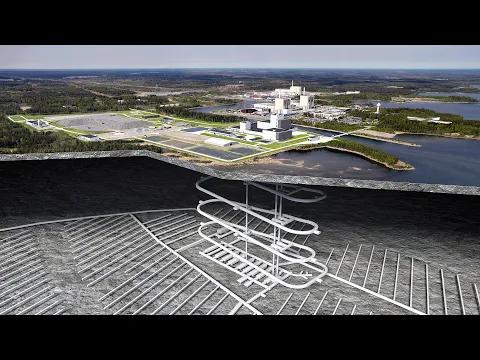

The Forsmark repository was designed to be a final and permanent disposal site for irradiated fuel, capable of keeping high-activity nuclear waste out of the environment for up to 100,000 years.
The site is located next to the Forsmark Nuclear Power Plant and also near the SFR, the Swedish final disposal site for low- and intermediate-activity waste, which concentrates logistics in one area.
The choice of the subsoil of Forsmark, in Sweden, is based on three technical arguments presented in the project. First, geological stability and very low seismic activity.
Second, a rock bed with few or no known fracture zones.
Third, the age and stability of the rock, described as being formed nearly two billion years ago and remaining virtually stable since then.
The logic is straightforward: if the rock mass has endured for eras, it can be the last barrier for nuclear waste.
The Subterranean Geometry: 5 km Ramp and a City of Tunnels
Above ground, the facility looks “normal” for a large construction site: a place for excavated soil and rock, buildings for teams and equipment.
What changes is below.
From the surface in Forsmark, Sweden, the project plans a winding ramp of five kilometers descending to a maximum depth of 500 meters.
From this main corridor comes the part that defines the scale: a network of tunnels branching out that can add up to 66 kilometers, spread across an area of 3 to 4 square kilometers.
These tunnels are the final destination for the country’s most dangerous nuclear waste, the irradiated fuel currently in temporary storage.
The engineering has been designed to minimize direct interventions: each capsule will have its own vertical deposition hole in the tunnel floor, and the movement is described as being done remotely, with vehicles developed to minimize human exposure.
6,000 Copper Capsules and the Mathematics of Irradiated Fuel
The number that shapes the Forsmark repository is 6,000. This is the total number of copper containers planned, each with about 2 tons of irradiated fuel.
The combination of quantity and mass explains why the project is planned as an underground industrial system, not as an isolated “vault.”
The capsules are described as copper containers with five meters in length and one meter in diameter, with an outer layer of copper that is five centimeters thick, designed to resist corrosion and the mechanical forces from underground movements.
Inside the copper, there is a cast iron insert, responsible for keeping the irradiated fuel securely in place.
The logistics begin before the copper.
After being used in a plant, the irradiated fuel is transported by ship to the facility known as Clab, next to operational nuclear plants in Oskarshamn, where all Swedish irradiated fuel is stored temporarily.
The stay there is estimated at 30 to 40 years, the period cited for radiation to gradually degrade before the encapsulation stage and shipment to Forsmark, in Sweden.
KBS-3 in Three Barriers: Copper, Bentonite, and Rock
The basic method of the Forsmark repository is called KBS-3, a technique developed by SKB for the permanent disposal of high-activity waste.
The central idea is to replicate, in a controlled manner, conditions in which radioactive materials naturally exist in the earth’s crust without human contact for very long times: buried deeply, in stable rock, far from the environment.
The system is described as a sequence of three barriers.
The first is the copper capsule. After the insert is assembled, sealing is done with a technique called friction welding.
Then, the weld joint is inspected to identify cracks and weaknesses that could compromise the seal. Once encapsulated, the assembly is sent to Forsmark.
The second barrier is a bentonite clay plug, presented as water-absorbing and compared to the substance used in cat litter for its clumping ability.
In its technical function, bentonite serves to prevent water flow into and out of the container.
When exposed to water, it expands and makes the deposition hole tighter.
The third barrier is the rock itself. Buried 500 meters underground in Forsmark, in Sweden, nuclear waste is beneath geologically stable rock and, according to the design, isolated from the external environment.
As the capsules enter, the tunnel is sealed with concrete and bentonite clay. In the end, the network of tunnels would be filled and sealed, as if it had never existed.
Timeline, Cost, and Scale: From 2009 to the Year 2080
The repository for irradiated fuel in Forsmark is attributed to SKB, a company created by the Swedish nuclear industry to manage and dispose of waste.
The project was initially proposed in 2009 and, after more than a decade of research and planning, was approved in 2024.
Construction began in January 2025, with an estimated cost of just over US$ 1 billion.
The construction sequence cited prioritizes above-ground structures before the total excavation of the underground network.
The estimate is that the repository could store its first copper containers by the end of the 2030s, as the first tunnels are completed, while other tunnels would continue to be excavated even with operations underway.
The timeline is admittedly long.
The total filling of the system is projected for 2080. By then, the total planned excavation is 2.3 million cubic meters of rock and soil, a volume that helps explain why the “end” of the project isn’t measured in inauguration, but in saturation and sealing.
Where the Plan May Delay: Corrosion, Legal Action, and the Weight of the Unlikely
Even with construction underway, the plan for Forsmark, in Sweden, is not described as unanimous. A study from the Royal Institute of Technology of Sweden is cited pointing out that the copper capsules, designed to resist corrosion, could be more vulnerable than previously thought.
Furthermore, a Swedish NGO has filed legal action demanding more rigorous safety assessments, which could potentially delay the project by several years.
These frictions highlight the sensitive point of any solution for nuclear waste: it is not enough for the method to work under normal conditions.
It needs to withstand uncertainties of materials, gradual changes in the subsoil, and regulatory decisions, without relying on constant human maintenance.
It is precisely this dependency, typical of pools and temporary structures, that the Forsmark project seeks to minimize.
What Remains Afterwards: A Site That Only “Ends” When It Disappears
The final design of the repository is almost paradoxical.
After depositing the 6,000 copper capsules and sealing the tunnels, the plan calls for the surface facilities to be demolished and for the area to be intentionally left unmarked.
The facility would only be truly completed when it ceases to exist as a visible work.
For Forsmark, in Sweden, this means transforming a billion-dollar construction site into an indistinguishable point, while the nuclear waste remains below, locked away by copper, bentonite, and rock.
The Inevitable Comparison: Finland and the Same Path
The account positions Forsmark as one of the first final and permanent disposal projects for irradiated fuel.
The only other facility cited as equivalent is Onkalo, in Finland, planned to start operations sometime following the schedule mentioned, utilizing the same technology and techniques from the Forsmark model.
The existence of two similar projects suggests an engineering pattern that can be replicated, provided that the geological prerequisite exists.
Still, the schedule itself and the technical disputes remind us that, in the real world, the solution for nuclear waste is not an event; it is a process.
The Dilemma That Doesn’t End with Excavation
Forsmark, in Sweden, seeks to close a chapter that nuclear energy opened in the 1950s and has never truly closed: where to leave irradiated fuel when it remains dangerous for times that surpass any political, industrial, or human cycle.
The bet is that deep tunnels, copper capsules, and sealing in rock can achieve what pools and dry casks cannot promise without oversight.
If Sweden is correct, nuclear waste will become a buried problem, not a problem managed day by day. If it is wrong, the error may be slow, invisible, and costly to correct.
Would you trust your future to a sealed system in Forsmark, in Sweden, for 100,000 years, or do you think nuclear waste still requires alternatives before being locked away forever?







-

-

-

4 pessoas reagiram a isso.