





 Portuguese
  English
  Spanish
  4 min of reading
  0 comments


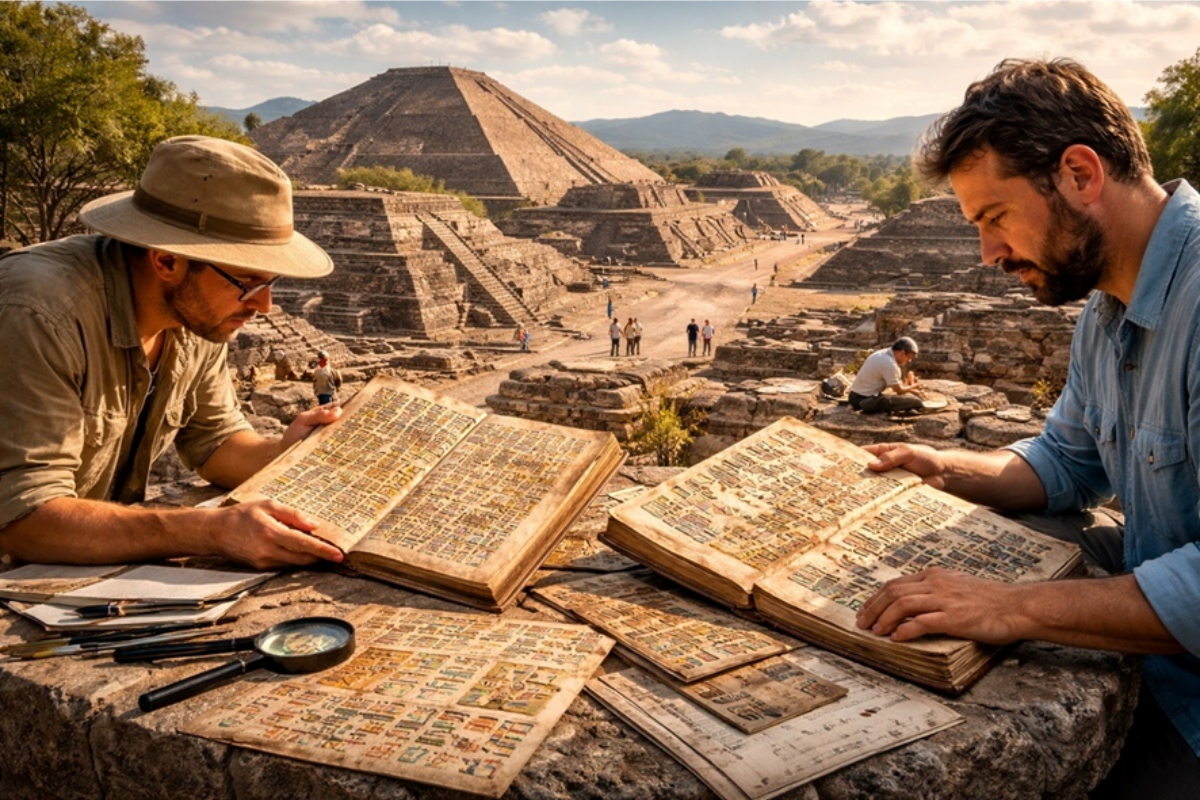
In Teotihuacan, Researchers from the University of Copenhagen Conducted a Linguistic Analysis Based on About 300 Records to Identify the Language Spoken Almost 2000 Years Ago, Provoking New Historical Interpretations and Catching the Attention of the Scientific Community
The ancient city of Teotihuacan dominated much of what is now Central Mexico for about half a millennium, between the 1st and 5th centuries AD. The site became globally known for the Pyramids of the Sun and Moon, monumental constructions erected many centuries before the arrival of the Aztecs in the region.
At the height of its expansion, Teotihuacan housed over 125,000 inhabitants, a number considered extremely high for the time. The political and cultural influence of the city extended to areas occupied by Maya city-states, located further south in Mesoamerican territory.
Despite this impressive power, the civilization remains shrouded in mysteries. The absence of a clearly deciphered writing system prevents definitive answers about who its inhabitants were and what language they spoke.
-
With a cost per shot close to zero, the DragonFire laser could change naval warfare in 2027 and provide British ships with nearly unlimited defense against drones.

-
A British startup creates tires that generate electricity in electric vehicles when passing over potholes, speed bumps, and cracks.

-
Scientists have created robots made with living cells that have their own nervous system, swim on their own, explore the environment, and self-organize without any genetic engineering, and now they want to do the same with human cells.

-
Students create a solar-powered ambulance that operates without a plug, without fuel, and still keeps medical equipment running in remote areas.


Powerful City of Central Mexico Still Keeps Mysteries About Its Origin
Teotihuacan began to form around the 1st century BC. Over the following centuries, the city grew, became organized, and became one of the largest urban centers of the ancient world.
The peak occurred in the 5th century AD, a period in which the city concentrated an estimated population of over 125,000 people. Even so, for reasons still debated, the site was completely abandoned around the year 750.
It was only centuries later, around 1300, that the Aztecs arrived in the region and founded a new civilization near the already existing ruins. Since then, the archaeological site has become one of the most visited tourist attractions in Mexico.
Glyphs Found in Murals and Ceramics Challenge Archaeologists for Decades
The Teotihuacanos left behind hundreds of symbols recorded in murals, ceramics, and architectural structures. These drawings draw attention for their level of detail and repetition.
The major challenge is that there is no consensus among experts as to whether these symbols actually form an organized writing system. If they are a code capable of being read, their deciphering could reveal crucial information about the city’s politics, religion, and social structure.
To this day, however, no researcher has managed to conclusively translate these records, keeping the enigma alive.
Study Reconstructs Possible Ancestral Language Linked to Nahuatl

A new study published in the scientific journal Current Anthropology brought a different approach to the problem. Researchers Magnus Pharao Hansen and Christophe Helmke from the University of Copenhagen propose that the language spoken in Teotihuacan was part of the Uto-Aztecan language family.
According to the research, this ancestral language would have given rise, centuries later, to several known languages, including Nahuatl, the language spoken by the Aztecs, and Huichol, still present in indigenous communities in Mexico.
To arrive at this hypothesis, the scientists reconstructed a possible version of this ancient language based on more recent languages from the same family, creating a kind of linguistic family tree.
Interpretation Suggests New Meanings for Ancient Symbols
From this theoretical reconstruction, the researchers proposed new meanings for some symbols found in Teotihuacan. Among them are concepts such as stone, mountain, and yellow.
The idea is to use this reconstructed language as a tool to attempt to interpret the glyphs left by the civilization. According to the authors, the method is still far from offering complete translations but is already beginning to show promising results.
The most striking detail is that this approach may open up a completely new avenue for the study of Teotihuacan writing.
Few Records Hinder Complete Deciphering of the Writing
One of the biggest obstacles faced by researchers is the limited amount of material available. There are about 300 records associated with Teotihuacan, a number considered low for deep linguistic analyses.
In comparison, languages like Maya and Nahuatl appear in thousands of preserved texts, a factor that has greatly facilitated their translation over time.
According to experts, if the hypothesis is correct, the impact goes far beyond deciphering isolated symbols. The result could transform the understanding of the cultural and linguistic formation of Mesoamerica.
In the end, the possibility of identifying the language spoken in Teotihuacan reignites interest in one of the largest cities of antiquity and shows that, even after almost 2000 years, there is still much to be discovered about this impressive people.
What do you think of this hypothesis about the language of Teotihuacan? Do you believe that the writing can finally be deciphered? Leave your opinion in the comments and join the discussion.








Seja o primeiro a reagir!