





 Portuguese
  English
  Spanish
  5 min of reading
  0 comments


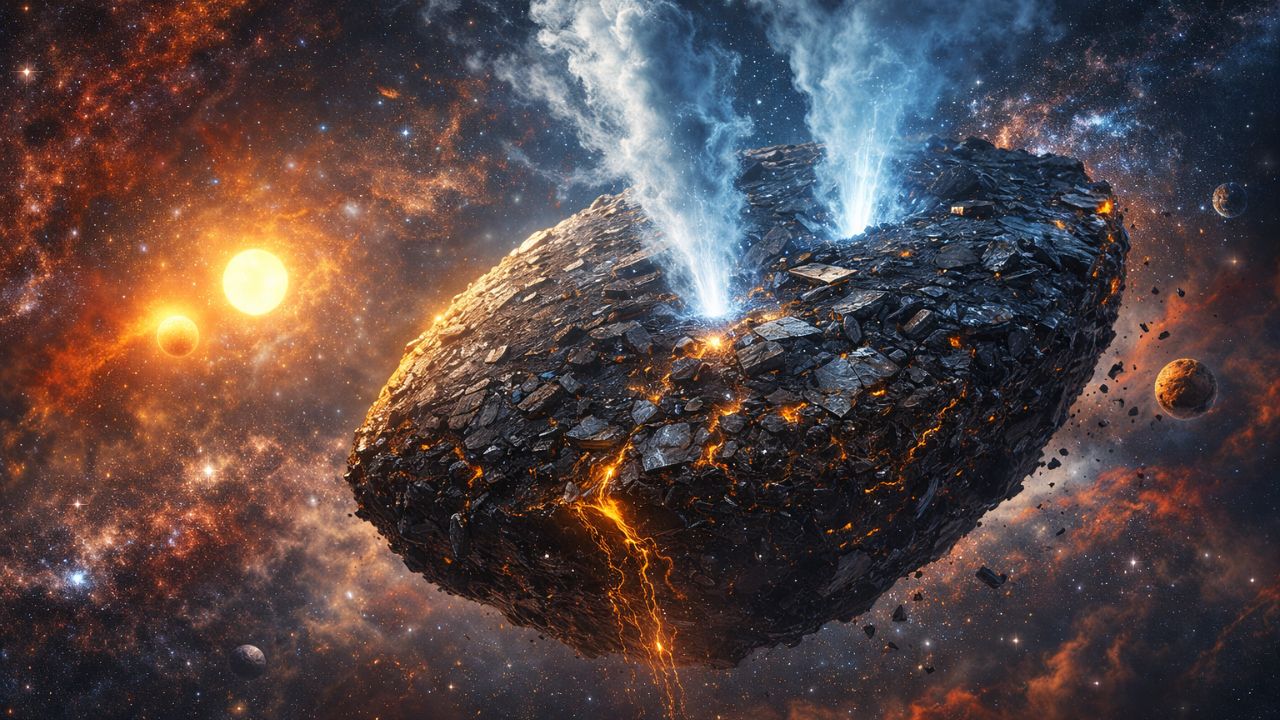
Recent Study Suggests That 3I/Atlas May Be An Ancient Planetesimal Rich In Metals And Carbon, With Icy Ejections Explaining The Coma And The Spiral Tail
The 3I/Atlas has drawn attention again because a recent study attempts to consistently explain the anomalies that astronomers have been observing since the object’s identification. One thing is to detect out-of-the-ordinary behavior; another is to interpret what it means, and the hypotheses raised directly challenge what we know about interstellar objects.
The most provocative reading is twofold: the 3I/Atlas may be a body of metallic origin, something like a planetesimal that formed in another planetary system and ended up wandering through the Milky Way, and at the same time, it may be exhibiting cryovolcanism, an activity that could help explain the brightness, coma, and the unusually shaped tail.
What Makes 3I/Atlas An Interstellar Object
The 3I/Atlas is classified as an interstellar object because it follows a hyperbolic trajectory, meaning it does not orbit the Sun and is not expected to return after passing through the Solar System. It enters, crosses, and continues on as a cosmic nomad, wandering through the galaxy. Before it, the examples recalled are Oumuamua in 2017 and Borisov in 2019, placing the 3I/Atlas as the third case of its kind.
-
While the world looks at oil, the war with Iran is already disrupting helium supply from Qatar, affecting car and iPhone chips, threatening AI expansion, and putting pressure on aluminum packaging at the highest value in four years.

-
Global warming will expose a treasure hidden under the ice of Antarctica and may spark an international dispute over gold and valuable minerals.

-
A street vendor from Praia Grande built a robot made of scrap from scooters and washing machines that pulls his popcorn cart on the beach, emits sounds, and interacts with customers, becoming an attraction on the coast of São Paulo.
-
The specifications of the Xiaomi 18 Pro Max have been leaked, and the highlight is a dual 200 MP camera with a new 22-nanometer technology that promises to consume less energy and capture details in shadows and bright areas using LOFIC HDR.

The Discovery And The Numbers That Already Impress
The 3I/Atlas was identified on July 1st by the ATLAS system in Chile. The estimated age cited in the database ranges from 3 to 11 billion years, opening an unsettling possibility: it may be older than the Solar System itself. Regarding dimensions, the range is still broad, between 300 meters and 5.6 km in diameter, and the rotation period appears as 16 hours, a data point that becomes key to understanding patterns in the coma.
Among the highlighted numbers, there is also an entry velocity of about 200,000 km/h and the information that the perihelion occurred on October 29. This data is not just curiosity: it helps to tie together the physical context and the observation window of the object.
The Two Anomalies That Motivated The Hypotheses
The central anomalies described are two. The first involves the chemical composition of the 3I/Atlas. The second is the brightness increase observed when it was still relatively distant, with a recorded jump of about two magnitudes, something that demands a plausible physical explanation.
This is where the stronger interpretations come in: metallic origin and cryovolcanic activity. The goal of the cited work is to fit these pieces into a single narrative without resorting to explanations outside known physics.
Hypothesis 1: Possible Metallic Origin And Planet In “Earlier Phase”

The proposed hypothesis suggests that the 3I/Atlas may not be a typical comet. Instead, it could be a primitive body rich in metals and carbon, something comparable to a “core” associated with planetary formation processes in another system. The idea is that cataclysmic collisions in that system could have generated dense, metallic fragments, and one of those fragments would be the 3I/Atlas.
To support this, the comparison goes to a familiar path in astronomy: the taxonomy of meteorites. The base text mentions alignments with families such as CR, CH, and even CB, especially due to the presence of metallic material mixed in a carbon-rich matrix.
The Spectrum That Points To Similarity With CR Chondrites
An important point presented is the spectrum of the 3I/Atlas aligning “almost perfectly” with CR-type chondrites, reinforcing the interpretation that it is natural and has a composition compatible with materials already studied. The base text also highlights the CH type as a rare carbonaceous material with high metal content, reinforcing the line of reasoning of a metal-rich nature.
In practice, the mental image proposed is clear: metal grains mixed in a carbonaceous matrix, like a “conglomerate” of materials that would carry preserved chemical signatures from another planetary system.
Hypothesis 2: Cryovolcanism To Explain Brightness And Coma Morphology
The second hypothesis is the one that catches the public’s attention the most because it translates anomaly into a visual phenomenon: cryovolcanism in 3I/Atlas. The reasoning described is that as the object approaches and is heated by the Sun, volatile materials inside may sublimate and produce violent ejections of gas, forming spiral patterns.
This connects directly to the rotation data: with 16 hours, the combination of spin and ejection can produce a complex morphology in the coma and a tail with an unusual appearance, consistent with what has been observed with specific filtering and processing.
Nickel In The Coma And The “Rare” Detail That Reinforces The Metallic Origin
Another cited element is the presence of nickel in the gas coma at a considered unusual distance, something described as rare and compatible with the suggested metallic origin. This detail serves as a “bridge” between the two hypotheses: the object may be metal-rich and, at the same time, have activity driven by volatiles, generating brightness and patterns.
Why 3I/Atlas May Change What We Know About Interstellar Objects
Even without any need for extraordinary explanations, the 3I/Atlas is already valuable for a direct reason: it may be a primitive object from another planetary system, preserved, and observable by us. This helps in studying planetary formation outside the Solar System using physical evidence, composition, and activity.
The database also mentions that the detection reinforces the importance of sky surveys by systems like ATLAS and others, in addition to the debate about missions like Comet Interceptor, designed to quickly intercept an interstellar object as soon as it appears.
The Most Likely Picture So Far
With the information presented, the picture that best fits everything is this: the 3I/Atlas may be a metal-rich body, with metal grains in a carbonaceous matrix, and with signs of cryovolcanism capable of explaining the brightness increase and the unusual morphology of the coma and tail. And above all, it remains a concrete reminder that the Solar System is still receiving visitors with chemical and dynamic stories very different from our own.
In your opinion, what intrigues you most about the 3I/Atlas: the possible metallic origin, the cryovolcanism, or the fact that it may be older than the Solar System?








-

Uma pessoa reagiu a isso.