





 Portuguese
  English
  Spanish
  6 min of reading
  1 comment


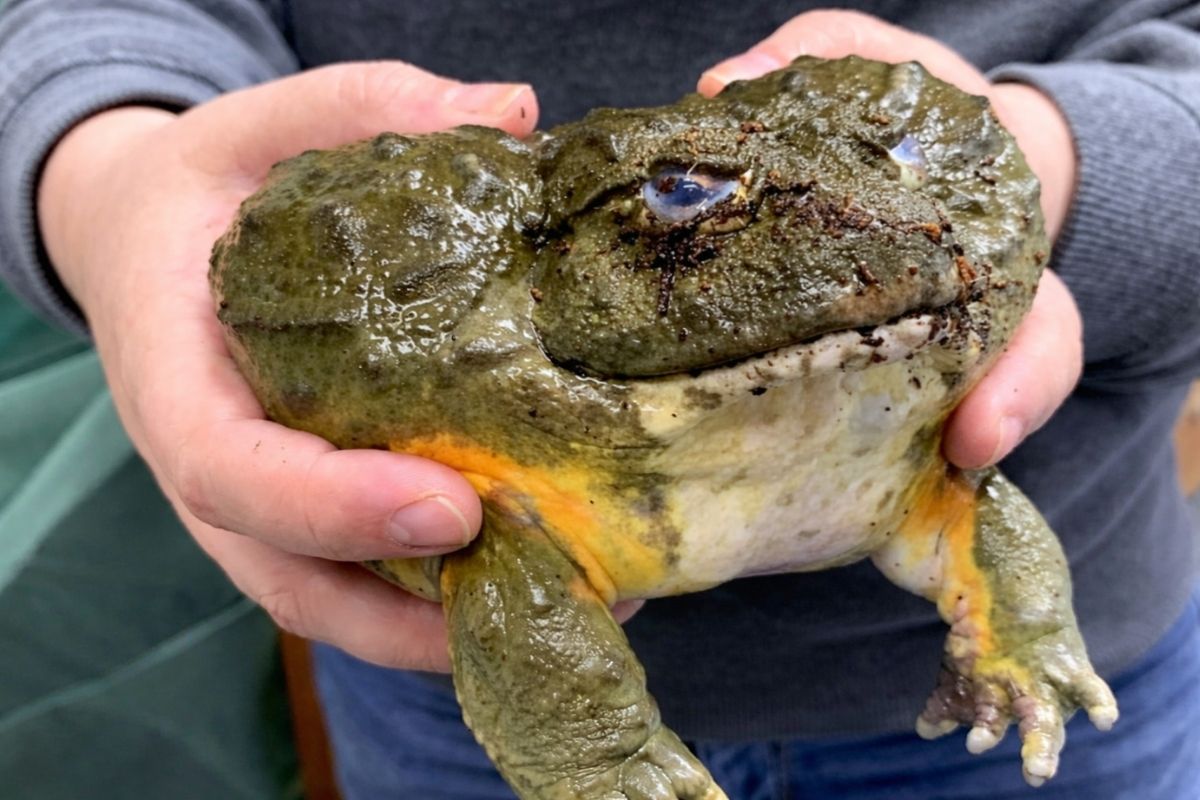


The African Bullfrog Is A Giant Amphibian That Lives In Puddles And Burrows, Practices Cannibalism Among Tadpoles, And Even Becomes An Exotic Pet In Several Countries.
The African bullfrog is one of the largest amphibians in the world, capable of digging deep burrows, hunting prey the size of small birds, eating its own offspring, and still relying on shallow puddles of water to avoid disappearing.
While in some countries the African bullfrog becomes an exotic pet in aquariums and terrariums, in nature it faces a harsh scenario of prolonged droughts, habitat destruction, and increasingly polluted water, which puts the entire amphibian family under pressure.
Where The African Bullfrog Lives And Why It Digs Burrows In The Ground
The African bullfrog mainly lives in the central region of the African continent, below the Sahara Desert. It appears in countries ranging from eastern Somalia to western Nigeria, extending down to southern South Africa, always associated with environments that have puddles, shallow ponds, and temporary flooded areas.
-
With a cost per shot close to zero, the DragonFire laser could change naval warfare in 2027 and provide British ships with nearly unlimited defense against drones.

-
A British startup creates tires that generate electricity in electric vehicles when passing over potholes, speed bumps, and cracks.

-
Scientists have created robots made with living cells that have their own nervous system, swim on their own, explore the environment, and self-organize without any genetic engineering, and now they want to do the same with human cells.
-
Students create a solar-powered ambulance that operates without a plug, without fuel, and still keeps medical equipment running in remote areas.


Although it is an amphibian, the species can survive in regions that can become dry for years, such as savannas and semi-arid areas.
The secret lies in its digging behavior. When the weather becomes extreme and water disappears, the African bullfrog digs chambers in the soil, buries itself, and remains there protected until the rains return.
These burrows function as a thermal and humidity refuge. Instead of migrating over long distances, it literally “turns off” its body underground and waits for the environment to improve.
Even so, it remains completely dependent on clean water and temporary puddles to complete its life cycle and allow the tadpoles to develop.
A Giant Amphibian With A Burrowing Body

Among frogs, the African bullfrog is a true giant amphibian, second only to the famous goliath frog in size. A large male can reach the size of a dinner plate, with a robust body and a huge head.
Adult males typically have olive-green coloration, with the throat region in brighter shades of orange or yellow. Females are much smaller, with coloring ranging from olive green to light brown and a white or cream throat.
Young frogs are much more colorful, with spots on their skin and light lines running down their backs that disappear as the animal grows.
In its hind feet, the African bullfrog has shovel-shaped feet, with webbing between the toes, typical of aquatic animals.
This makes it an excellent swimmer and, at the same time, an efficient digger, capable of opening deep holes in the ground. In its front feet, the toes are smaller and without webbing, aiding in manipulating the substrate.
Another interesting fact is that the African bullfrog is one of the few frogs that have teeth. It has teeth in the upper jaw and, in the lower part of its mouth, three tooth-like structures that grow superficially in the skin. These “blades” do not serve to chew but to grasp and hold prey tightly.
Voracious Hunter, Cannibal, And Not Afraid Of Snakes
The African bullfrog is carnivorous and extremely voracious. It hunts almost anything it can overpower: rats, large insects, smaller amphibians, small fish, small birds, and even snakes when the size permits.
Like other frogs, it uses its sticky tongue to capture prey. In fractions of a second, the tip of its tongue sticks to the target and pulls the animal into its huge mouth, where it is crushed by its teeth and the sharp structures of its jaw.
But the most shocking detail is its cannibalistic behavior. The African bullfrog does not hesitate to attack individuals of the same species when necessary.
Larger tadpoles can eat smaller tadpoles, and a father African bullfrog sometimes eats some eggs or tadpoles that he is watching, especially when there is competition for food or a very high density of offspring in the same puddle.
This cannibalism may seem cruel, but it is part of the species’ survival strategy. In extreme environments where water quickly disappears and food is limited, only the strongest and most adapted reach adulthood.
When The African Bullfrog Becomes An Exotic Pet

With all this fame as a predator, it may seem strange, but in some countries the African bullfrog is kept as a pet. Its robust size, imposing appearance, and curious behavior attract the attention of those who like exotic animals.
However, all that is impressive in videos also brings responsibility. An African bullfrog can live decades in captivity, with records of individuals reaching about 45 years under human care.
This means a long-term commitment, constant carnivorous feeding, and proper management for an animal that is not docile, does not like handling, and can bite hard.
More than just a “different pet,” the species is a wild, cannibalistic, and opportunistic animal that depends on specific conditions of temperature, humidity, space, and clean water.
Anyone thinking of an African bullfrog as a pet needs to understand that it does not function as a toy or decoration, and that the animal’s well-being comes before human curiosity.
Explosive Reproduction And The War For Tadpole Survival
The African bullfrog reaches sexual maturity between 1.5 and 2 years of age. The breeding season begins after heavy rains, which form shallow and temporary puddles, perfect for receiving eggs and tadpoles.
Younger males tend to gather in smaller water areas at the edges. Older and larger males go to the center of the lake or puddle, where they try to push away the younger ones and dominate the area. The disputes can be violent and, in some cases, end in the death of one of the individuals.
Once the area is established, the males begin an intense vocalization, with low and loud sounds to attract females.
The females enter the water and look to mate with the dominant male, usually the largest and strongest one. This is part of natural selection, ensuring that the most robust genes have a better chance of being passed on.
A single female African bullfrog can lay up to 4,000 eggs at once. Fertilization is external: the female deposits the eggs on the water surface and the male fertilizes them. After that, it is the male that takes on the role of guarding the eggs and tadpoles against predators.
The tadpoles hatch in about two days. In the early phase, they are omnivores, feeding on aquatic plants, insects, and small fish.
As they grow, they become exclusively carnivorous and may even eat other tadpoles, including younger siblings. In approximately three weeks, they undergo metamorphosis and begin to look like miniature adults.
Despite the explosion of eggs, most do not reach adulthood. The egg and tadpole phases are fraught with dangers: birds of prey, monitor lizards, turtles, and other frogs make these little ones an easy food source, in addition to the cannibalism among them.
Predators, Human Threats, And An Increasingly Polluted Planet
Even being a giant amphibian, the African bullfrog is not at the absolute top of the food chain. Birds of prey that can catch an adult with their claws, large lizards, and turtles mainly attack young ones and smaller frogs.
However, the most dangerous threat does not come from other animals, but from human actions. Habitat destruction, deforestation, global warming, and freshwater contamination have been affecting amphibians worldwide.
Toads, frogs, tree frogs, and salamanders are disappearing in many places, and the African bullfrog is part of this risky scenario.
Even having developed adaptations to live in everything from more desert-like areas to savannas where temperatures can drop below freezing in winter, the species remains dependent on quality water to survive. Polluted puddles, contaminated rivers, and sudden climate changes compromise eggs, tadpoles, and adults.
Preserving nature, caring for freshwater, and reducing pollution is not just a way to protect the African bullfrog. It is, in practice, a way to protect the entire balance of ecosystems and also our own survival as a species.
Looking at this animal capable of digging burrows, facing snakes, eating its own offspring, and still being vulnerable to what we do to the planet makes it clear how great the human responsibility is.
And you, after learning about the African bullfrog, would you consider having such a giant amphibian nearby, or do you prefer to admire this force of nature from a distance?






Eu já criei 15 rãs touro como pet e quando estavam todas adultas levei-as em minha fazenda e as soltei em igarapé que tem água permanente. A princípio fizeram uma festa, mergulharam pra todos os lados. Eu saí de perto e fui percorrer as pastagens mas, aconteceu algo inusitado, elas abandonaram o igarapé e foram atrás de mim. Deu pra notar que elas possuem faro apurado, pois eu estava a mais de um quilômetro quando todas chegaram e foram se posicionando ao meu redor. Fiquei muito impressionado com esse fato mas, voltei até o igarapé e elas me seguiram. Quando entraram na água peguei meu veículo e fui embora. Passado quase um ano, vi alguns filhotes delas no igarapé. Mas nãos as vi mais.