





 Portuguese
  English
  Spanish
  4 min of reading
  3 comments


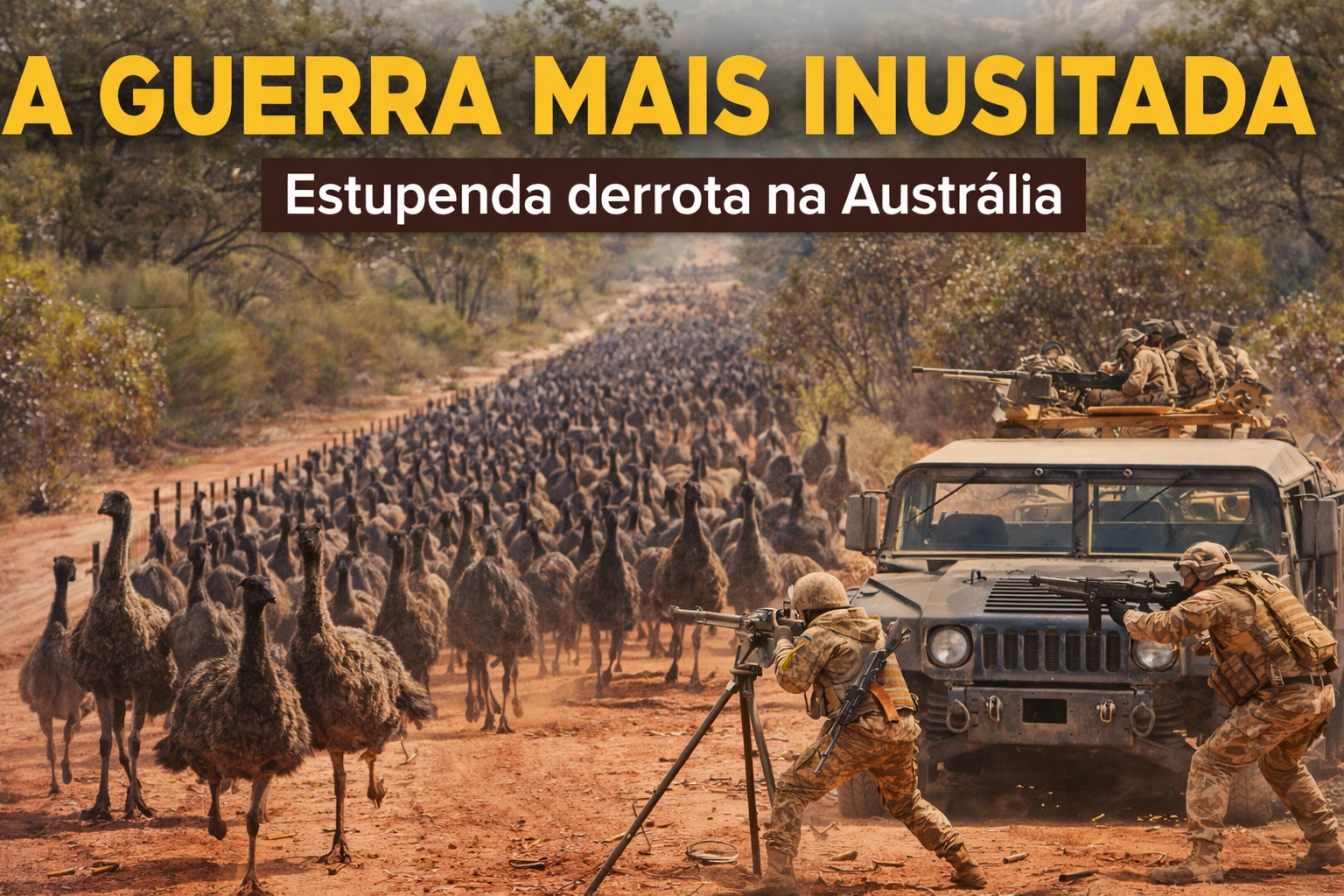


In 1932, Australia Mobilized Soldiers And Machine Guns Against Native Birds, Failed And Turned The Emu War Into An Historical Case About Limits Of Human Power.
Few people imagine that one of the most curious episodes in 20th-century military history did not involve enemy tanks, rival armies, or epic battles between nations. In 1932, in Western Australia, the government decided to mobilize soldiers armed with machine guns to face an unexpected enemy: native migrating birds. What began as an agricultural control operation ended up as a lasting symbol of how nature can expose the limits of human force.
The so-called Emu War was not a metaphor. It was an official state action of the Australian government, recorded in documents, military reports, and parliamentary debates. And the outcome was clear: the emus won.
The Agricultural Context That Led The Government To Declare War On Birds
In the early 1930s, Australia was experiencing the effects of the Great Depression. Ex-soldiers from World War I had been given farmland in Western Australia as a form of resettlement. These areas began to be cultivated mainly with wheat.
-
The Argentine government celebrates the lowest poverty rate in 7 years, but experts warn that the methodology has changed, real wages have fallen, unemployment has risen, and the number of people on the streets of Buenos Aires has increased by 57% since Milei took office.

-
7.8 magnitude earthquake in Indonesia frightens the population, triggers tsunami alert, and hits an island with over 200,000 inhabitants this Thursday.

-
Google will finally let you change that embarrassing Gmail address you created in your teenage years without losing any accounts, logins, or old emails: the feature is already available in the United States.

-
Heading to Brazil in a Bonanza F33 single-engine aircraft: a couple departs from Florida on a visual flight, makes technical stops in the Caribbean to refuel and organize paperwork, and begins the staged crossing until they reach the country.




The problem arose when large flocks of emus, native birds that can reach over 1.8 meters in height and run at more than 50 km/h, migrated towards agricultural areas. It is estimated that about 20,000 emus began to roam the fields, trampling crops, consuming grains, and damaging fences, further exacerbating the losses.
With no resources to compensate farmers and facing political pressure, the government opted for an extreme solution: to use the Army.
Soldiers, Machine Guns, And The Expectation Of A Quick Solution
In November 1932, a military unit was sent to the area with Lewis machine guns, weaponry recently used in World War I. The logic seemed simple. A small group of soldiers, armed with automatic weapons, would be enough to quickly reduce the bird population and protect the crops.
In theory, it was a short, technical, and efficient operation. In practice, it was an operational disaster.
Right from the first confrontations, the military realized that emus did not behave like predictable targets. The birds scattered into small groups, changed direction rapidly, and ran in uneven terrain where vehicles could not follow.
Why The Machine Guns Failed Against The Emus
Reports from the time show that the success rate was extremely low. Even with thousands of shots fired, the number of birds killed fell far short of expectations. At times, the machine guns jammed; at others, emus simply escaped before soldiers could align their shots.
Attempts were made to mount weapons on trucks to keep up with the birds’ speed, but the rough terrain made the strategy unfeasible. The operation’s commander himself admitted that the emus seemed to operate like decentralized units, dispersing in the face of danger and rendering any attempt at encirclement futile.
The result was humiliating for the military: much effort, little effect, and no lasting solution.
The End Of The Operation And The Recognition Of Failure
After weeks of frustrated attempts, the operation was officially terminated in December 1932. Estimates suggest that less than a thousand emus were killed, an insignificant number compared to the total population involved.
The operation came to be seen as a clear failure. In the Australian Parliament, the episode was debated, and public criticism arose regarding the use of armed forces against native wildlife. The government definitively abandoned the idea of direct military actions and began to adopt alternative methods, such as fencing and incentives for local control.
How The Emu War Became A Historical Symbol
As the years went by, the Emu War ceased to be just an agricultural episode and transformed into a historical symbol. It is often cited as an example of poorly calibrated decisions, excessive technological confidence, and underestimation of environmental complexity.
The episode also entered popular culture, being remembered with irony and humor, but always backed by real documentation. It is not a legend or an exaggeration. It was an official military operation that failed so dramatically that it became unforgettable.
The Victory Of The Emus And The Lesson About Human Limits
From a practical standpoint, emus continued to migrate, survive, and adapt. From a symbolic perspective, they exposed an uncomfortable truth: force, technology, and armament do not always guarantee control.

The Emu War showed that complex natural systems do not respond well to simplistic solutions. Animals do not follow military patterns, do not concentrate when attacked, and do not respect front lines.
What seemed like an easy mission turned out to be an involuntary study on ecology, animal behavior, and human error.
A Unique Episode That Still Echoes Almost A Century Later
Almost a hundred years later, the Emu War continues to be cited in books, universities, documentaries, and historical analyses. Not for its military significance, but for its ability to reveal the limits of human intervention when disconnected from environmental reality.
It remains a rare reminder that in certain scenarios, nature does not need weapons to win. It just needs to keep existing, adapting, and ignoring attempts at absolute control.
In the end, the Emu War was not just a historical curiosity. It was a real, documented, and instructive episode, in which 20,000 birds forced an entire state to admit defeat.
And you, reader: if even an armed army failed before migrating birds, how far does human control over nature actually extend?









Chamar de guerra a tentativa de extermínio de uma espécie…
É gozação.
1000 aves assassinadas simplesmente por existirem em seu habitat. Nenhum ser humano morto. E ainda consideram um fracasso.
A natureza e tão poderosa q o humano não a domina.Temos provas TD dia disto:Vide tsunamis,ciclones,vulcões e uma infinidade de demonstração da natureza,mesmo no seu silêncio,ela se mostra poderosa.