





 Portuguese
  English
  Spanish
  5 min of reading
  8 comments


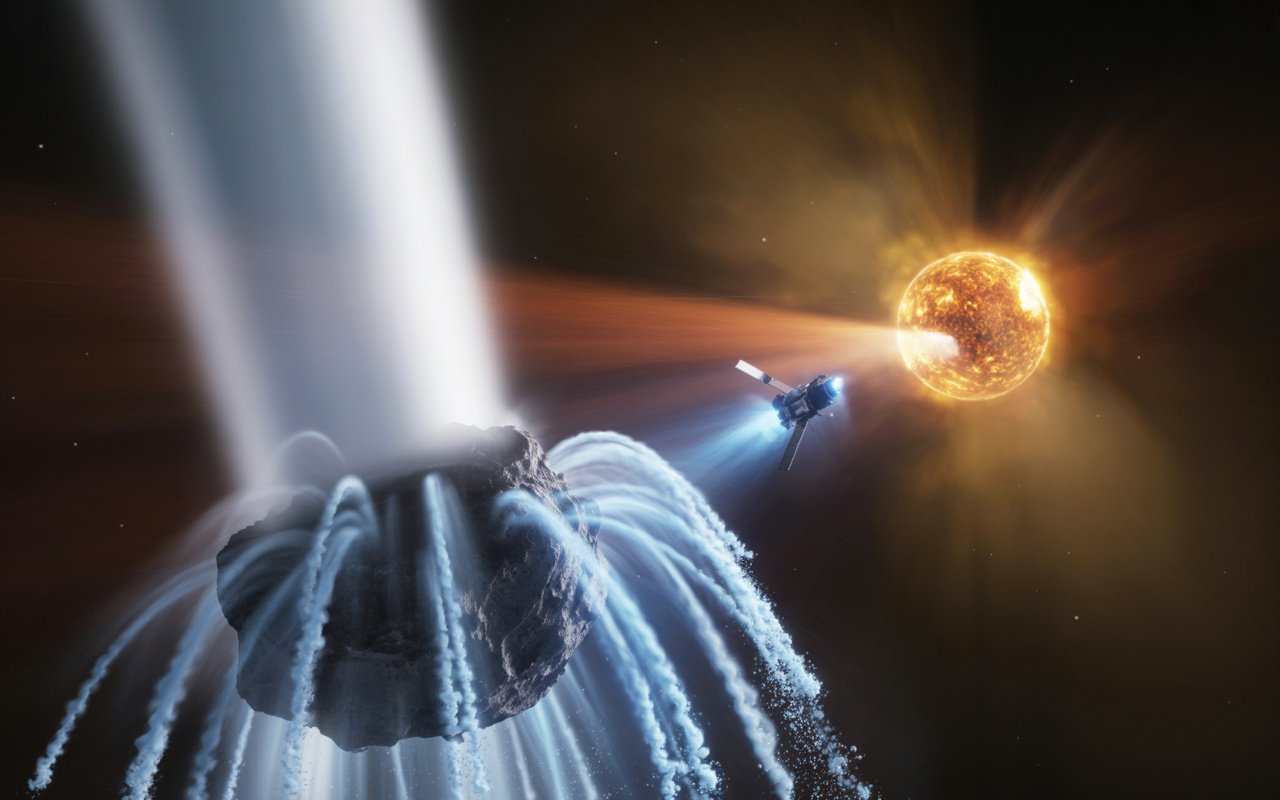


The Rosetta Mission Revealed That Comet 67P Releases Trillions of Liters of Water Each Time It Passes the Sun, Acting as a Mobile Reservoir Capable of Explaining the Origin of Water in the Solar System.
For a long time, comets were seen only as occasional visitors, icy bodies that cross the sky and disappear for decades or centuries. This view changed radically when science began to observe them closely, not only as astronomical objects but as active reservoirs of water and volatile compounds. The definitive turning point occurred with the Rosetta mission from the European Space Agency, which followed comet 67P/Churyumov-Gerasimenko for years. For the first time in history, humanity was able to measure, in real-time, how much material a comet releases as it approaches the Sun — and the numbers are colossal.
The measurements revealed that, with each perihelion approach, 67P ejects trillions of liters of water, along with dust, organic gases, and complex molecules. This transformed comets from simple “icy bodies” into dynamics players in the Solar System’s water cycle.
How the Rosetta Mission Managed to Measure the Release of Water from a Comet in Real Time
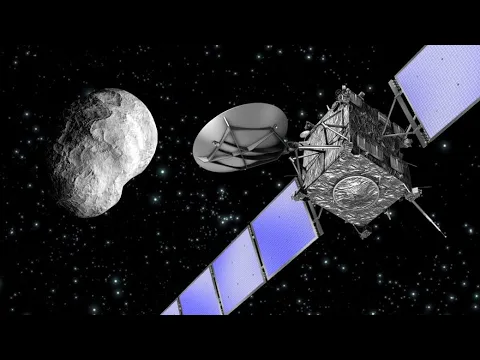

Before Rosetta, estimates of the composition of comets were indirect, based on telescopic observations of the tail. The mission changed everything by orbiting the comet for over two years, tracking its activity as it approached the Sun.
-
With a cost per shot close to zero, the DragonFire laser could change naval warfare in 2027 and provide British ships with nearly unlimited defense against drones.

-
A British startup creates tires that generate electricity in electric vehicles when passing over potholes, speed bumps, and cracks.

-
Scientists have created robots made with living cells that have their own nervous system, swim on their own, explore the environment, and self-organize without any genetic engineering, and now they want to do the same with human cells.

-
Students create a solar-powered ambulance that operates without a plug, without fuel, and still keeps medical equipment running in remote areas.


Instruments such as the ROSINA spectrometer allowed for direct measurements of:
- water vapor;
- carbon dioxide;
- carbon monoxide;
- volatile organic compounds.
The data showed that the comet does not release water consistently. Instead, there are intermittent jets, more active regions, and diurnal variations caused by the rotation of the nucleus.
During periods of higher activity, 67P was able to release hundreds of kilograms of water per second, which, over months, translates into volumes equivalent to trillions of liters.
What Happens When the Ice of a Comet Starts to “Boil” in Space
Although the term “melt” is common, the physical process is sublimation. In the vacuum of space, ice does not transition from solid to liquid; it transforms directly into vapor.
When the comet approaches the Sun:
- the surface heats up quickly;
- the water ice begins to sublimate;
- trapped gases are released;
- dust particles are dragged, forming the coma and tail.
This process is not superficial. Rosetta showed that the heat penetrates layers of the nucleus, activating internal reservoirs and causing collapses, fractures, and landslides on the surface.
Trillions of Liters of Water: The Real Impact of This Release in Outer Space
At first glance, releasing trillions of liters of water into space may seem irrelevant in a vast Solar System. However, over billions of years, the cumulative effect is profound.

Astronomical models indicate that:
- Jupiter family comets, like 67P, make thousands of solar passes;
- each passage contributes significant volumes of water to interplanetary space;
- part of this material is captured by planets and moons.
This reinforces the idea that comets act as mobile water reservoirs, redistributing this resource throughout the Solar System.
Comet 67P and the Direct Link to the Origin of Water on Earth
One of the big questions in planetary science is: where did Earth’s water come from?
For decades, it was believed that oceans formed mainly from comet impacts. Rosetta brought a more complex and interesting answer.
By analyzing the ratio of ordinary hydrogen to deuterium in the water of 67P, scientists found that it does not exactly match the water of Earth’s oceans. This indicates that:
- not all of Earth’s water came from comets of this type;
- different classes of icy bodies contributed;
- water-rich asteroids also played a fundamental role.
Still, the mission confirmed that comets are real and abundant sources of water, reinforcing their role in supplying water to rocky planets.
Comets as Time Capsules of the Primitive Solar System
Besides water, Rosetta detected a surprising variety of organic molecules on 67P, including precursors to amino acids. This transformed comets into true chemical archives of the birth of the Solar System.
These bodies preserve material that has remained virtually untouched since:
- the formation of the Sun;
- the collapse of the solar nebula;
- the start of planetary aggregation.
By releasing trillions of liters of water mixed with organic compounds, comets act as chemical seeds, spreading essential ingredients for life.
The Role of Comets in the Water Cycle Beyond Earth

The discovery of Rosetta expanded the concept of the water cycle. It is not exclusive to Earth. There is a hydrological cycle on a planetary and interstellar scale, involving:
- sublimation in comets;
- transport through space;
- gravitational capture by planets and moons;
- incorporation into oceans, atmospheres, and ice.
This means that water is not just a planetary byproduct, but a mobile and recyclable component of the Solar System.
How Rosetta’s Data Changed the Planning of Future Space Missions
After Rosetta, new missions began to consider comets as priority targets, not only for scientific curiosity but for their strategic role. Studying comets helps to:
- understand the distribution of water in space;
- plan future crewed missions;
- identify usable resources beyond Earth;
- assess risks and opportunities of impacts.
The water released by comets may, in the future, be explored as:
- fuel (hydrogen and oxygen);
- support for life;
- raw material for space infrastructure.
A Mobile Reservoir Connecting the Past and Future of the Solar System
Comet 67P showed that water is not confined to oceans or polar caps. It circulates, migrates, and redistributes continuously, carried by bodies crossing billions of kilometers. By releasing trillions of liters of water with each orbit, comets:
- connect the primitive past to the dynamic present;
- help explain why water is common on rocky worlds;
- reinforce the idea that life could emerge in various places.
Before Rosetta, comets were seen as frozen remnants. After it, they began to be understood as active systems, complex and fundamental to planetary evolution.
67P was not just a scientific target. It became a living proof that water traverses space in unimaginable quantities, nourishing planets, moons, and perhaps future human habitats.
Much more than a celestial spectacle, each active comet is a cosmic source of moving water, silently shaping the Solar System for billions of years.







Excelente matéria.
Algum tempo atrás vi uma matéria que um cientista conseguiu filmar partículas de água sendo absorvidas pela atmosfera terrestre
Muito bom e ilustrativo.