





 Portuguese
  English
  Spanish
  4 min of reading
  0 comments


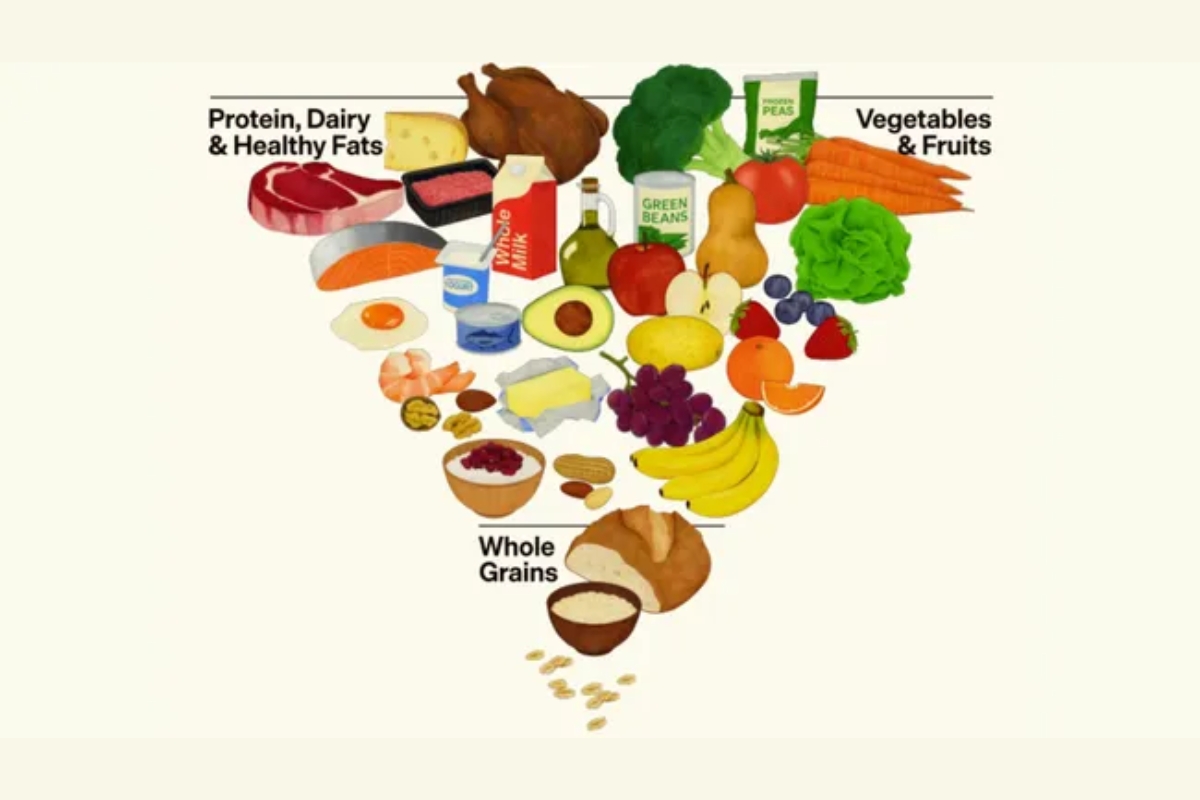
Official Guide Places High Protein Consumption at the Center of Nutrition and Reduces the Prominence of Whole Grains
The new food pyramid adopted in the United States marks a profound change in official nutritional recommendations and redefines the role of major food groups. The model abandons the traditional format and emerges as an inverted triangle, placing proteins, whole dairy, and healthy fats at the top of the dietary guidance.
The change goes beyond the visual and has direct impacts on how the population is guided to assemble their meals. The focus shifts to increasing the consumption of meat, eggs, fish, and dairy products, while whole grains are positioned at the base, with less emphasis. The proposal also reinforces the reduction of highly processed foods in daily life.
This guideline serves as a reference for public policies and food programs, influencing everything from individual choices to decisions in schools, armed forces, and federal food assistance initiatives.
-
How to build a 35,000-liter cistern with 60 by 50 cm panels and rainwater for drinking and cooking without relying on water trucks or the city hall.

-
A woman went out for a regular walk and ended up finding a treasure buried for over 900 years, with more than 2,000 medieval silver coins compared by archaeologists to a lottery prize and considered one of the most significant finds in recent years in the country.

-
Scientists revealed 11 signs that very intelligent people exhibit in their daily lives, and most people have no idea that some of these common behaviors are directly linked to an above-average brain.

-
From space, Buenos Aires appears as a colossal spot of light surrounded by kilometers of darkness, revealing at a single glance the exact boundary between the metropolis and the countryside, seen from 400 km altitude.

What Happened to the Food Pyramid and Why Was the Model Inverted
The federal government replaced the old MyPlate, adopted since 2011, with a new graphic representation of healthy eating. The change resulted in an inverted pyramid that reorganizes nutritional priorities and alters the hierarchy among food groups.
At the top of the new model are animal proteins, whole dairy, and healthy fats, accompanied by fruits and vegetables. At the bottom are whole grains, which previously occupied a more central position in the guidance.
The inversion aims to reflect an approach that values less processed foods and those with greater nutritional density, while reducing emphasis on refined carbohydrates and ultraprocessed products.
Emphasis on Proteins Alters Daily Consumption Goals
The new guidelines significantly raise the amount of protein recommended for daily intake. Previously, the general reference was 0.8 grams per kilogram of body weight, sufficient only for an average sedentary adult.
Now, the reference intake rises to 1.2 to 1.6 grams per kilogram of body weight, which represents a substantial increase in practice. For a person weighing 68 kg, the daily recommendation increases from 54.4 grams to somewhere between 81.6 and 108.8 grams of protein.
This change particularly affects physically active adults and older individuals, groups that already had differentiated recommendations but are now set to have elevated consumption as a broader standard.
Animal Fats and Whole Dairy Enter as Healthy Options
Another central point of the new pyramid is the redefinition of so-called healthy fats. The list includes fats found in meats, poultry, eggs, seafood rich in omega-3, nuts, seeds, olives, avocados, and whole dairy.
Among the options for food preparation are olive oil, butter, and beef tallow, all recognized as suitable for culinary use. Even with this expansion, the rule remains that saturated fats should not exceed 10 percent of daily calories.
In practice, this signals greater acceptance of traditional fats in cooking as long as total consumption is balanced throughout the day.
Guidelines Reinforce the Fight Against Highly Processed Foods
The new guide highlights the need to avoid highly processed foods, although it does not provide a detailed technical definition for the term. Still, there is clear guidance to reduce the consumption of ready-to-eat industrial products.
This group includes packaged meals, excessively salty or sweet foods, sugary beverages, and items containing artificial flavorings, preservatives, or non-nutritive low-calorie sweeteners.
At the same time, the document clarifies that naturally occurring sugars in fruits and milk are not considered added sugars, reinforcing the value of foods in their closest natural form.
Critics Point Out Risks of Increased Red Meat Consumption
The strong presence of meats and whole dairy in the new pyramid has raised concerns among nutrition and public health experts. The official illustration includes steaks, ground beef, and whole milk, which may encourage higher consumption of these foods.
There are warnings that diets high in red meat and animal products may not be ideal for long-term health and also have significant environmental impacts. The debate centers around the balance between nutritional density and food sustainability.
Despite these criticisms, the model maintains fruits and vegetables in a prominent position, indicating that the proposal does not exclude traditional groups but redefines their proportions.
Direct Impact on Schools, Federal Programs, and Institutional Meals
The national dietary guidelines serve as the basis for decisions regarding school lunches, military meals, and federal food assistance programs, including SNAP. This means that the new pyramid will have practical effects on menu compositions at scale.
The implementation is expected to occur gradually over the next two years, allowing for adjustments in contracts, food supply, and public system adaptations.
Besides institutions, the guide also acknowledges that nutritional needs vary according to age, level of physical activity, pregnancy, breastfeeding, and aging, offering general guidance for these groups.
The new food pyramid represents a structural change in how healthy eating is communicated in the United States, with a greater focus on proteins, traditional fats, and less processed foods. The model alters references used for over a decade and is likely to influence individual choices and public policies.
For the reader, the main impact lies in the reassessment of the balance between meats, dairy, vegetables, and grains on the daily plate. The proposal reinforces the importance of food quality and the reduction of processed products while expanding the space for animal sources in everyday diets.









-

-

-

-

-

-

33 pessoas reagiram a isso.