





 Portuguese
  English
  Spanish
  4 min of reading
  0 comments


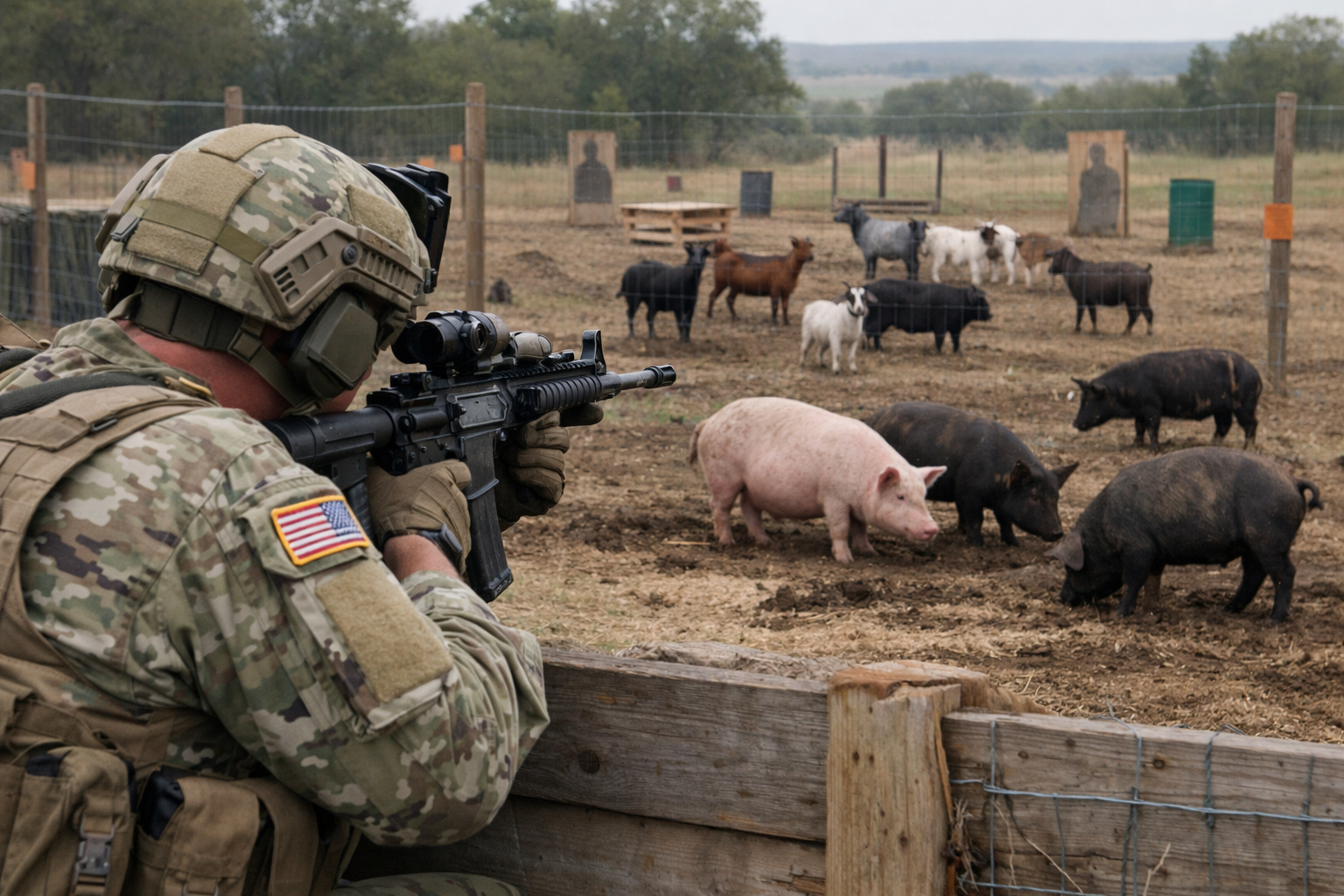
The New Legislation Approved in December Fundamentally Changes Military Medical Training, Restricts the Use of Live Ammunition on Live Animals, and Pressures the Armed Forces to Adopt Advanced Simulation Technologies on the Battlefield
The Army of the United States has been officially prohibited from using live animals as targets for live ammunition in training programs aimed at training combat medics. The change ends a historic practice adopted since the Vietnam War and marks a turning point in how the U.S. Armed Forces conduct medical training for modern combat scenarios.
The information was disclosed by the Associated Press (AP), based on the text of the new legislation approved by the U.S. Congress on December 18, as part of the National Defense Authorization Act for 2026. The regulation expressly prohibits any application of gunshot wounds on live animals conducted by the Department of Defense for the purpose of training combat medics.
While the decision eliminates the use of live ammunition, the law still allows other types of procedures involving animals, as long as they do not include shooting. Thus, military medical training undergoes a partial reformulation, but not a total one, as argued by animal rights organizations.
-
A Brazilian millionaire couple restores a farm over 150 years old in the interior of São Paulo and transforms the historic property with Portuguese tiles, antique furniture, and new spaces into a refuge that blends tradition, comfort, and sophistication.

-
Submerged city in a lake in Minas reveals intact streets, preserved vehicles, and houses after more than 60 years, impressing divers.

-
Yellowstone has started to rise again in an area of the caldera, and the movement rekindles fears surrounding the U.S. supervolcano, as scientists monitor the deformation and try to understand what is happening underground.

-
Woman arrested after receiving $1.2 million due to banking error and not returning the amount.


Why Live Animals Were Used in Military Medical Training
Historically, the use of live animals, especially pigs and goats, has been justified by the Armed Forces as a way to simulate real wartime injuries. According to a 2022 report by the U.S. Government Accountability Office, these animals have organs and tissues with anatomical similarities to humans, as well as biological variations that can complicate medical procedures, creating complex training scenarios.
According to the document, such variations would be important for exposing military medics to unpredictable scenarios, common in real battlefields. Still, this justification has been widely questioned over the last few decades.
The practice, officially adopted since at least the Vietnam War, has become the target of constant denunciations and public campaigns led by organizations like the Physicians Committee for Responsible Medicine and the People for the Ethical Treatment of Animals (PETA). Both argue that technological advancements have made this type of training unnecessary and ethically unjustifiable.
According to the Associated Press, there are no precise public data on the frequency with which American military personnel used live animals in medical training, which further increased the pressure for transparency and review of the practices adopted.
What Changes with the New Law and What Exceptions Remain
With the enactment of the new legislation, the Department of Defense is prohibited from authorizing any combat medical training involving injuries caused by live ammunition on live animals. However, the legal text does not completely prohibit the use of animals in other types of simulations.
The office of Republican Representative Vern Buchanan, from Florida — one of the key proponents of the measure — stated that procedures such as stabbings, burns, and blunt force impacts could still be authorized. In these cases, the declared objective is to replicate specific traumas without the use of firearms.
Additionally, the law provides an exception for situations classified as weapon testing, in which animals may be harmed, as long as they are properly anesthetized. This point continues to generate criticism from activists, who consider the exception too broad.
Buchanan stated that the new rule represents an effort to eliminate practices deemed “outdated and inhumane,” while still preserving the operational capacity of the Armed Forces. However, animal rights organizations argue that the change should have gone further.
Advanced Simulators and the Future of War Medical Training
The legislation also explicitly directs the Armed Forces to utilize modern alternatives, such as advanced simulators, high-fidelity mannequins, human cadavers donated for scientific purposes, and even trained actors wearing injury simulation clothing.
According to the Physicians Committee for Responsible Medicine, these technologies have evolved significantly in recent decades, allowing the reproduction of bleeding, physiological responses, and human reactions with greater realism than anesthetized animals.
In an official statement, the organization stated that anesthetized pigs and goats offer little pedagogical value for combat medics, while simulations with people equipped with special suits can more effectively replicate the behavior of a severely injured human in a hostile environment.
Activists emphasize that, in addition to the ethical aspect, the use of simulators reduces costs, increases the repetition of scenarios, and allows for more accurate assessments of medical performance, something difficult to achieve with live animals.
The new national law also prohibits the use of dogs, cats, non-human primates, and other mammals in battlefield training exercises, consolidating a gradual but significant shift in the military medical preparedness doctrine of the States.




-

2 pessoas reagiram a isso.