





 Portuguese
  English
  Spanish
  5 min of reading
  0 comments


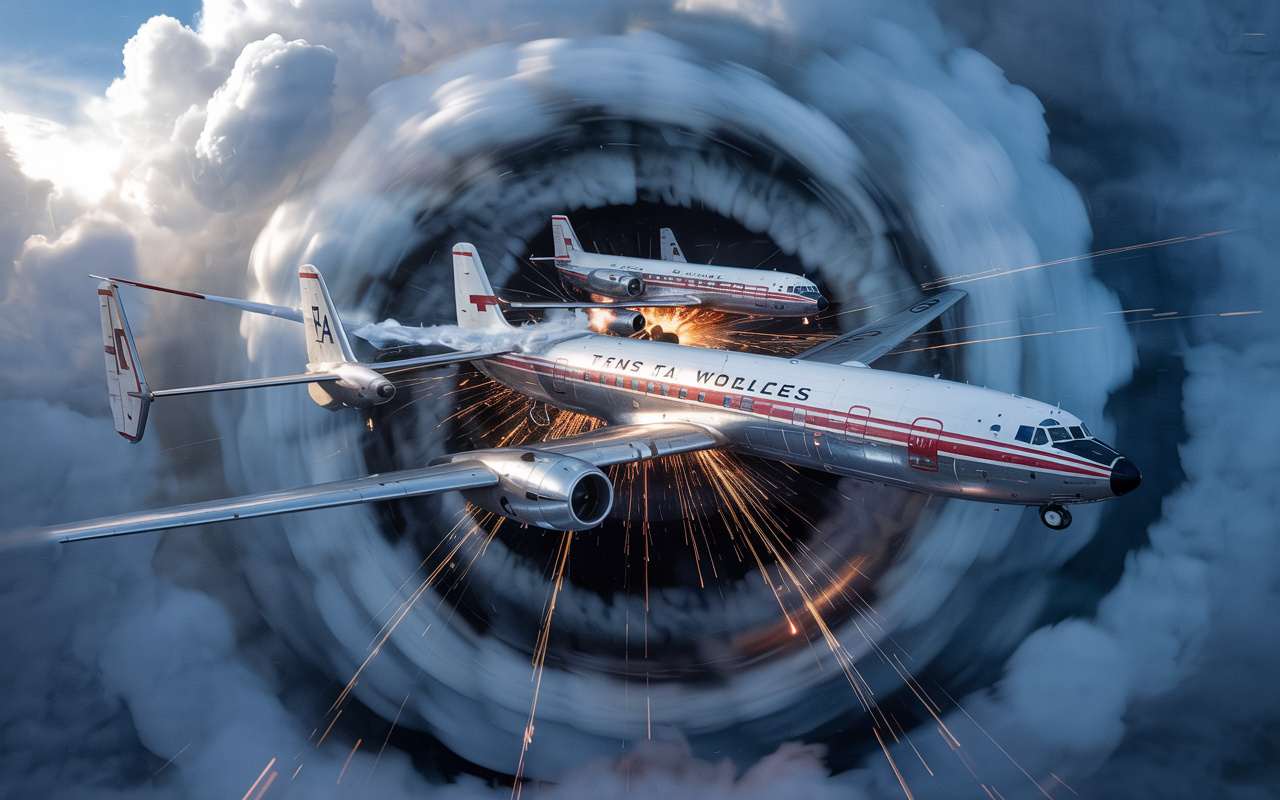
A Saturday That Marked World Aviation: In 1956, An Air Collision Over The Grand Canyon Changed Air Safety In The US Forever, Resulting In The Creation Of The FAA And The NTSB. Understand How This Happened.
On June 30, 1956, a sunny Saturday in the United States, the country witnessed one of the most tragic and transformative air accidents in history. Around 10:30 AM, a Lockheed Super Constellation from Trans World Airlines (TWA) and a Douglas DC-7 from United Airlines collided mid-air over the Grand Canyon in Arizona, causing both planes to crash and resulting in the deaths of 128 people. This was the first commercial air accident to surpass a hundred deaths, profoundly shaking public confidence in aviation.
Until that moment, air collisions were not uncommon in the United States. Between 1948 and 1955, there were 127 collisions in US airspace, 30 of which involved commercial airplanes. But it was only after the 1956 tragedy that the country recognized the urgency to reform its air safety systems.
How The Collision Occurred In The Grand Canyon
The TWA Super Constellation, carrying 70 people, was flying toward Chicago. The United Airlines DC-7, with 58 people on board, was heading to Kansas City. Both were flying through uncontrolled airspace, where the prevailing rule was “see and be seen,” with pilots responsible for maintaining safe visual distance. In practice, this was an invitation to risk.
-
A rare storm transformed part of the Gulf into an unlikely scene of hail, extreme rain, and tornado risk in the middle of the desert, with volumes that exceeded the annual average in a single day.

-
Brazil catches the world’s attention with ships powered by ethanol and biodiesel that have lower emissions, an unprecedented certification with advantages in chartering, and a revolution in cabotage.

-
A couple who only has Sundays free has built a hand-dug pool, a hamburger joint, a dance hall, and a playground in their own home without hiring a mason, and even with breaks due to accidents and the pandemic, the work has never truly stopped.

-
Furniture made with aluminum and glass does not warp and has become an alternative to replace MDF in Brazil.


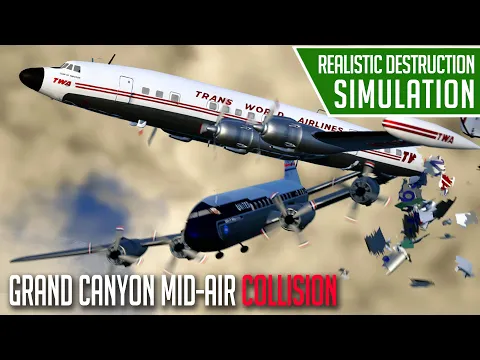

On that day, both planes were flying nearly at the same altitude, 21,000 feet, and at similar speeds. Presumably, the pilots slightly deviated from their routes to give passengers a privileged view of the Grand Canyon. However, cumulus clouds at 7,600 meters blocked visibility. As the planes flew parallel for a few moments, they entered each other’s blind spots, and tragedy became inevitable.
The left wing of the DC-7 struck the upper part of the vertical stabilizer of the Super Constellation, breaking the tail of the TWA plane, which dropped in a vertical dive, colliding with the ground at 770 km/h in the Temple Butte area. The DC-7, with its left wing damaged and engine number one without lift, spiraled down over Chuar Butte. Both planes disintegrated on impact.
The Rescue In An Inaccessible Location
At that moment, there were no radars to track the exact position of the planes in real-time, and the collision was not immediately realized. It was only after the absence of radio communication that controllers and ground teams declared the flights missing.
Interestingly, two brothers, Henry and Palen Hudgin from Grand Canyon Airlines, had spotted black smoke in the Temple Butte area that day, but assumed it was a forest fire. After learning about the missing planes, they flew over the area and located the tail of the Constellation, alerting the authorities. The following day, the crash site of the DC-7 was also found.
The locations were so remote that helicopters were needed to transport teams and recover the wreckage and bodies. The scene was desolate: no bodies were recovered intact, and only three passengers could be positively identified before DNA advancements. A mass funeral was held for the victims, and many were buried in collective memorials near the Grand Canyon.
The Impact On Aviation And Air Safety
The Civil Aeronautics Board (CAB) concluded that the collision occurred due to visibility limitations and the “see and be seen” system in complex weather conditions. The investigation also pointed out that the flights were off course and at unauthorized altitudes, trying to provide passengers with views of the Grand Canyon.
The accident generated public outrage. How could commercial aviation allow two planes to collide in open sky, without the interference of controllers? The air traffic control system in the United States was inadequate, relying on radio transmissions, without radar tracking, and with an increasing volume of air traffic that exceeded the operational capacities of the time. It took a tragedy of such magnitude to drive a revolution in aviation.
The Birth Of The FAA And The Change In Commercial Aviation
The collision over the Grand Canyon was the catalyst for Congress to pass legislation in 1957, resulting in the creation of the Federal Aviation Administration (FAA) and the National Transportation Safety Board (NTSB). These agencies began to:
- Implement radar systems for air traffic control;
- Improve communications between aircraft and towers;
- Require minimum separation between aircraft on routes and altitudes;
- Monitor airline practices to prevent unauthorized deviations from flight paths.
This marked the beginning of an era of air safety in the United States, transforming commercial aviation into one of the safest modes of transport in the world, as we know today.
A Legacy Forged In Tragedy
The 1956 air collision over the Grand Canyon remains one of the most impactful accidents in aviation history, not only because of the number of casualties but also because it forced the country to modernize its control and safety systems.
At the time, aviation was rapidly expanding but still operated under outdated concepts, where pilots relied on their own vision in an increasingly crowded sky. The tragedy served as a warning about the dangers of an inefficient system.
Today, every radar at an airport, every air traffic controller, and every proximity alert in aircraft is grounded in the memory of that accident, which, despite costing 128 lives, helped to save thousands in the following decades.
The story of the plane crash in the Grand Canyon in 1956 is more than a reminder of a tragic day: it is a reminder of how air safety has evolved at the cost of lost lives. It was the turning point that made the world understand that in aviation, nothing can be left to chance.
The next time you are on a plane, remember that every safety measure — every flight procedure, every radar control — has been built to ensure that tragedies like that of 1956 do not happen again.






Seja o primeiro a reagir!