





 Portuguese
  English
  Spanish
  4 min of reading
  1 comment


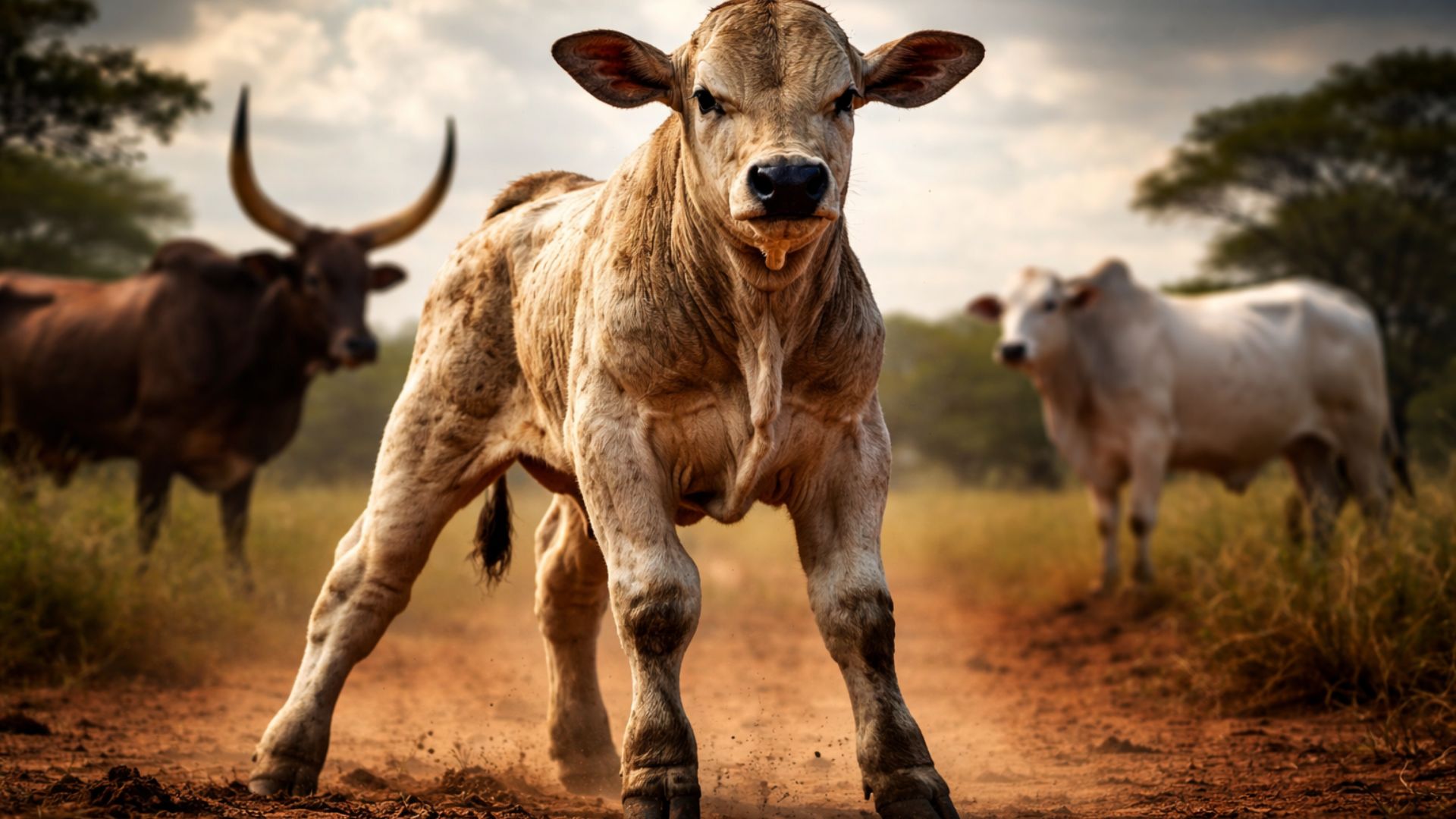


Unique Crossbreeding Between African and Brazilian Breeds Marks Start of Technical Observation in the Congolese Field, Bringing Extreme Adaptation, Tropical Selection, and Realistic Management in an Extensive System, Without Immediate Promises and Focused on Practical Learning for Central African Cattle Raising.
A calf born in the Republic of Congo caught the attention of technicians and producers for representing a still rare milestone in Central Africa.
This is the first animal publicized as a result of the crossbreeding between Ankole and Nelore in the country, in a test conducted under field conditions and with natural mating.
The birth was shared by Leandro Cazelli Alencar, a veterinary doctor and zootecnist working with production in the region.
-
The eggshell that almost everyone throws away is made up of about 95% calcium carbonate and can help enrich the soil when crushed, slowly releasing nutrients and being reused in home gardens and vegetable patches.

-
This farm in the United States does not use sunlight, does not use soil, and produces 500 times more food per square meter than traditional agriculture: the secret lies in 42,000 LEDs, hydroponics, and a system that recycles even the heat from the lamps.

-
The water that almost everyone throws away after cooking potatoes carries nutrients released during the preparation and can be reused to help in the development of plants when used correctly at the base of gardens and pots, at no additional cost and without changing the routine.

-
The sea water temperature rose from 28 to 34 degrees in Santa Catarina and killed up to 90% of the oysters: producers who planted over 1 million seeds lost practically everything and say that if it happens again, production is doomed to end.


The crossbreeding involved a Nelore bull of Brazilian origin, which gives the record a practical character, far removed from trials limited to laboratory or experimental station.
Although the initiative has resonated due to the uniqueness of the encounter between breeds, the central point is not just the novelty.
The episode opens a window of observation on how two distinct genetic histories can interact in an environment marked by sanitary and climatic challenges.
The irregular availability of supplies and the variable infrastructure between properties make the context even more relevant.
Natural Mating Reinforces Test in Real Production Conditions

By highlighting that the calf was born from natural mating, the announcement reinforces that the crossbreeding occurred within the routine of management.
The process followed the real dynamics of a herd in an extensive system, without complex artificial interventions.
This information reduces the gap between the experiment and the reality of the local producer.
If the proposal is to evaluate practical viability, the result needs to arise in a scenario similar to what is intended to be applied afterward.
Still, the first birth does not allow for premature conclusions about zootechnical performance.
In crossbreeding, productive impacts usually appear only with prolonged monitoring.
The case serves as a starting point, and not as a definitive validation of a genetic strategy.
Ankole Carries African Tradition and Adaptation to Adverse Environments
The Ankole is recognized for its strong cultural and historical presence in different regions of the African continent.
More than the striking appearance, the breed is valued for its functionality in environments of intense heat and irregular pasture availability.


In extensive systems, the Ankole is often associated with the ability to maintain performance with less dependence on supplementation.
The expression “animal that endures the field” synthesizes this practical perception among breeders.
Studies on African cattle describe local populations as genetic resources linked to adaptation to thermal stress.
There are also records of tolerance to sanitary challenges in certain productive contexts.
However, rusticity is not an absolute concept and depends heavily on management, environment, and sanitary pressure.
For this reason, results observed in one region cannot be automatically extrapolated to another.
Nelore Symbolizes Tropical Selection and Productive Predictability
The Nelore represents one of the longest trajectories of zootechnical selection in a tropical environment.
In Brazil, the breed has consolidated itself as the basis of beef cattle raising, sustained by decades of genetic improvement.
Programs focused on growth, reproduction, feed efficiency, and pasture performance.
In practice, the Nelore is associated with productive predictability in hot systems.
This characteristic explains the extensive use of the breed in crossbreeding strategies both inside and outside the country.
Still, the simple introduction of Nelore genetics does not guarantee an automatic increase in productivity.
Performance depends on the interaction between genetics, environment, and management.
What Can Be Observed From the Birth of the Calf
The main technical question involves understanding how Ankole’s adaptation interacts with the selected genetics of Nelore.
This answer does not arise at birth, but over the development of the animal.
The first indicator is usually body growth under normal and critical conditions of the year.
Health also comes into focus, especially in environments with disease pressure.
The expectation is to observe if resistance characteristics are maintained with the introduction of Nelore genetics.
Productive efficiency can only be evaluated with direct comparisons in the same environment.
Weight gain, need for supplementation, and response to management need to be measured consistently.
Fertility, longevity, and maternal ability require even more time and often, more than one generation.
Viability for the Producer Defines Practical Relevance of the Crossbreeding
Beyond the technical indicators, economic and operational viability is decisive.
The animal needs to fit into the level of intensification possible in the region.
Management costs and adaptation to the local routine directly influence the adoption of any genetic strategy.
Without this alignment, the result tends to remain limited to curiosity, without real impact on production.









How does it’s weight compare with the weight of a similar ankole calf?