





 Portuguese
  English
  Spanish
  6 min of reading
  0 comments


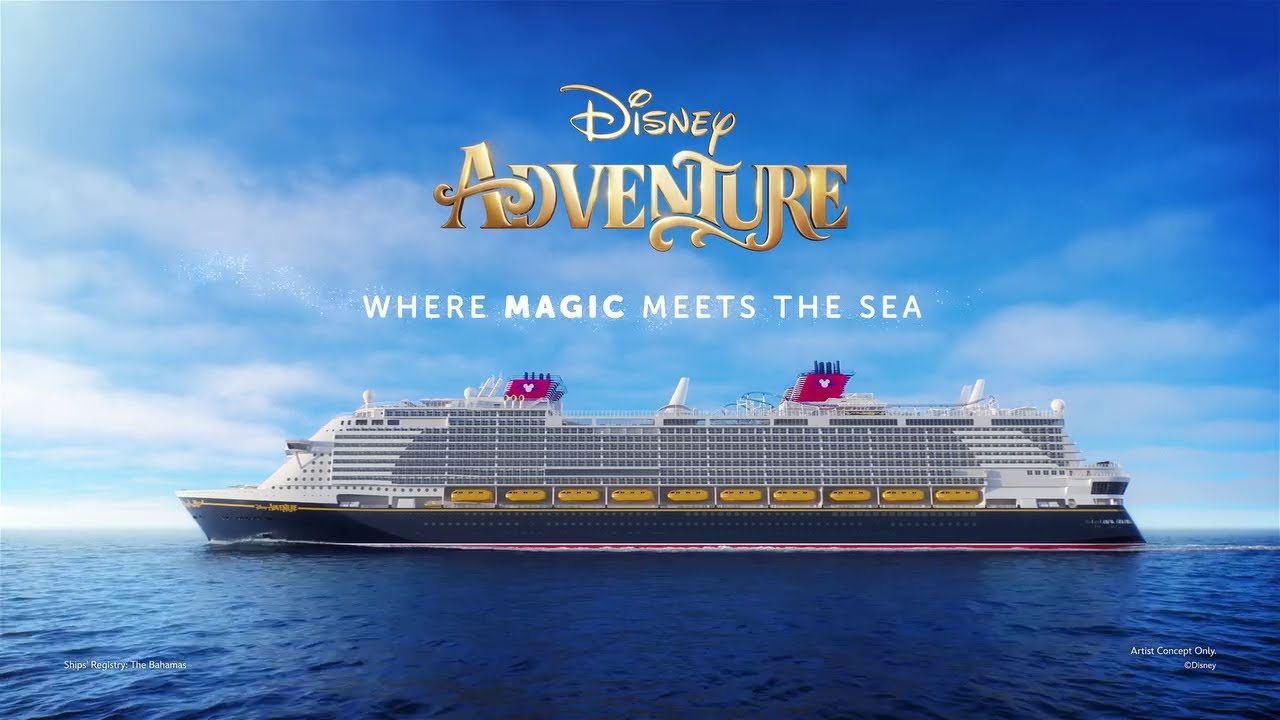
Disney Adventure: Ship of 342 Meters Purchased for €40 Million After Bankruptcy Becomes the Largest of Disney Cruise Line and Begins Operations of Luxury Cruises from Singapore.
The Disney Adventure, now the largest ship in the history of Disney Cruise Line, began its journey as a completely different project. Before being transformed into a Disney-themed cruise ship, the vessel was known as Global Dream, a massive cruise ship of 342 meters in length and over 208,000 gross tons that was under construction in Germany for the Asian maritime tourism market. The project was initiated by a conglomerate that ultimately went into financial collapse. The ship was left abandoned in a German shipyard with about 70% of the construction completed, without funding and without a buyer. In 2022, Disney Cruise Line acquired the vessel for € 40 million, a fraction of the original investment estimated at € 1.8 billion.
After a complete overhaul, the former Global Dream was transformed into the Disney Adventure, a megaship designed to operate from Singapore and capable of carrying around 6,000 passengers, making it the largest ship ever operated by the company.
The Original Plan of Genting Hong Kong to Build the Largest Cruise Ships in Germany
The ship’s story begins in 2016, when Malaysian billionaire Tan Sri Lim Kok Thay, leader of the tourism conglomerate Genting Hong Kong, decided to aggressively expand his presence in the cruise industry.
-
With no separate outdoor unit and designed to fit in the window, monoblock air conditioners used in Japan emerge as an alternative for those who cannot install a split system in a rented apartment.

-
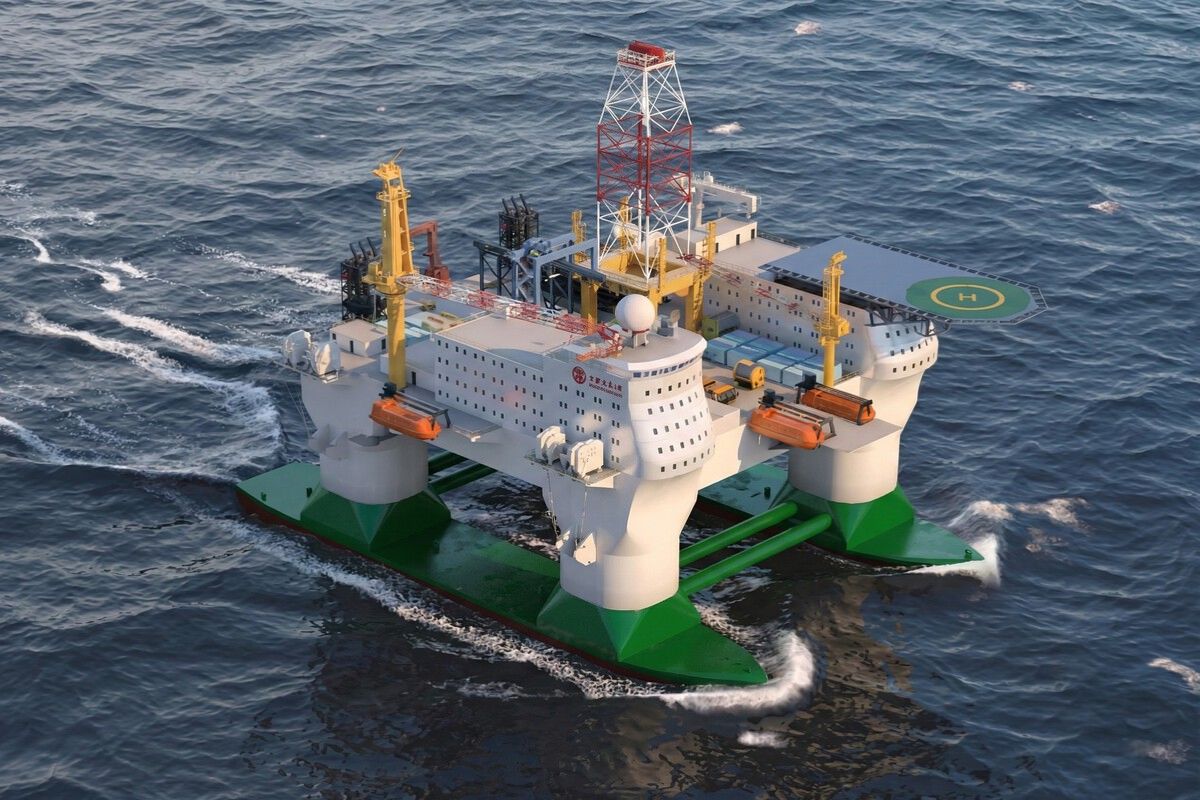
China prepares a 78,000-ton pilotable floating island for deep-sea research: it accommodates 240 people for months, withstands category 17 typhoons and 9-meter waves, and uses metamaterials that dissipate nuclear explosions.
-
End of the stove: new technology from Xiaomi promises to retire the old stove with a smart pot that prepares up to 16 servings in 24 minutes and has 10 automatic levels controlled by an app.

-
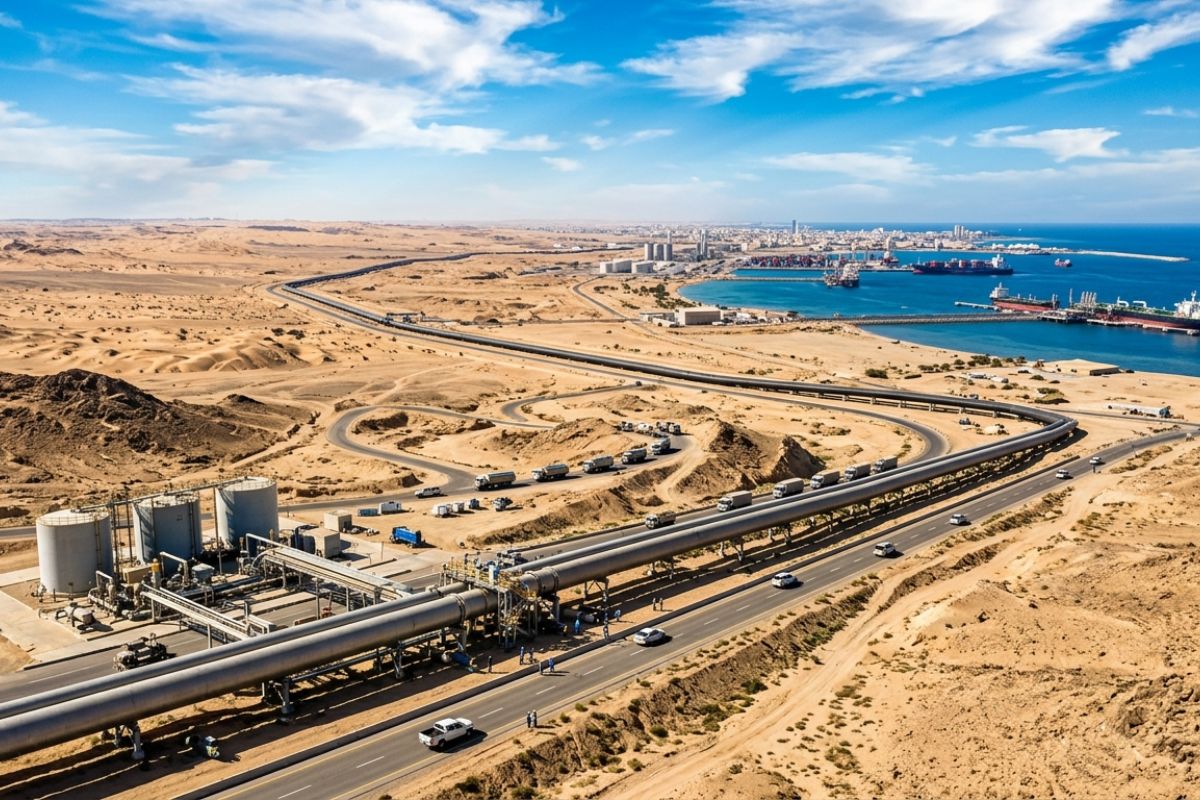
If Ormuz closes, the world freezes: the 1,200 km Saudi Petroline transports oil from the Gulf to the Red Sea, operates near 7 million barrels/day, and becomes a geopolitical weapon in the crisis with the US.

To achieve this, the group acquired three German shipyards located in Wismar, Rostock, and Warnemünde, consolidating all operations under a new company called MV Werften. The goal was to build gigantic ships for the Dream Cruises brand, which is primarily aimed at the Asian luxury cruise market.
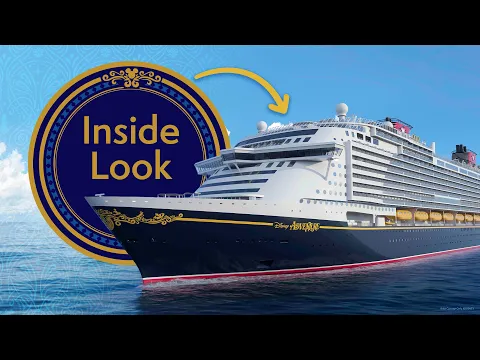

The project was named Global Class. The first keel was laid in September 2018, at the Rostock shipyard. The event was treated as a milestone for the German shipbuilding industry and was attended by regional authorities and about a thousand guests.
The first ship of the class was named Global Dream. With 342 meters in length, 208,000 gross tons, and capacity for up to 9,500 passengers, the project had the potential to become the world’s largest-capacity cruise ship.
The COVID-19 Pandemic Causes the Collapse of Genting Hong Kong
The project advanced rapidly until the start of 2020, when the COVID-19 pandemic hit the global cruise industry hard. In March of that year, nearly all cruise ships in the world were taken out of operation. Bookings disappeared, and the sector fell into an unprecedented crisis.
Genting Hong Kong, which was already operating with high levels of debt, saw its cash flow interrupted. In August 2020, the group suspended payments to creditors and began negotiations with the German government for financial support. The MV Werften shipyards employed about 1,800 direct workers, which increased political pressure to save the project.
However, negotiations did not progress. On January 10, 2022, MV Werften entered insolvency. Just hours later, Lloyd Werft, another shipyard linked to the group, also declared bankruptcy.
On January 19, 2022, Genting Hong Kong itself entered liquidation, accumulating about US$ 2.8 billion in debt.
The Global Dream is Left Abandoned in a German Shipyard
With the group’s bankruptcy, the Global Dream remained idle at the Wismar shipyard in Germany. The hull was nearly complete, and various internal systems had already been installed. Still, the ship was far from finished.
The second ship of the Global Class, which was at an earlier stage of construction, was ultimately sold for scrap. Meanwhile, the Wismar shipyard was acquired by ThyssenKrupp Marine Systems, a company known for manufacturing military submarines.
For months, the judicial administrator responsible for the liquidation tried to find buyers for the ship. The founder of Genting himself showed interest in repurchasing the project, and a group led by the Swedish company Stena also evaluated the acquisition. No negotiations progressed.
The Purchase of the Ship by Disney Cruise Line
The situation changed on November 16, 2022, when Disney Cruise Line announced the purchase of the ship for € 40 million. The amount represented a small fraction of the original investment, but still required a huge financial effort to complete the project. It was estimated that about US$ 1 billion additional would be needed to finalize the construction.
Even so, the final cost would be well below the amount necessary to build an equivalent ship from scratch.
Meyer Werft, a long-time partner of Disney in building cruise ships, took over the completion of the project. The company received authorization to use the facilities in Wismar and rehired hundreds of workers who had been laid off after the bankruptcy of MV Werften.
The Transformation of Global Dream into Disney Adventure
When Disney took over the project, it was clear that the ship would need to be completely adapted to the company’s standards. The Imagineers, the creative team responsible for Disney’s theme parks, redesigned much of the internal spaces.
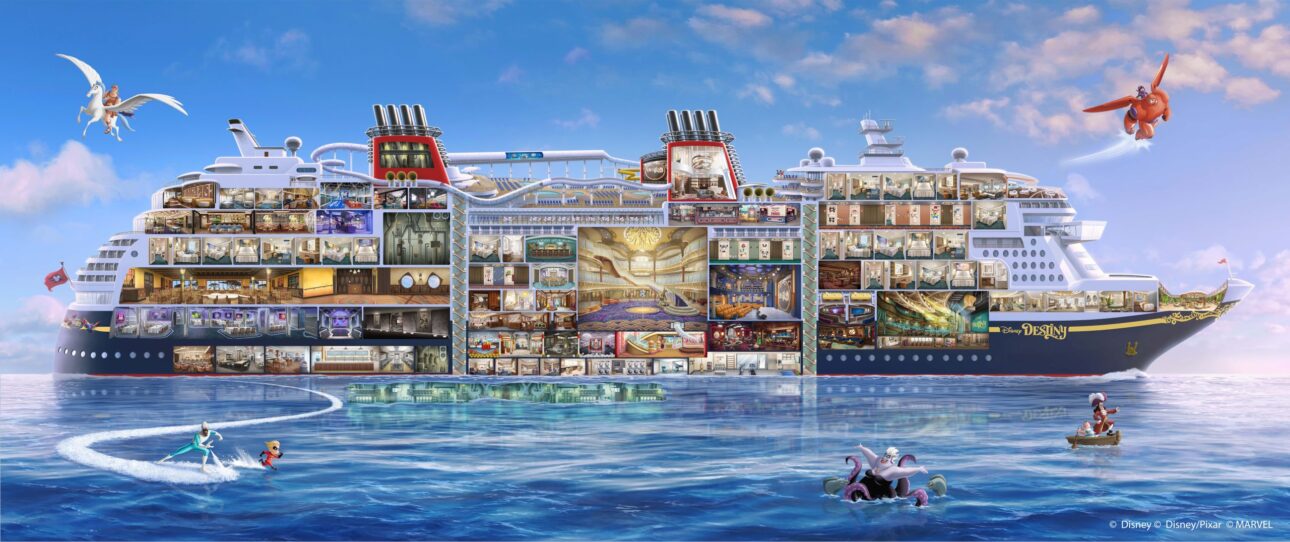
The first major adjustment was passenger capacity. The original design envisioned about 9,500 guests, a number considered excessive for Disney’s experience model. The company reduced capacity to approximately 6,000 passengers, increasing the available space per guest.
The casino, a central element of the original project aimed at the adult Asian audience, was removed. In its place, family entertainment areas emerged. The number of cabins was also changed. The 2,350 cabins originally planned were reduced to 2,111, with layouts adapted to the Disney Cruise Line’s characteristic split-bath model.
The Thematic Areas of the New Disney Ship
The ship is now organized into seven themed areas, inspired by different company franchises. Among them is Marvel Landing, which houses the attraction Ironcycle Test Run, described as one of the largest roller coasters ever installed on a cruise ship.
Another themed area is inspired by the movie Big Hero 6. The region recreates the fictional city of San Fransokyo in the form of a culinary promenade, heavily influenced by Asian cuisine.
This setting was specifically designed for the audience the ship would cater to in the region.
Propulsion System Prepared for Cleaner Fuels
The ship’s propulsion system was originally designed to utilize methanol, considered a potentially less polluting fuel than traditional marine fuels.
The system uses six MAN engines, with a combined power of approximately 96 megawatts, connected to three ABB Azipod propellers. However, when the ship began operations, green methanol was still not available in sufficient scale in Singapore, leading to initial operation with conventional fuel.
Still, the infrastructure remains prepared for a future transition.
The Disney Adventure Arrives in Singapore
The official delivery of the Disney Adventure took place on December 13, 2025, at the Wismar shipyard. On January 4, 2026, the ship began its journey to Asia.
After a voyage of approximately two months, the ship arrived at the Marina Bay Cruise Centre in Singapore on March 3, 2026. The baptism ceremony featured actor Robert Downey Jr., known for playing Iron Man in the Marvel Cinematic Universe. The inaugural voyage took place on March 10, 2026.
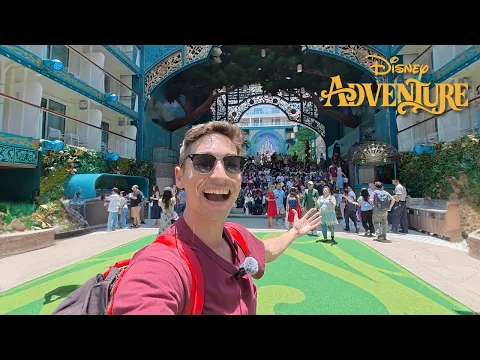
With 342.7 meters in length and 208,108 gross tons, the Disney Adventure became the largest ship ever built in Germany and the largest ship in the history of Disney Cruise Line, about 45% larger than the Wish-class ships, which were the largest in the fleet until then.
The “Cruise to Nowhere” Model Operated from Singapore
The Disney Adventure operates on a different model than the rest of Disney’s fleet. The itineraries consist of three and four-night trips, which depart and return to Singapore without stops at other ports.
In this format, the ship functions as the tourist attraction itself. The strategy was defined when Disney signed an agreement with the Singapore Tourism Board in 2023, guaranteeing at least five years of the ship’s operation from the city.
Singapore was chosen for its modern port infrastructure, a large international airport, and easy access to tourist markets such as India, Indonesia, Malaysia, and Australia.
A Ship Purchased for €40 Million that Can Generate Millions per Voyage
The Disney Adventure represents a rare case in the modern shipbuilding industry. The ship started as a project from another company, was abandoned after the bankruptcy of the shipyard building it, and was ultimately acquired in a judicial sale for € 40 million.
Today, with capacity for 6,000 passengers, the ship can generate gross revenue exceeding US$ 9 million in a single voyage, considering fares starting at around US$ 1,500 per person for three-night cruises.
This combination of circumstances transformed the former Global Dream into one of the most unusual examples of repurposing a large-scale naval project in the recent history of the cruise industry.






Seja o primeiro a reagir!