





 Portuguese
  English
  Spanish
  4 min of reading
  5 comments


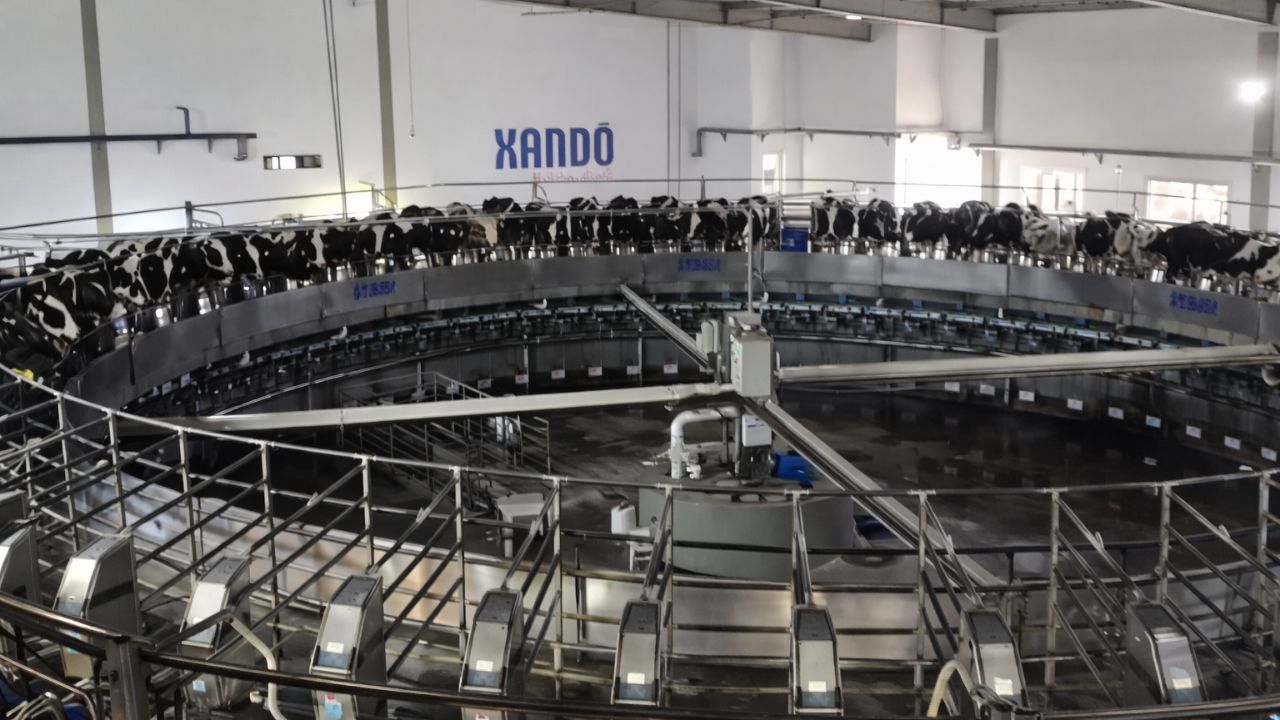


At The Largest Dairy Cow Farm In Brazil, Fazenda Colorado Combines Milking Carousel, Animal Welfare, A2A2 Genetics, And Precision Management To Sustain High Volume With Standardized Routine.
At the largest dairy cow farm in Brazil, Fazenda Colorado transforms milking into an industrial-scale operation, with a carousel of 72 stalls and a routine that seeks consistency between shifts. The result is reflected in the volume: 2,400 cows are milked in about six hours, producing over 100,000 liters per day and an average of 43 liters per cow per day.
Behind these numbers, the farm relies on well-defined pillars to maintain performance day in and day out: controlled environment, adjusted nutrition, A2A2 genetics, and team management with indicators in hand. The goal is not just to produce more but to produce with stable routine, quality, and predictability.
Milking In Carousel: Rhythm, Routine, And Standardization By Shift


The heart of the operation is the milking parlor in carousel format, with 72 stalls and a constant flow of animal entry and exit. The farm works with lean teams per shift, divided by function, from pre-dip to drying, equipment placement, and post-dip.
-
The water that almost everyone throws away after cooking potatoes carries nutrients released during the preparation and can be reused to help in the development of plants when used correctly at the base of gardens and pots, at no additional cost and without changing the routine.

-
The sea water temperature rose from 28 to 34 degrees in Santa Catarina and killed up to 90% of the oysters: producers who planted over 1 million seeds lost practically everything and say that if it happens again, production is doomed to end.

-
An Indian tree that grows in the Brazilian Northeast produces an oil capable of acting against more than 200 species of pests and interrupting the insect cycle, gaining ground as a natural alternative in soybean, cotton, and vegetable crops.

-
The rise in oil prices in the Middle East is already affecting Brazilian sugar: mills in the Central-South are seeing their margins shrink just as ethanol gains strength.


The logic is simple and demanding: cows like routine, and maintaining the same delivery in the morning, afternoon, and evening depends on training, monitoring, and aligning procedures. Colorado reinforces this with meetings, indicators, and monitoring of milk speed and quality.
Production Above 100 Thousand Liters Per Day And Focus On Consistency
Fazenda Colorado operates with daily production exceeding 100 thousand liters and projects even higher peaks during specific periods. The strategy is not to depend on “good days,” but to build results through process repetition.
This point explains why the farm treats the milking parlor as a critical operation: consistency is harder than volume, especially when the goal is to reduce variations between groups and maintain stable ‘quality’.
Animal Welfare With Controlled Ambience And Real Comfort
The farm works with a cross-ventilation cooling system, with cooled air intake and exhaust fans pulling the flow into the barn. The proposal is to improve ambiance, especially when the air is drier, increasing system efficiency and reducing thermal stress.
In daily management, comfort is not just talk. The operation monitors bedding, feed troughs, flooring, ventilation, and tranquility of the animals. A pleasant environment helps sustain production, as the most efficient moment occurs when the cow is lying down, resting, and ruminating.
People Management: Data, Meeting, And Consistency Of Execution
Colorado treats team management as a pillar as important as nutrition and genetics. Training and meetings keep the team in touch with what is actually happening, alongside routine, quality, and efficiency indicators.
The focus is on reducing distortions between shifts and maintaining operational standards. Without trained and engaged people, routine breaks, and any break in routine tends to appear quickly in production and quality.
Nutrition With More Feeds Per Day And Quality Control Of Forages

For high-production groups, the farm increases the feeding frequency, reaching up to six feeds per day. The logic is to keep food more accessible and reduce consumption fluctuations, especially during challenging periods.
In the formulation, corn silage, pre-dried forages, energy and protein ingredients, minerals, and additives are included based on the phase. The farm conducts frequent forage analyses, monitoring dry matter, fiber, and digestibility because large-scale feeding cannot be done “by eye”.
A2A2 Genetics And Reproduction As A Long-Term Leverage
The farm works with genetics as a tool to increase productivity per animal and meet market demand. Within this strategy, A2A2 milk stands out, linked to the animal’s genetics and obtained through targeted selection and crossings.
Colorado also employs reproductive techniques, such as collection and implantation of embryos in selected animals, aiming to accelerate genetic gain and increase the proportion of females. Genetics Is The Silent Engine Of Scale, as it improves the herd without relying on increasing facilities.
Hygiene, Reuse Water, And Sustainability In The Farm Routine
The cleaning of corridors and floors involves a flushing system, with a “wave” of water that washes the floor and carries residues for separation between solids and sand. A significant portion of this water is reused, reducing the use of clean water for cleaning.
The operation also separates materials, conducts composting, and directs fractions for fertilization in agricultural areas. Sustainability here is a process, not a decoration, as it is integrated into the routine of cleaning, reuse, and waste management.
Precision Management: Collars, Sensors, And Decisions Based On Behavior
The farm uses monitoring technology through collars, collecting data on movement, time at the trough, time lying down, and signals that help understand the comfort and behavior of the group. This data feeds reports that support management and health decisions.
The result is a more predictable operation, with the ability to identify deviations before they become significant problems. Precision Management Becomes A Routine When The Herd Is Large, because the details make a difference at scale.
In your opinion, what most explains the strength of the largest dairy cow farm in Brazil: animal welfare, A2A2 genetics, or precision management in daily routine?








Why do people tolerate these dusgusting **** concentration camps?
Goodday, how to apply as a dairy farmer? I have experience in dairy farming. I’m willing to learn, willing to experience your culture, language and also I want to be part of your company. Thank you
A tar de Fazenda Colorado fica nos EUA, no Afeganistão ou no Burundi? (5 W + 1 H).
Ela fica em São Paulo.