





 Portuguese
  English
  Spanish
  5 min of reading
  0 comments


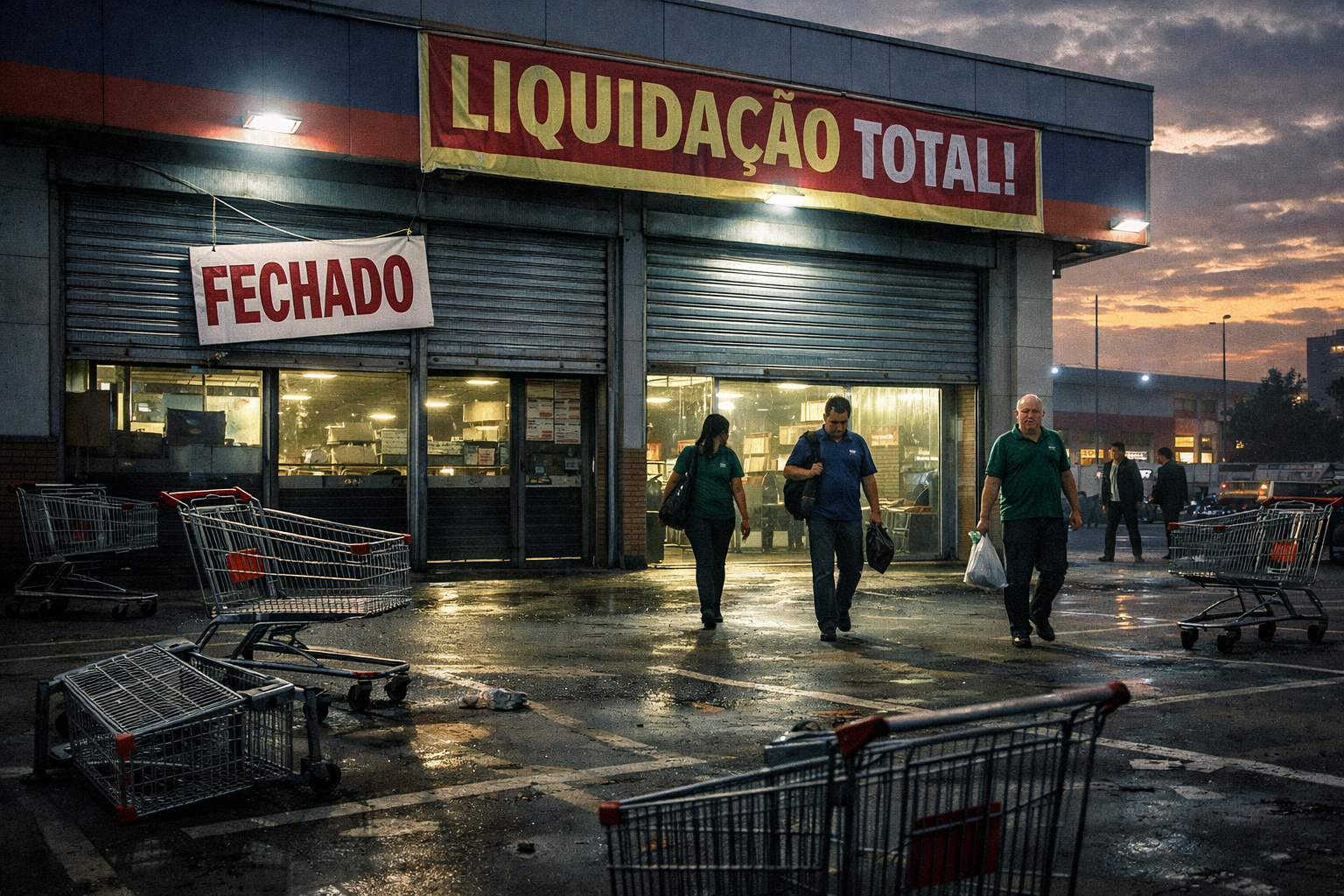
While The Food Retail Enters A Critical Phase Of Adaptation, Chain Store Closures, Deep Restructurings, And Changes In Consumption Expose A Silent Transformation That Threatens Traditional Stores, Jobs, And The Physical Supermarket Model
The closure of physical stores of large supermarket chains has been intensifying and has caught the attention not only of consumers but also of workers, investors, and industry analysts. The recent movement involving French chain Alcampo, one of the most recognized in the European food retail, has become a symbol of a structural change that goes far beyond isolated decisions. This is a reorganization forced by rising costs, declining profitability, the advancement of e-commerce, and a deep change in consumer buying behavior.
The information was disclosed by the website Em Foco, based on reports and data from the European retail sector, as well as analyses published by specialized economic and consumer media. According to the material, the closure of physical units of Alcampo reflects a scenario of continuous pressure on margins, requiring quick responses from traditional chains to avoid even greater losses.
Over the past few months, consumers have begun to notice changes in the operation of stores, reduction of in-person services, and definitive closures of units in regions previously considered strategic. At the same time, workers face growing uncertainties as the sector tries to balance operational efficiency with social impact.
-
He started running at 66 years old, broke records at 82, and is now a subject of study for having a metabolic age comparable to that of a 20-year-old, in a case that is intriguing scientists and inspiring the world.

-
Oldest tree on the planet reappears after 130 years of searches: Wattieza, 385 million years old, was 10 meters tall and had no leaves or seeds; Gilboa fossils in New York solved the mystery in 2007.

-
A 48-square-meter house assembled in hours with 4,000 bricks made of recycled plastic that does not absorb moisture, has natural thermal insulation, and costs less than 90,000 reais in a complete kit.

-
Luciano Hang revealed that Havan’s air fleet has already accumulated more than 20,000 landings, 10,000 flight hours, and 6 million kilometers traveled, and he says that without the planes, the company would never have grown so quickly.


Why Is Alcampo Closing Physical Stores And Accelerating Its Restructuring In Food Retail? Explain The Restructuring

The decision of Alcampo to close 16 physical supermarkets was officially justified for organizational, productive, and economic reasons, in a scenario marked by decline in sales, significant rise in operational costs, and accelerated change in consumer buying behavior. The closures affect units located in Madrid, Castilla y León, Galicia, Navarra, and the Basque Country, areas where the chain historically had a strong presence.
By 2025, Alcampo operated more than 520 establishments and employed over 23,000 people, highlighting the scale of the impact caused by this restructuring. Still, the current strategy aims to reduce financial losses and concentrate investments in areas considered more profitable and aligned with the new consumption model.
Furthermore, the company faces increasingly aggressive competition, spurred by the price war among supermarkets, the growth of neighborhood markets, and the advancement of online grocery shopping. As a result, large stores in less profitable areas have become costly, with diminishing returns.
In this sense, the restructuring emerges as an attempt to preserve the sustainability of the business in the medium and long term. The current logic prioritizes efficiency per square meter, digital integration, and operational flexibility, gradually abandoning the traditional model of extensive hypermarkets.
Social Impact: Almost 200 Workers Affected And Negotiated Protection Measures
The closure of stores affects not only consumers but also has a direct impact on workers. The restructuring plan includes the dismissal of 196 employees, a number that could be reduced if internal proposals are accepted, such as reallocations, adjustment of working hours, and changes in roles within the company’s structure.
To minimize the social impact, structured fixed positions with reduced hours were offered, as well as specific financial compensation and severance payments calculated based on days worked per year, respecting the limits set by current legislation and practices in the Spanish market.
Some groups considered more vulnerable received additional protection. Individuals with disabilities equal to or greater than 33% and victims of gender violence were excluded from the layoffs and should keep their jobs, according to clauses negotiated during the process.
Additionally, the company announced it will collaborate with a specialized outplacement company, responsible for structuring a professional reintegration plan. This support includes personalized guidance, resume reviews, assistance in selection processes, identification of opportunities in sectors close to food retail, and additional training in high-demand areas.
Financial Results Under Pressure, Losses And Measures To Strengthen Liquidity
As detailed by Em Foco, the closure of stores by Alcampo occurs amid a delicate financial scenario. The year 2024 ended in negative territory, with million-dollar losses, reversing the profit recorded in the previous period. The network’s business figure shrank a few percentage points, while the operating result suffered severe deterioration, pressured by the decline in the fuel segment and the intensification of the price war in food retail.
Among the main factors are the significant decline in the fuel business, the intensification of the price war, the increase in personnel costs after the integration of more than 220 acquired stores, in addition to extraordinary costs related to a cyberattack. This is compounded by the impact of extreme weather events that affected a specific hypermarket and the loss of market share to nimbler competitors.
To bolster liquidity without immediately abandoning its commercial locations, the group resorted to sale & lease-back operations, selling properties and leasing them back. This strategy allows for the release of capital in the short term while keeping the operation active as deeper decisions are assessed.
Does The Closure Of Stores Mean The End Of The Brand Or A Change In Strategy?
Despite the closure of 16 physical locations and the layoff plan, the scenario does not indicate the end of Alcampo, but rather a deep change in its business model. The chain is now betting on franchise expansion, strengthening the digital channel, and transitioning to smaller, more efficient stores integrated with e-commerce.
In the franchise sector, a growth plan has been outlined until 2025, prioritizing projects with quality, good locations, and sustainable profitability in the medium and long term. Regions such as Galicia and Asturias have been identified as high-potential areas, supported by a new logistics platform in Villanubla, Valladolid, created to enhance supply efficiency in the northern part of the country and support the growth of food e-commerce.
This new logistical structure is seen as a key element to ensure faster deliveries, cost reductions, and better integration between online purchases and in-store pickups.
What The Case Reveals About The Future Of Food Retail
The closure of traditional supermarkets illustrates a broader movement in retail, marked by the reduction of large surfaces in less profitable areas, the advancement of neighborhood supermarkets, the rapid growth of e-commerce, and the constant search for greater productivity in every square meter.
For consumers, this means finding fewer hypermarkets and more compact stores, with adjusted assortments, digital services, pickup of online orders, and greater integration between channels. For workers and local communities, the challenge will be to navigate this transition without significant loss of income and opportunities.
Whether you are a consumer, employee, or entrepreneur interested in franchises and new formats, keeping up with these changes has become a necessity. Food retail is being redesigned now, and those who do not adapt risk being left behind.








-

-

-

-

-

9 pessoas reagiram a isso.