





 Portuguese
  English
  Spanish
  4 min of reading
  0 comments


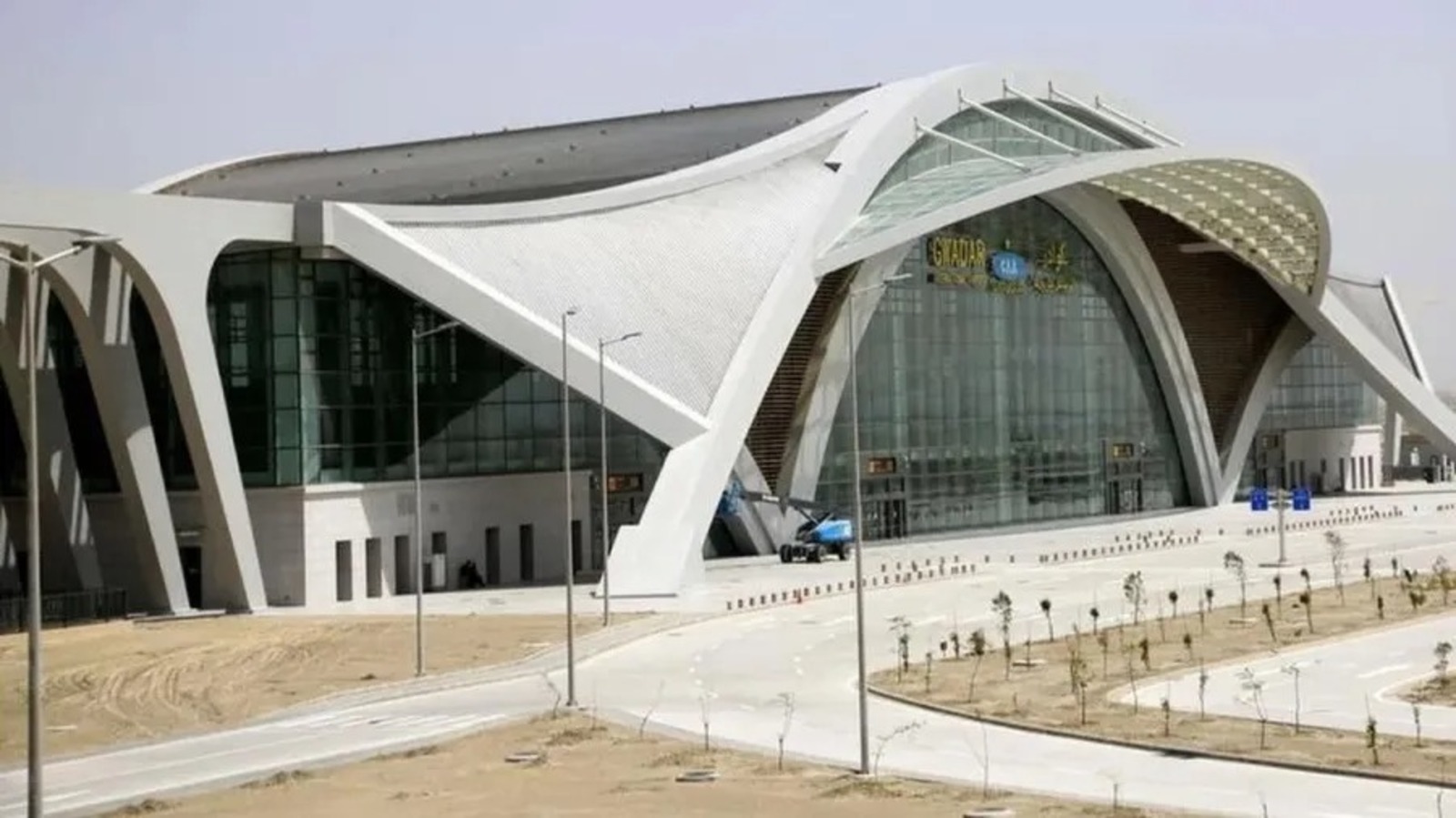
Built at a Cost of US$ 240 Million, the New Gwadar International Airport in Pakistan Has Become a Symbol of Chinese Ambition on the New Silk Road — But Is Almost Empty of Flights and Surrounded by Tensions
The New Gwadar International Airport, built at a cost of US$ 240 million — around R$ 1.3 billion —, has become a symbol of an ambitious infrastructure project that has yet to take off. Located in the Balochistan region of Pakistan, the terminal replaced the old airport of the same name, but operates only one flight per week when there are no cancellations.
Inauguration Without Traffic
Officially inaugurated on January 10, 2025, the airport received its first flight to Muscat, Oman.
However, the first landing only occurred at the end of that month, with an Airbus A319 from Rotana Jet coming from the United Arab Emirates.
-
The largest food company on the planet, JBS, has just opened a 4,000 square meter laboratory in Florianópolis to develop customized proteins that modulate muscle mass gain, immune response, and metabolic performance.

-
After nearly 30 bids and competition among industry giants, a Spanish company purchases one of the largest airports in Brazil for almost R$ 3 billion and takes over the management of Galeão in a concession that will last until 2039.

-
The Federal Revenue Service now automatically cross-references everything you declare with data from banks, credit cards, brokerage firms, and insurance companies, and any discrepancy between your income and your expenses triggers an alert in seconds.

-
Amid global tensions, Brazil blocks the United States’ proposal at the WTO and paves the way for a trade crisis and possible retaliations.


In the following months, the outlook was one of uncertainty. In February, the Associated Press reported that the airport remained without planes or passengers, and that the reasons for its construction continued to be “a mystery,” as the old terminal offered only three flights per week.
With a capacity for 400,000 passengers, the airport serves a city of only 90,000 inhabitants, which still faces basic shortages.
Gwadar is not even connected to the national power grid and relies on supply from Iran or solar panels.
The scarcity of drinking water is also a constant problem, raising questions about the utility of the billion-dollar structure.
Cancelled Flights and Empty Runway
The airport only began appearing in August on the FlightRadar24 platform, but with scarce records. A single weekly flight was supposed to connect Gwadar to the city of Karachi.
However, a recent survey indicated that even that flight was cancelled, and international media report that cancellations are frequent.
On the FlightAware platform, the departure and arrival boards remain completely empty. The air traffic map also shows no movement in the region’s airspace.
The lack of regular operations has turned the modern terminal into a practically idle structure, fueling criticism and speculation about its true intentions.
A Project of the New Silk Road
Much of the investment came from China, as part of the strategy to expand the New Silk Road, a global network of infrastructure aiming to integrate trade and logistics routes between Asia, Africa, and Europe.
“This airport is not for Pakistan or Gwadar. It is for China, so they can have secure access to Balochistan,” stated international relations expert Azeem Khalid to the Associated Press.
In the last decade, the Chinese government has allocated billions of dollars to the Balochistan coast. The region is strategic because it connects Xinjiang, China’s westernmost province, to the Arabian Sea and the Gulf of Oman.
This route is vital for oil transport — about a quarter of the world’s production passes through there — and represents a crucial link in the China-Pakistan Economic Corridor (CPEC).
Gwadar, in this context, was planned as one of the main gateways to the economic corridor, but the region’s political and social instability threatens the project.
Tension and Militarization at the Airport
Chinese investments have provoked local tensions. Separatist groups accuse the Pakistani government and Beijing of exploiting the region’s resources to the detriment of the Baloch population, an ethnic minority claiming discrimination and lack of opportunities.
These groups have already carried out attacks against Pakistani forces and Chinese workers. In response, the government increased military presence, setting up checkpoints, watchtowers, and barriers throughout the city.
Today, Gwadar resembles a militarized zone more than a tourist or economic hub. Intelligence officials monitor journalists and restrict access to public places like the fish market, deemed “too sensitive” for reporting.
According to the government, the CPEC has already created about 2,000 jobs in the area, although it is unclear how many were allocated to local residents.
The increasing military presence and sense of insecurity deter investors and visitors.
Potential Military Use and Climate of Distrust
The tension is not limited to Pakistan’s borders. Researcher Antoine Levesques from the International Institute for Strategic Studies stated to the South China Morning Post that India, Pakistan’s main regional rival, has “deep doubts” about the economic corridor and the new airport.
According to him, there is potential for “layers of militarization” that could result in a hybrid war or even open high-intensity conflict.
Levesques believes that the Gwadar airport could eventually integrate into a future Chinese military base in the Indian Ocean.
The proximity of the mountains also makes the location vulnerable to separatist attacks. The risk is so real that, during the inauguration, the government chose to hold the ceremony virtually, avoiding crowds.
Therefore, despite the grandeur and billion-dollar investment, the future of the New Gwadar International Airport remains uncertain.
Amid political tensions, international distrust, and flight cancellations, the terminal continues waiting to truly take off.
With information from UOL.







-

-

-

-

-

-

77 pessoas reagiram a isso.