





 Portuguese
  English
  Spanish
  4 min of reading
  1 comment


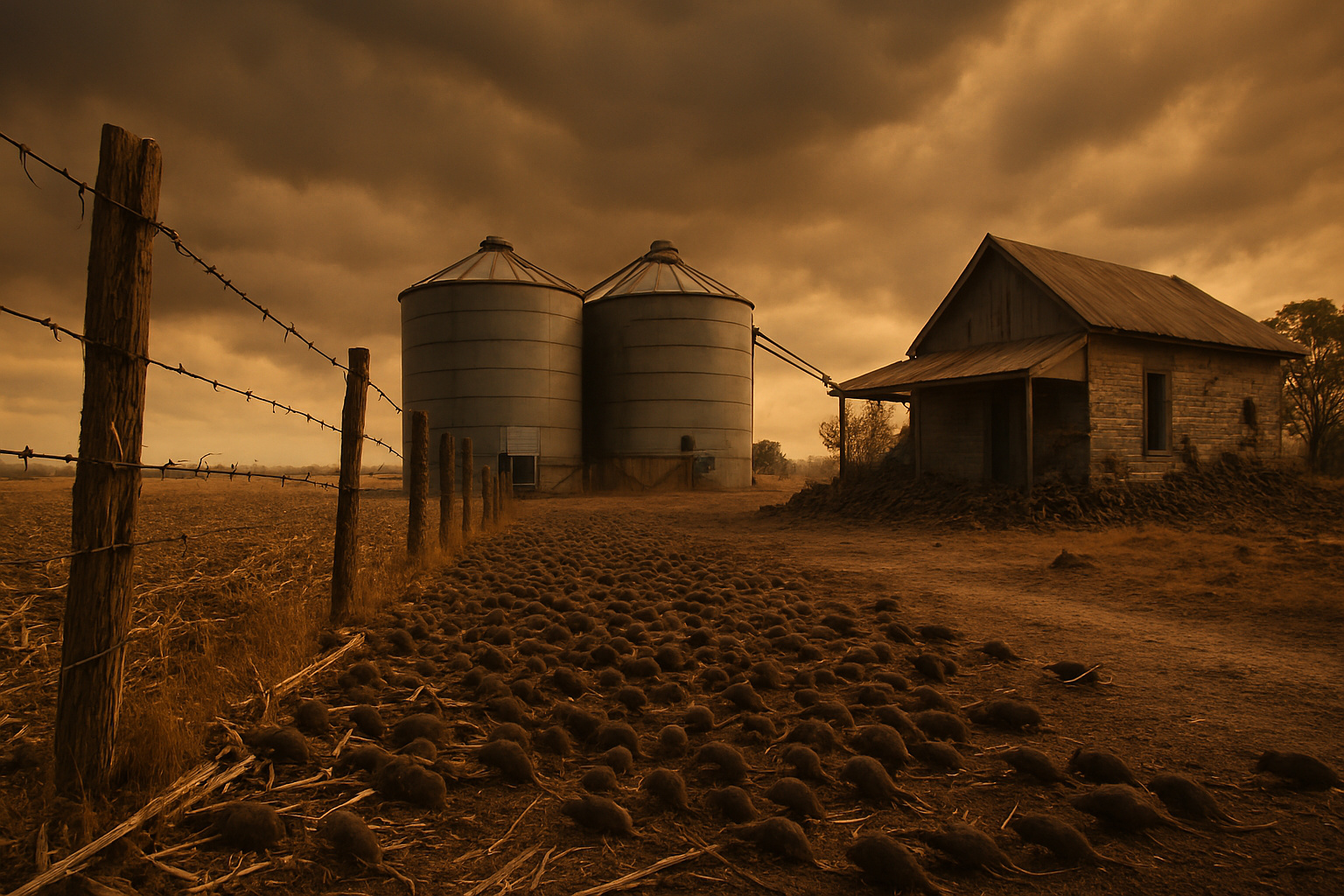


Millions of Rats Invaded Cities and Farms in Australia, Causing Billion Dollar Losses and Leading the Country to Declare Environmental Emergency. Understand What Happened.
Australia has faced historic droughts, devastating wildfires, and large-scale floods, but few recent events have shocked the population as much as the so-called “sea of rats”. In a scenario that seemed straight out of an apocalyptic movie, millions of rodents spread simultaneously across rural areas and cities, invading homes, hospitals, schools, grain silos, and entire crops. The phenomenon reached such a scale that local authorities were forced to declare an environmental emergency in strategic agricultural regions of the country.
The episode, which peaked between 2020 and 2021, revealed deep vulnerabilities in Australia’s ecological balance and left economic, social, and psychological damages that still resonate years later.
What Was the “Sea of Rats” That Took Over Australia
The term “sea of rats” started being used by the Australian press itself to describe the absurd density of mice, mainly of the species Mus musculus, which covered vast areas of the states of New South Wales, Queensland, Victoria, and South Australia. In some localities, the ground literally moved, given the number of rodents running in all directions.
-
The world consumes 50 billion tons of sand per year and no one is monitoring it: the UN warns that the second most used resource on the planet after water is running out and has even created an international mafia.

-
With a length of 211 meters, a double iron hull, and propulsion by sails, paddles, and a screw propeller simultaneously, the Great Eastern was the largest ship on the planet and ultimately laid the first successful transatlantic telegraph cable.

-
A truck driver spent 21 years building a 15-meter replica of New York using balsa wood, cardboard, and regular glue; the work, featuring hundreds of thousands of buildings, has become an attraction in a museum in the city itself.
-
More than 138 stone tools found on the seabed between Turkey and Europe reignite the hypothesis of a lost land bridge from the Ice Age that may have been used by humans to cross continents.



Reports indicate that during the peak of the infestation, it was impossible to walk without stepping on rats, especially at night. They invaded homes in droves, gnawed through walls, electrical wires, furniture, mattresses, and appliances. In agricultural areas, trucks, tractors, and harvesters were rendered useless as the animals destroyed internal cables and hoses.
Why Millions of Rats Multiplied at the Same Time
The population explosion was not a coincidence. Experts point out that the “sea of rats” was the result of a rare combination of climatic, agricultural, and biological factors.
After years of severe drought, Australia recorded above-average rainfall, resulting in exceptionally large agricultural yields, particularly of wheat, barley, and canola. This abundance created a perfect environment for the rodents, who found unlimited food and shelter in silos, fields, and rural facilities.
Rats have an extremely fast reproductive cycle. A female can have up to 10 litters per year, with several offspring in each. Under ideal conditions, a small population can turn into millions in a matter of months. With an excess of food and favorable weather, growth spiraled completely out of control.
Cities and Homes Invaded by Rodents
Although the phenomenon began in the countryside, it quickly reached urban areas. Residents reported finding rats inside beds, wardrobes, sofas, ovens, refrigerators, and even baby cribs. In some cities, hospitals needed to strengthen hygiene protocols to prevent contamination.
There were reports of people sleeping with the lights on, using makeshift plugs in doors and drains, and storing food in airtight containers out of fear of contamination. In certain municipalities, the constant noise of rats at night became part of the routine, causing extreme stress and mental health problems.
Crops Destroyed and Billion Dollar Losses
In the countryside, the impact was even more devastating. The rodents consumed grains directly in the fields, attacked stored stocks, and contaminated tons of food with feces and urine. Estimates point to billion-dollar losses for the agricultural sector.
Whole silos had to be discarded. Farmers reported total crop losses and difficulties in keeping equipment operational. In some cases, farmers temporarily abandoned productive areas due to lack of minimum working conditions.
Environmental Emergency and Extreme Measures
In light of the gravity of the situation, state authorities declared an environmental state of emergency, allowing exceptional population control actions. The government released emergency use of more potent rodenticides, which are usually restricted due to risks to native fauna.
However, combating the rats proved to be extremely complex. The use of poisons raised concerns about the indirect deaths of birds of prey, reptiles, and native mammals that feed on the rodents. Additionally, the scale of the infestation made it impossible to reach all hotspots at the same time.
Why Australia Suffers from Recurrent Rat Plagues
Unlike other countries, Australia has faced cyclical rat plagues for over a century. These events usually occur every 4 to 10 years, especially after periods of drought followed by heavy rains.
The combination of large-scale agriculture, vast open areas, and introduced species creates a scenario conducive to population explosions. As rats are not native, the natural predator balance is not always sufficient to contain their growth during critical moments.
The Current Situation After the “Sea of Rats”
After the peak between 2020 and 2021, the rat population gradually decreased in many regions, primarily due to reduced crop yields and subsequent climate changes. However, regional hotspots continue to arise, and authorities remain on constant alert.
In recent years, residents of some cities have reported an increase in the presence of rodents, reigniting fears of a new ecological collapse similar to the previous one. Experts warn that if climatic conditions repeat, a new “sea of rats” may occur again.
The “Sea of Rats” as a Global Environmental Alert
More than an isolated event, the “sea of rats” exposed how climatic imbalances, intensive agriculture, and invasive species can generate large-scale environmental crises. The episode became the subject of international study and serves as a warning for other countries with extensive agricultural production.
Australia learned, in the hardest way possible, that seemingly simple natural phenomena can turn into national catastrophes when multiple factors align at the same time.








Dia desses li uma reportagem sobre a matança de gatos, agora onda de ratos, tudo isso causado pela interferência do bicho homem, que invadiu a Austrália…..