





 Portuguese
  English
  Spanish
  4 min of reading
  2 comments




Founded in 1350, Naarden Consolidated Itself as a Key Fortress of the Netherlands by Controlling Eastern Routes, Evolving Its Defenses, Shaping Urban Life and Influencing Military Strategies from the Middle Ages to the Twentieth Century
The fortress city of Naarden, founded in 1350, became a strategic fortress of the Netherlands by controlling eastern routes, influencing military, urban, and defensive decisions for decisive centuries in European history.
Foundation and Strategic Position of the City
Naarden was founded by the Count of Holland in 1350, on a strip of land overlooking the only eastern route of the province.
The location allowed control of strategic land access, making the city relevant from its inception for territorial defense and continuous military surveillance.
-
He started running at 66 years old, broke records at 82, and is now a subject of study for having a metabolic age comparable to that of a 20-year-old, in a case that is intriguing scientists and inspiring the world.

-
Oldest tree on the planet reappears after 130 years of searches: Wattieza, 385 million years old, was 10 meters tall and had no leaves or seeds; Gilboa fossils in New York solved the mystery in 2007.

-
A 48-square-meter house assembled in hours with 4,000 bricks made of recycled plastic that does not absorb moisture, has natural thermal insulation, and costs less than 90,000 reais in a complete kit.

-
Luciano Hang revealed that Havan’s air fleet has already accumulated more than 20,000 landings, 10,000 flight hours, and 6 million kilometers traveled, and he says that without the planes, the company would never have grown so quickly.


For this reason, Naarden received formal authorization to construct a complete defensive perimeter around the initial urban core.

Evolution of Defenses Over the Centuries
With the growth of Amsterdam, the strategic value of Naarden progressively increased, requiring constant improvements to the existing defensive structures.
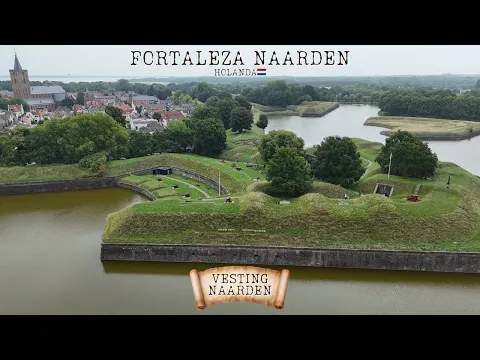
The original medieval walls were destroyed over time, but successive fortifications arose between the seventeenth, nineteenth, and early twentieth centuries.
A large part of these military buildings has been restored, preserving distinct historical layers of European defensive architecture that are still visible today.
This ensemble makes Naarden one of the most complete examples of preserved historical fortress in continental Europe.
The French Invasion of 1672
In 1672, French King Louis XIV invaded the Dutch Republic and quickly conquered Naarden, exploiting momentary weaknesses in the defense.
However, Dutch forces broke nearby dikes, flooding lands west of the city in a decisive maneuver.
The water and mud created an insurmountable barrier, forcing the French to retreat and altering the course of the conflict.
This strategy marked the beginning of the Old Dutch Water Line, in which Naarden played a central role.
The Star-Shaped Fortress
After the siege, Naarden returned to Dutch control and had its fortifications completely redesigned according to new military principles.
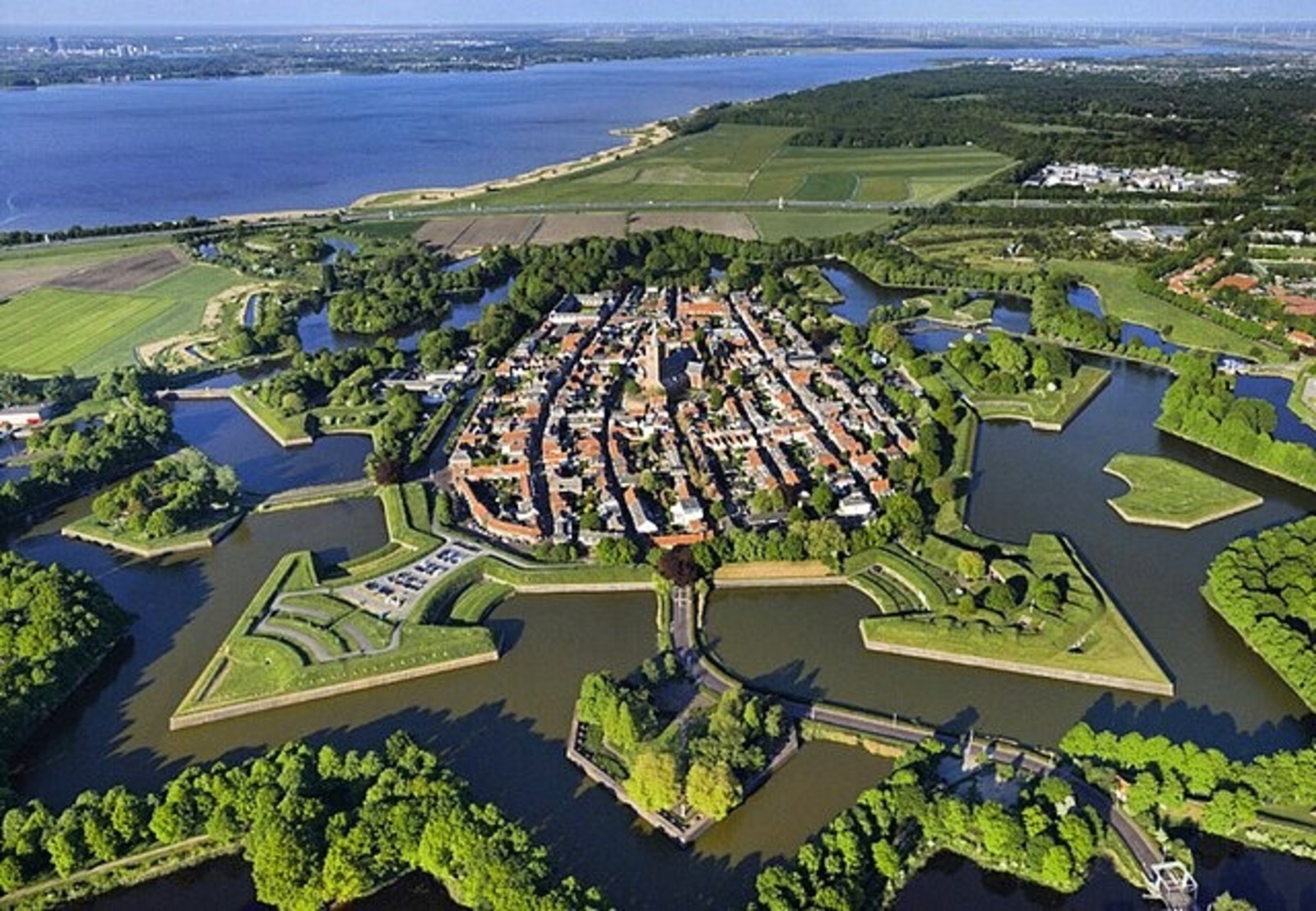
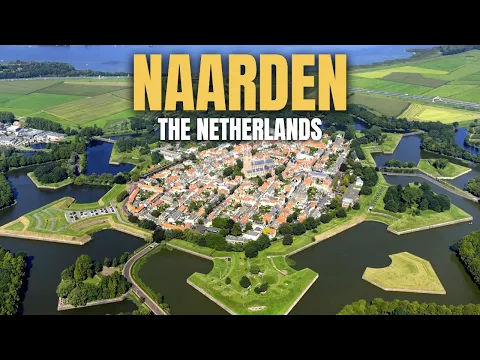
The city then assumed its characteristic star shape, designed to maximize defense and field of fire.
The new fortifications were completed in 1685, establishing the configuration that remains practically intact to this day.
Since then, structural alterations have been minimal, preserving the original defensive logic of the modern period.
The New Dutch Water Line
In the early nineteenth century, under Napoleon’s rule, plans emerged to modernize the Dutch Water Line and expand it to the east.
These plans included the Utrecht region, strengthening the national defensive system against new military threats.
After Napoleon’s final defeat, King William I pushed the projects forward, creating the New Dutch Water Line.
Naarden continued to play a significant role in this system, maintaining fortifications considered sufficient for decades.
Impact of the Franco-Prussian War
This perception changed after the Franco-Prussian War of 1870 when military advancements revealed the limitations of existing defenses.
It became evident that warfare had evolved radically, requiring urgent adaptations to the New Dutch Water Line.
The Fortress of Naarden needed to be modernized to face new forms of artillery and extended range.
Technological Advancements and New Solutions
The nineteenth century brought significant advancements in military technology, deeply impacting the design of European fortifications.
The introduction of rifled guns in 1860 increased range, accuracy, and penetrating power of modern artillery.
Unprotected masonry structures became vulnerable, easily destroyed by concentrated enemy fire.
For protection, walls and buildings began to be covered with thick layers of defensive earth.
After 1873, all new constructions in Naarden were designed to be bomb-proof from the foundation.
Only monumental facades remained visible, always facing away from the direct reach of attackers.
The Fortress City: Urban Life and Military Restrictions
Naarden operated as a garrison city, and the constant presence of the army deeply shaped the local urban daily life.
Military lands were surrounded by barbed wire, and access to the walls was prohibited for common inhabitants.
To ensure unobstructed view and free field of fire, large areas around the city were requisitioned.
These lands, called schootvelden, had strict rules defined by the Requisition Act of 1851, the Kringenwet.
Any construction in these areas could be demolished at the first sign of imminent war.
The End of the Military Function of the Fortress City
World War I marked a definitive break in Naarden’s defensive role as an active fortress.
The heavy artillery of the conflict rendered many traditional defensive structures of the city obsolete.
In 1926, Naarden officially lost its military function, ending centuries of continuous strategic use.
Since then, the fortress remains as a preserved historical testimony of successive military and urban transformations.
With information from Geleloods.








hoje em dia, um míssil manda a cidade pro ar.
Cidade notável