





 Portuguese
  English
  Spanish
  4 min of reading
  0 comments


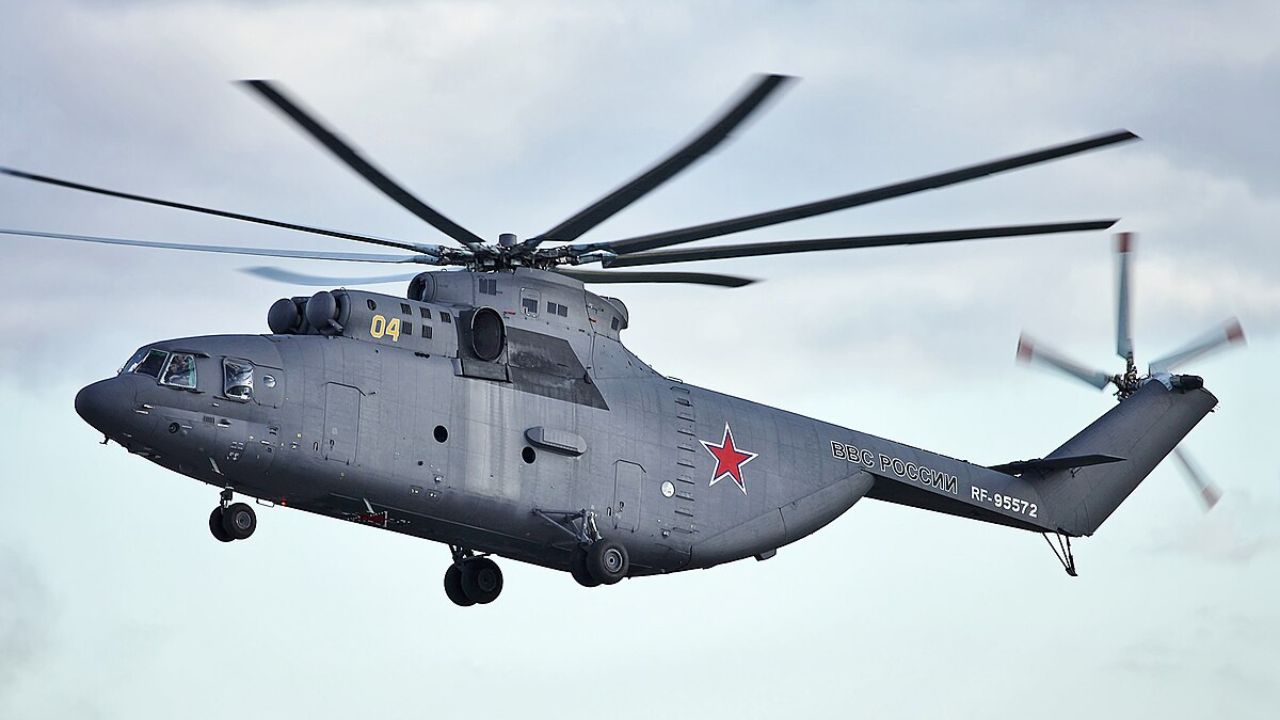
Know The Largest Helicopter In The World, Capable Of Carrying 20 Tons And Reaching Almost 300 Km/h. See How The Mi-26 Remains Essential In Military And Humanitarian Operations.
The largest helicopter in the world, the Mil Mi-26, continues its global operation in 2025, performing military and humanitarian missions in remote regions and conflict zones.
Developed by the Russian Mil Moscow Helicopter Plant in the 1970s, the model was designed to transport extremely heavy loads — up to 20 tons — in environments where trucks, planes, or ships cannot reach.
With a size comparable to a three-story building, the Mi-26 continues to be used because, even after decades, no other helicopter in production achieves the same combination of power, transport volume, and reliability.
-
He started running at 66 years old, broke records at 82, and is now a subject of study for having a metabolic age comparable to that of a 20-year-old, in a case that is intriguing scientists and inspiring the world.

-
Oldest tree on the planet reappears after 130 years of searches: Wattieza, 385 million years old, was 10 meters tall and had no leaves or seeds; Gilboa fossils in New York solved the mystery in 2007.

-
A 48-square-meter house assembled in hours with 4,000 bricks made of recycled plastic that does not absorb moisture, has natural thermal insulation, and costs less than 90,000 reais in a complete kit.

-
Luciano Hang revealed that Havan’s air fleet has already accumulated more than 20,000 landings, 10,000 flight hours, and 6 million kilometers traveled, and he says that without the planes, the company would never have grown so quickly.


The Giant That Dominates The Skies: Why The Mi-26 Holds The Title Of Largest Helicopter In The World?
The Mi-26 impresses with its set of dimensions and capacity.
Its main rotor has about 32 meters in diameter, the fuselage approaches 40 meters, and the entire aircraft reaches approximately 56 meters in length, making it the largest helicopter ever mass-produced.
Its height reaches approximately 8 meters, equivalent to a three-story building, reinforcing the colossal scale of the design.
In addition, the aircraft can carry 20 tons of internal or external cargo, something unattainable for other operational models.
These numbers allow for the transport of items such as armored vehicles, trucks, containers, metal structures, or industrial machinery — tasks impossible for conventional helicopters.
Operational Capacity: From Transporting Armored Vehicles To Complex Medical Missions
Versatility has always been one of the main reasons for the success of the largest helicopter in the world.
The Mi-26 can carry 90 armed soldiers, perform medical evacuations with 60 stretchers and three health professionals, and engage in rescues and logistical operations.
Tanks, cranes, and even disassembled aircraft have already been lifted or transported by it in war and reconstruction missions.
This adaptability makes it employed by both armed forces and emergency and civil defense teams.
Powerful Engines And Extreme Consumption: The Price Of Moving The Impossible
To lift such structure and cargo, the Mi-26 uses two Lotarev D-136 engines with 11,400 hp each.
Together, they produce enough power to spin an eight-blade rotor and perform flights with weights that no other helicopter can handle.
When fully loaded, fuel consumption reaches 9 liters per second, which means approximately 5,400 liters per hour.
Although high, this expenditure is necessary for an aircraft that can achieve around 295 km/h and reach approximately 800 km of range even with heavy loads.
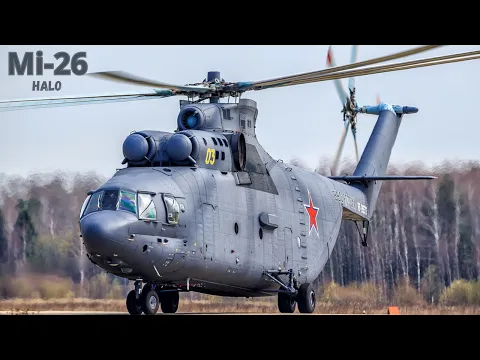

Origin And Evolution: From 1977 To Strategic Role In 2025
The largest helicopter in the world had its first flight in 1977 and officially entered service in the early 1980s.
Even after more than four decades, the Mi-26 continues operating thanks to successive upgrades, especially in avionics and navigation systems.
The persistence of the model is explained by a simple factor: to this day, no helicopter has replaced its place in heavy airlift.
In various situations — especially during wars and in isolated areas — the Mi-26 is the only means capable of quickly moving crucial equipment.
Global Presence: From War Zones To Rescue Operations
In 2025, the Mi-26 continues to be used for troop movement, armored vehicle transport, and logistical support in conflicts.
Outside of the military environment, the giant is also called upon for humanitarian operations, disaster relief, and large rescues.
Its ability to land in impossible terrains, transport immense volumes, and operate in adverse conditions makes it an indispensable resource in natural disasters, wildfires, and reconstruction of devastated areas.
Comparison With Other Models: Why It Still Reigns Supreme
Even contemporary helicopters, such as the CH-53K King Stallion, do not reach the payload capacity of the Mi-26.
While competitors approach in technology, none achieve the same physical scale and transportable cargo volume. Therefore, the title of largest helicopter in the world remains unquestionable.
The Mil Mi-26 is more than an impressive aircraft — it is a landmark of aerospace engineering. Its power, capacity, and history of operations in extreme conditions explain why the largest helicopter in the world remains indispensable in 2025.
While no other rotary-wing aircraft matches its size and efficiency in large-scale missions, the Mi-26 will remain the uncontested giant of the skies.









-

-

-

-

-

-

123 pessoas reagiram a isso.