





 Portuguese
  English
  Spanish
  4 min of reading
  0 comments



With 85.4 m and 18 Floors, the Tallest Wooden Building in the World Uses Fire-Resistant CLT and Redefines Sustainable Engineering in Civil Construction.
In the interior of Norway, on the shores of Lake Mjøsa, one of the most impressive projects of contemporary engineering has been erected: Mjøstårnet, officially recognized as the tallest wooden building in the world. With 85.4 meters, distributed over 18 floors and built almost entirely of CLT (Cross-Laminated Timber), the skyscraper redefines everything understood about structural safety and fire resistance in large wooden buildings.
Inaugurated in March 2019, in the municipality of Brumunddal, the building has become a global landmark of sustainability, industrial precision, and innovation, proving that wood can not only match but exceed performance standards of steel and concrete in various technical aspects.
The Wood That Does Not Burn Like Common Wood: The Secret of CLT
The idea of building a wooden skyscraper may seem risky, especially for those who imagine that wood is inherently flammable. But Mjøstårnet uses CLT, an industrialized material in which layers of wood are glued in cross directions, forming solid panels with:
-
Neither the Pyramids nor the Great Wall of China, this gigantic construction in Spain is the human mark on planet Earth that intrigues the most when seen in images from space.

-
Surrounded by cliffs, mist, and chilling stories, the ancient Hotel del Salto has been reborn as a museum while still unable to shake off its reputation as a haunted place.

-
This star-shaped fortified construction, hidden near the border of Spain, may be the largest fortress on the planet.

-
Congonhas receives the monorail promised for the 2014 World Cup after more than a decade of delays and becomes the first airport in Brazil with integrated subway.


- high mechanical strength,
- stiffness comparable to concrete,
- controlled deformation capacity,
- predictable behavior in fires.


The CLT carbonizes externally when exposed to fire, creating a protective layer that prevents the internal core from being reached. This allows the panels to remain stable for extended periods.
European safety tests show that CLT panels can withstand fire for more than 120 minutes, a time far exceeding various international standards for high structures.
It is exactly this behavior that allowed Mjøstårnet to be approved by the stringent Scandinavian standards.
A Millimeter-Precision Engineering
The building was designed by the office Voll Arkitekter and constructed by the company Hent. The entire structural system uses wood:
- glulam columns,
- structurally calculated beams for long spans,
- CLT panels as load-bearing walls,
- rigid cores also in engineered wood.

The assembly occurred like a “gigantic structural Lego”: the pieces arrived ready and numbered directly from the factory, allowing rapid assembly and minimal waste generation.
The building also utilizes strategically positioned metal connectors, ensuring extra rigidity against lateral loads such as strong winds at height.
Sustainability at the Highest Level
Beyond its visual and technical impact, Mjøstårnet has attracted global attention for its sustainability:
- The wood used came from certified Norwegian forests.
- The building sequesters CO₂ throughout its useful life.
- There is a significant reduction in environmental impact compared to concrete.
- The construction emits fewer greenhouse gases.

According to estimates from the engineered wood sector, replacing concrete with CLT in buildings over 8 stories can reduce emissions by up to 75%.
This places the Norwegian skyscraper among the most environmentally efficient buildings ever constructed.
A Functional Building: Hotel, Offices, Apartments, and Pool
Mjøstårnet is not just an architectural experiment; it is a multifunctional building. Inside, there are:
- residential apartments,
- a full hotel,
- restaurants,
- offices,
- commercial spaces,
- a theater,
- and even a heated public swimming pool connected to the structure.
Each environment has been designed to take advantage of the natural aesthetics of wood, creating warm interiors, controlled acoustics, and a sense of thermal comfort superior to that of traditional buildings.
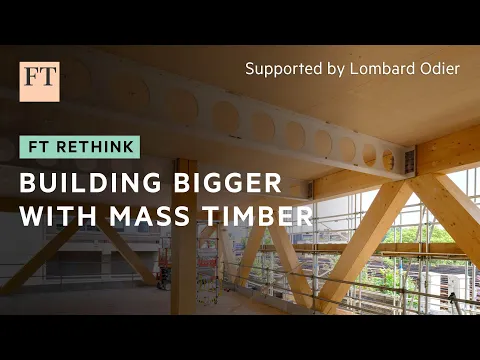
How It Performs Against Wind, Fire, and Load
Scandinavian engineers claim that the building has been exhaustively tested in digital simulations:
Fire Resistance
The thickness of the panels was sized to allow carbonization without loss of structural stability.
Wind Resistance
The height of 85.4 meters requires advanced lateral rigidity. This was achieved with CLT cores reinforced by glulam beams.
Vertical Load Resistance
The laminated columns have performance similar to steel in compression.
Durability
Engineered wood does not rot when properly protected from moisture, and the Norwegian climate facilitates this control.
A Project That Paved the Way for New Wooden Skyscrapers
After Mjøstårnet, the global construction sector began to seriously discuss:
- hybrid buildings (wood + concrete),
- skyscrapers up to 150 meters mainly made of CLT,
- faster and cleaner constructions in urban areas,
- reduction of emissions from the concrete industry.
Cities like Vienna, Toronto, and Tokyo are already studying even taller structures, inspired by the Norwegian success.
The Skyscraper That Redefined the Future of Construction
Mjøstårnet proved that wood is not synonymous with fragility. On the contrary: in the form of CLT and glulam, it becomes one of the most efficient materials for tall buildings, uniting aesthetics, safety, and sustainability in a single work.
With 85.4 meters, 18 floors, and proven technical resistance, the tallest wooden building in the world not only challenged concrete but opened the way for a new era in civil construction, where technology, nature, and engineering walk together.









-

Uma pessoa reagiu a isso.