





 Portuguese
  English
  Spanish
  5 min of reading
  11 comments


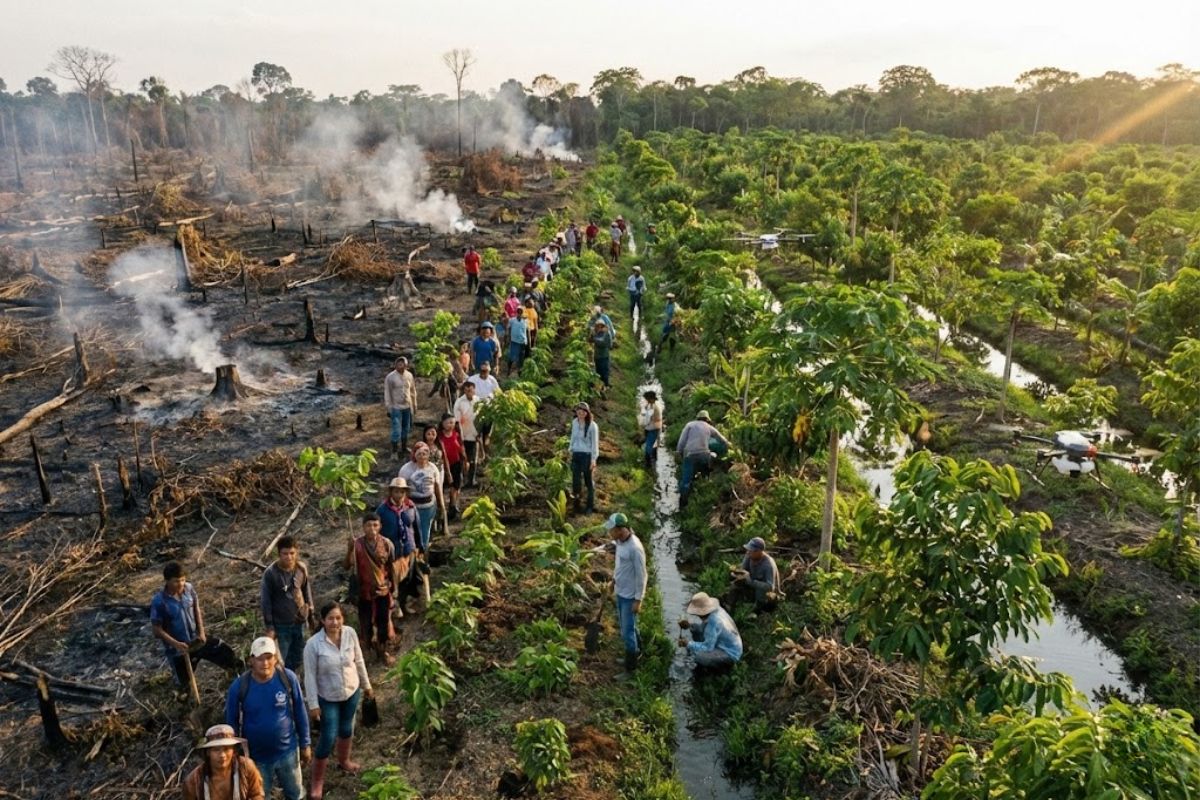


In The Amazon, The Tatuyo Indigenous Community, In The Rural Area Of Manaus, On The Banks Of The Rio Negro, Cultivates Seedlings Of Andiroba And Chestnut And Receives Technical Support From Reflora. In 2025, Seven Thousand Seedlings Were Delivered To The Reserve, With A Goal Of Restoring 200 Hectares And Serving 18 Communities With Local Direct Income.
In The Amazon, communities that saw the forest disappear have started to rebuild what was degraded through continuous work, seed collection, and planned planting.
In Manaus, in the rural area on the banks of the Rio Negro, the Tatuyo indigenous community is transforming degraded areas into productive agroforests.
The restoration takes place in the state of Amazonas, with technical support from the Reflora project.
-
How an innovative city combines high technology, well-being, and sustainability to become the largest reference in clean energy on the planet.
-
Couple buys 1846 church in ruins for R$ 660,000, invests R$ 3.2 million in renovations, transforms it into a millionaire mansion, and even preserved a historic cemetery with over 300 graves.
-
He started running at 66 years old, broke records at 82, and is now a subject of study for having a metabolic age comparable to that of a 20-year-old, in a case that is intriguing scientists and inspiring the world.

-
Oldest tree on the planet reappears after 130 years of searches: Wattieza, 385 million years old, was 10 meters tall and had no leaves or seeds; Gilboa fossils in New York solved the mystery in 2007.


The initiative strengthens local communities and organizes a restoration chain that combines traditional knowledge with agroforestry system techniques.
The goal is to recover the Amazon without destroying the environment while simultaneously creating income for families.
Where It All Happens In The Amazon And Why The Location Matters

The initiative takes place in the Amazon, in the municipality of Manaus, in a rural area on the banks of the Rio Negro.
It is in this territory that the Tatuyo indigenous community is located.
The location defines the project’s pace, as the river’s dynamics, distances, and logistics influence each stage, from seedling production to final planting.
The work is also connected to the Puranga Conquista Sustainable Development Reserve in Manaus.
It is in this Amazonian territory that residents try to reverse degradation with planning and community participation, focusing on recovering the environment and strengthening local life.
The Reflora Project And The Turning Point In Amazon Restoration

The reforestation project called Reflora is changing the reality of communities in Manaus by transforming degraded areas into sustainable agroforests.
The process was built from a demand from the residents themselves, with technical support to organize restoration and make it productive.
The goal of restoring 200 hectares and strengthening the economy of 18 communities guides the scale of work in 2025.
When the initiative originates from the community itself, adherence is greater and the commitment becomes generational, as the result is seen as something belonging to the territory, not as something imposed from outside.
The Tatuyo Community As A Symbol Of Reconstruction In The Amazon
In the Tatuyo community, reforestation is regarded as an old dream, now possible with access to knowledge and technical support.
The recovery of the Amazon is seen as something that goes beyond the community itself, as the effort has an impact for society as a whole.
Seed collection and local seedling production create a multiplier effect.
The more people learn to collect seeds and produce seedlings, the greater the local capacity to expand planting and sustain reforestation with autonomy.
Native Trees Of The Amazon That Start To Change The Landscape
The planting prioritizes seedlings of native trees from the Amazon, particularly andiroba and chestnut.
The choice of native species strengthens environmental recovery because it maintains ecological coherence with the territory and creates a basis for regeneration that respects the natural functioning of the forest.
At the same time, seedling cultivation requires care, time, and community organization.
Producing seedlings is not just planting; it is ensuring that each step is done correctly so that reforestation has survival and continuity, especially in already degraded areas.
The Role Of Family And The New Generation In The Amazon
The project is marked by family participation.
Reforestation appears as a path to ensure the future, with continuity between children and grandchildren and a long-term vision within the territory.
The new generation is also committed to this horizon.
The future forest is envisioned with tall trees, shade, seeds, and fruits, starting now with small seedlings that need to grow for the children to harvest and plant again.
This vision transforms reforestation into a life plan, not a one-off action.
Agroforestry System: How The Amazon Becomes Production Without Felling Forest
The adopted technique is the agroforestry system, described as productive restoration that delivers both economic and environmental returns.
In the short term, agricultural species are introduced.
In the medium term, fruit species are introduced.
In the long term, forest species, including timber species, are introduced according to local planning.
This composition creates a calendar of results.
While larger trees take time to grow, short-cycle crops can generate returns and sustain the community in the present.
The agroforestry system allows for the recovery of the Amazon while simultaneously enabling the community to produce and live off their own territory.
Logistics In The Amazon: The Challenge Of Getting Seedlings To The Reserve
One of the biggest reported obstacles is logistics.
To transport seedlings to the Puranga Conquista Sustainable Development Reserve in Manaus, travel can take many hours by boat on the Rio Negro.
The distance and travel time increase operational costs and require rigorous planning.
Therefore, the future plan is to increase the capacity to collect seeds and produce seedlings locally.
The goal is to reduce costs and strengthen species better adapted to the Amazon environment.
Numbers For 2025 In The Amazon: Seven Thousand Seedlings And A Goal Of 200 Hectares
In 2025, seven thousand seedlings of native trees arrived at the reserve.
The announced goal is to restore 200 hectares of degraded areas.
The initiative also works on income generation for 18 communities, connecting reforestation, productive chains, and local strengthening.
When the project restores hectares while simultaneously supporting communities, it reduces the economic incentive for new cycles of degradation.
Income In The Amazon: Seeds, Seedlings, And Sustainable Economic Uses
In addition to environmental recovery, the proposal encourages income generation through seed collection and seedling production.
These activities supply local nurseries and reinforce community autonomy in the restoration process.
The seeds can also be applied in higher value chains, expanding economic possibilities without felling forest.
The standing forest needs to be economically viable for families, and the project seeks this balance between restoration and local economy.
What The Amazon Gains When Restoration Becomes Routine
When a community transforms reforestation into a routine, the gains become cumulative.
With each cycle of seed collection, seedling production, and planting, the capacity for restoration increases and dependence on external structures decreases.
The process also strengthens the sense of belonging to the territory.
Instead of viewing degraded areas as a definitive loss, residents begin to treat these spaces as areas for reconstruction and productive future.
The Amazon ceases to be merely a threatened backdrop and becomes an ongoing project, made by those who live in it.
In your opinion, should the experience of the Amazon in Manaus be expanded to other degraded areas of Amazonas with similar goals for hectares restored and income for communities?





Sim. É uma forma inteligente de combater a destruição criminosa e gananciosa desse patrimônio primordial para todo o Brasil. Muito obrigada.
Interessante é notar, recorrentemente, que raros são os projetos que se propõem incentivar a agrossilvicultura na Amazônia manejando primeiro O SISTEMA SOLO.
Interessante também é notar, que as espécies florestais ofertadas aos silvicultores, são sempre as mesmas:
As mais fáceis de obter sementes…
Outra informação interessante, é O FATO de que pouco se sabe sobre a resiliência de cada espécie ao aumento da temperatura e à falta d’água… (O famoso Estresse Hídrico; E SE as espécies que estão escolhendo plantar forem as mais vulneráveis às Mudanças Climáticas, como é que fica🤷🏽???…)
Sim. Também vim para o cerrado e caatinga